

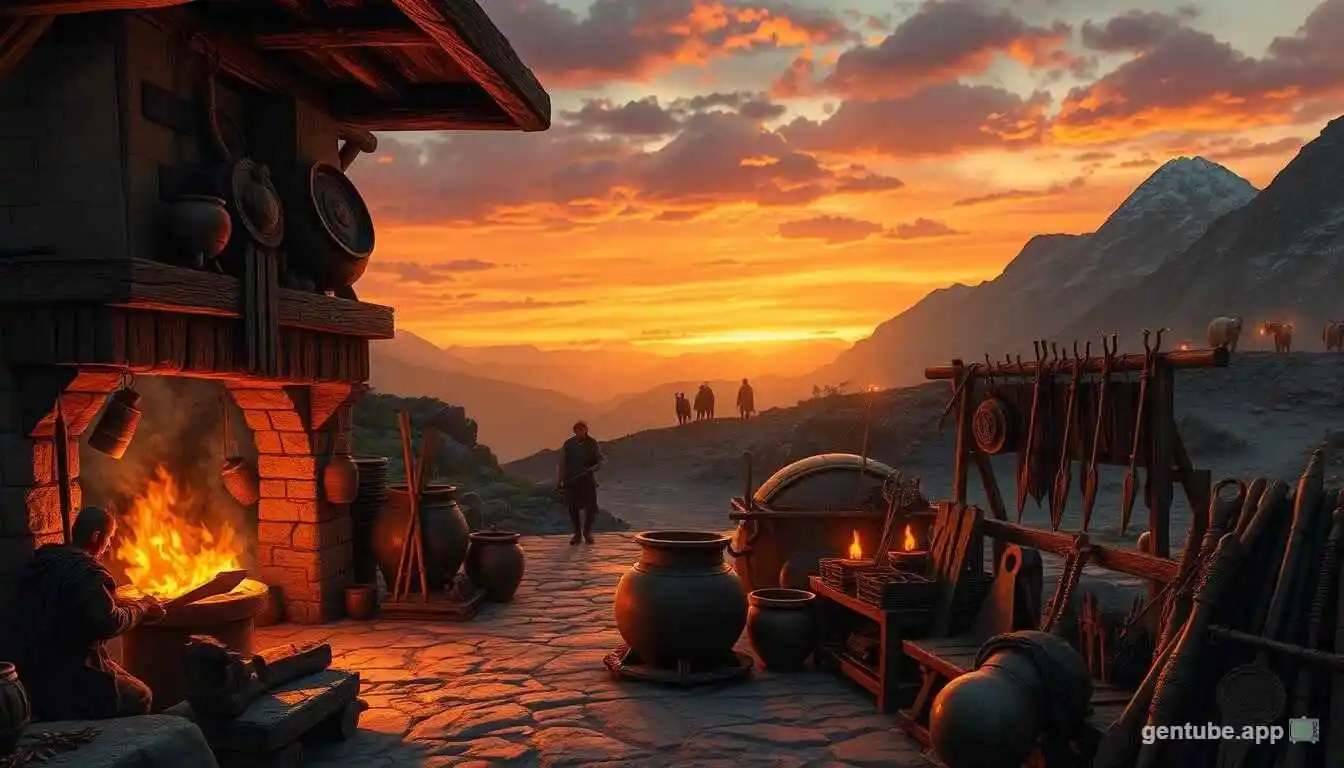
The Fire That Built Civilization: Inside the Metal Age That Changed Everything
Introduction: The Invention Nobody Saw Coming
Somewhere between 5,000 and 6,000 years ago, a nameless craftsperson threw a strange blue-green stone into a fire pit that was already blazing hot for pottery. Instead of cracking or crumbling like ordinary rock, the stone melted, pooled, and hardened into a shape unlike anything nature had ever produced on its own. That accidental — or perhaps deliberately curious — moment set off a chain reaction that would reshape human civilization more dramatically than almost any invention before or since.
We call this era the Metal Age, and it’s easy to underestimate just how radical it was. Before this period, humans had spent hundreds of thousands of years working with what nature directly provided: stone, wood, bone, and antler. Suddenly, humans discovered they could take raw material from the earth and, through fire and skill, transform it into something entirely new — something stronger, sharper, and more useful than anything found in the wild.
This article takes a fresh look at the Metal Age: not just as a timeline of copper, bronze, and iron, but as a turning point that redefined power, trade, warfare, art, and the very structure of human society. Let’s step into the forge.
Chapter 1: Naming an Era — What the “Metal Age” Really Means
Archaeologists don’t use the term “Metal Age” as a single, precisely dated period. Instead, it’s a broad umbrella covering several overlapping phases:
- The Chalcolithic (Copper) Age — the transitional era when copper first entered human toolkits alongside existing stone tools
- The Bronze Age — when copper was alloyed with tin (or sometimes arsenic) to create a harder, more versatile metal
- The Iron Age — when iron, and eventually steel, became the dominant material for tools and weapons
This framework, known as the Three-Age System, was proposed in the 1830s by Danish scholar Christian Jürgensen Thomsen as a way of organizing museum artifacts by material and presumed chronological order. It proved so useful that it remains the backbone of archaeological classification today, even though modern scholars recognize its limitations — namely, that different regions of the world moved through (or skipped) these phases at wildly different times.
Some cultures, such as those in parts of Sub-Saharan Africa, appear to have moved directly from stone tools to iron-working, bypassing a distinct bronze phase altogether. Others, like many Indigenous societies in the Americas and Australia, developed sophisticated civilizations without ever entering a “Bronze Age” in the traditional sense, relying instead on other materials and technologies suited to their environments and resources.
Chapter 2: Before Bronze — The Copper Age Experiment
Long before bronze became history’s most celebrated alloy, ancient people were already experimenting with copper on its own, during what’s known as the Chalcolithic period, roughly 4500–3300 BCE.
A Metal Anyone Could Find
Unlike most metals, copper occasionally occurs in nature in a relatively pure, workable form called native copper. This meant early humans didn’t necessarily need advanced smelting knowledge to begin experimenting with it — they could hammer naturally occurring copper nuggets into basic shapes using techniques similar to stone-working.
Eventually, though, true metallurgical knowledge emerged: heating copper ore to extract the metal chemically, a process requiring temperatures around 1,085°C (1,984°F) — remarkably high for the technology of the time, achieved through specially designed kilns and furnaces with controlled airflow.
Ötzi’s Axe: A Frozen Snapshot of the Copper Age
One of the most extraordinary archaeological finds bridging the Stone and Metal Ages is Ötzi the Iceman, a naturally mummified body discovered in the Alps in 1991, dated to approximately 3300 BCE. Among his possessions was a copper axe with a yew handle — a stunning, tangible piece of evidence showing that copper tools had already become valuable, practical possessions, even while stone tools remained in everyday use alongside them.
The Problem With Pure Copper
For all its promise, copper alone had a critical flaw: it was too soft. Axes and blades would bend or dull with regular use, and edges needed frequent re-sharpening or reshaping. This limitation is precisely what pushed ancient metalworkers toward one of history’s most important breakthroughs — combining copper with another metal to create something fundamentally stronger.
Chapter 3: The Bronze Revolution
Around 3300 BCE, the recipe changed forever. Metalworkers discovered that mixing molten copper with a small amount of tin — typically around 10–12% — produced an alloy with dramatically improved properties. This new material, bronze, was harder, more durable, easier to cast into complex shapes, and far more resistant to corrosion than pure copper.
The Tin Problem — And the Trade Solution
Here’s the twist: tin deposits are rare, and they’re almost never found near copper deposits. This mismatch created one of history’s first truly global economic challenges — and one of its first truly global economic solutions.
Civilizations desperate for tin built extensive trade networks stretching across enormous distances. Tin mined in places like Cornwall in Britain, Central Asia, and Iberia made its way — through multiple intermediaries, sea routes, and overland caravans — to bronze workshops in the Eastern Mediterranean and Near East. Some historians argue this tin-driven trade was one of the earliest examples of a truly interconnected, long-distance economic system, foreshadowing globalization thousands of years before the term existed.
Bronze Age Superpowers
The Bronze Age (roughly 3300–1200 BCE, though dates vary by region) saw the emergence of history’s first great civilizations:
Sumer and Mesopotamia pioneered writing (cuneiform), codified law, and complex urban administration, using bronze extensively in tools, weapons, and religious artifacts.
Ancient Egypt built pyramids and temples while developing distinctive bronze-working traditions for both practical tools and ornate ceremonial objects.
The Indus Valley Civilization created remarkably advanced urban centers with standardized measurements and drainage systems, alongside skilled bronze craftsmanship.
Shang Dynasty China produced some of the most artistically sophisticated bronze ritual vessels in human history, often intricately decorated and used in ancestor-worship ceremonies.
Mycenaean Greece built fortified palace complexes and engaged in extensive Mediterranean trade, later immortalized in Homeric legend.
The Hittite Empire in Anatolia became a major military and diplomatic power, and — intriguingly — some of the earliest experiments with iron-working have been traced to Hittite territory, long before iron became widespread elsewhere.
War Machines of Bronze
The Bronze Age also transformed warfare. Bronze swords, spearheads, and armor gave warriors a decisive edge over opponents still relying on stone or wood. Perhaps most significantly, the combination of bronze weaponry, wheeled vehicles, and domesticated horses gave rise to the war chariot — a battlefield innovation that dominated warfare across Egypt, the Near East, and beyond for centuries.
Chapter 4: Collapse — When the Bronze Age World Fell Apart
Around 1200 BCE, in a span of roughly 50 years, many of the era’s greatest powers — the Hittite Empire, Mycenaean Greece, and various city-states across the Levant — collapsed, weakened, or disappeared almost entirely. Historians call this the Late Bronze Age Collapse, and it remains one of history’s most debated archaeological mysteries.
Proposed explanations include:
- Extended drought and climate disruption, undermining agricultural stability
- Invasions by the “Sea Peoples,” a mysterious confederation of raiders recorded in Egyptian inscriptions
- The fragility of interconnected trade networks, particularly the long tin-supply chains essential to bronze production
- Internal political upheaval and rebellion
- A cascading combination of the above, where the failure of one system (agriculture, trade, or governance) triggered failures throughout the entire interconnected network
Whatever the precise cause, the collapse led to widespread depopulation, abandoned cities, and — in some regions — a temporary loss of literacy. Yet from this disruption, a new technological era would soon rise, born partly out of necessity.
Chapter 5: Iron — Born From Scarcity, Built for Everyone
As the elite bronze-trade networks crumbled, communities increasingly turned toward a metal previously considered a poor substitute: iron. This shift marked the beginning of the Iron Age, generally dated from around 1200 BCE onward, though again, timing varied significantly by region.
Abundance Changes Everything
Unlike copper and tin, iron ore is remarkably abundant and widely distributed across nearly every inhabited continent. This meant societies no longer needed to depend on fragile long-distance trade relationships just to produce functional tools and weapons.
However, iron came with its own significant technical hurdles:
- It requires much higher smelting temperatures — around 1,538°C (2,800°F) — compared to bronze
- Early, unrefined “wrought iron” was actually softer than bronze
- Producing genuinely useful iron required carburization, a process of repeatedly heating and hammering iron to introduce carbon into its structure, gradually increasing hardness
A More Democratic Metal
Because iron ore was so widely available, iron tools and weapons eventually became accessible to far more people than bronze ever had been. This had profound social consequences: farmers could now afford iron plowshares, common soldiers could be equipped with iron weapons, and blacksmithing became an essential trade in towns and villages across entire regions, not just among wealthy elites.
Empires Forged in Iron
The Assyrian Empire built one of history’s most feared military machines, combining iron weaponry with brutal, effective siege warfare tactics.
Classical Greece saw iron tools support the rise of city-states, hoplite armies, and eventually the flourishing of Greek philosophy, theater, and early democracy.
Rome, both as a Republic and later an Empire, built its dominance on a foundation of iron tools, weapons, engineering, and eventually early steel-making techniques.
Iron Age Celtic Europe — represented by the Hallstatt and La Tène archaeological cultures — produced intricately designed weapons, jewelry, and artwork across much of the continent.
Sub-Saharan Africa developed independent iron-smelting traditions, supporting complex trade networks and the rise of early states, in some cases running parallel to or even predating comparable Eurasian developments.
Ancient India achieved remarkable metallurgical sophistication, exemplified by artifacts like the Iron Pillar of Delhi, celebrated for its extraordinary resistance to rust even after more than 1,600 years.
Chapter 6: The Craft Behind the Revolution
None of this would have been possible without an extraordinary, largely undocumented tradition of ancient scientific experimentation — trial, error, and accumulated craft knowledge passed down across generations.
Smelting
Smelting involves heating metal ore, often alongside charcoal as a reducing agent, to chemically separate metal from surrounding rock. Early smelting relied on simple pit or bowl furnaces, later evolving into more advanced bloomery furnaces equipped with bellows to increase airflow and achieve higher, more consistent temperatures.
Casting
Once molten, metal could be poured into molds to create standardized tools and weapons. The lost-wax casting technique — where a wax model is encased in clay, then melted out and replaced with molten metal — allowed for extraordinarily intricate designs, particularly in decorative bronze work.
Alloying
Combining metals to create new materials with improved properties was one of humanity’s earliest forms of applied materials science, discovered entirely through empirical experimentation, long before any formal understanding of chemistry existed.
Forging
Especially critical for iron, forging involved repeated cycles of heating and hammering, gradually working carbon into the metal’s structure and improving its hardness — an early precursor to modern heat-treatment metallurgy.
Chapter 7: How Metal Reshaped Human Society
The story of the Metal Age isn’t just about tools — it’s about how those tools reshaped the structure of human civilization itself.
Social hierarchy deepened, as metallurgy required specialized skills and access to raw materials not equally available to everyone, often reinforcing the power of ruling elites who controlled production and trade.
Specialized labor emerged as a defining feature of complex societies, with dedicated smiths, casters, and traders forming increasingly important professional classes.
Warfare and empire-building accelerated, as superior weaponry enabled the rise of larger, more centralized states capable of conquering and administering vast territories.
Trade and cultural exchange flourished, as the search for raw materials connected distant civilizations, facilitating the exchange of not just goods, but ideas, art, religious beliefs, and technical knowledge.
Agricultural productivity improved dramatically, as metal plows, sickles, and hoes allowed for more efficient farming, supporting larger populations and the growth of cities.
Chapter 8: Why the Metal Age Still Matters Today
https://youtu.be/N3lC1SfuMBA
https://youtu.be/N3lC1SfuMBA
Though modern civilization has moved through the Industrial Age and into the Information Age, the metallurgical foundations laid during the ancient Metal Age remain deeply embedded in contemporary life. Steel — a direct descendant of Iron Age carburization techniques — remains one of the most widely used materials on the planet, forming the structural backbone of buildings, bridges, vehicles, and machinery.
The core concept of alloying, first discovered through ancient bronze experimentation, continues to underlie modern materials science, from aerospace-grade alloys to medical implants. Even patterns of resource-driven trade, specialized labor, and geopolitical competition over raw materials trace conceptual roots back to Bronze Age tin routes and Iron Age resource networks.
The Metal Age never truly ended — it simply evolved, continuing to shape the modern world in ways most people never stop to consider.
Conclusion: What a Glowing Piece of Rock Taught Humanity
The story of the Metal Age is, at its heart, a story about human curiosity and persistence. Long before science had names for elements, chemical reactions, or thermodynamics, our ancestors observed, experimented, failed, adjusted, and eventually mastered one of nature’s most transformative processes: turning raw rock into powerful, reshaped tools through fire and skill.
From a single glowing lump of copper in an ancient fire to the steel skyscrapers of today’s skylines, the legacy of the Metal Age surrounds us constantly — quiet, foundational, and almost entirely taken for granted.
FAQS
1.What defines the Metal Age?
The Metal Age refers to the broad historical period when human societies transitioned from stone-based tools to tools and weapons crafted from metals such as copper, bronze, and iron.
2.What are the three key phases within the Metal Age?
The three key phases are the Chalcolithic (Copper) Age, the Bronze Age, and the Iron Age.
3.Who created the Three-Age System?
Danish archaeologist Christian Jürgensen Thomsen proposed the Three-Age System in the 1830s as a way to classify prehistoric artifacts by material.
4.Did every civilization experience the same Metal Age timeline?
No, different regions developed metallurgy at different times, and some cultures skipped certain phases, like the Bronze Age, entirely.
5.Why was copper the first metal widely used by humans?
Copper occasionally occurs naturally in a relatively pure form and has a comparatively low melting point, making it accessible to early metalworkers.
6.What is native copper?
Native copper refers to copper found in nature in a relatively pure metallic form, which could be shaped through hammering without needing to be melted first.
7.What was the main weakness of pure copper tools?
Pure copper is relatively soft, meaning tools and blades made from it would bend, dull, or deform relatively quickly under regular use.
8.What is bronze made from?
Bronze is an alloy typically composed of roughly 88% copper and 12% tin, although arsenic was sometimes used as a substitute in certain regions.
9..Why was tin so difficult to obtain during the Bronze Age?
Tin deposits are relatively rare and are rarely found near copper deposits, requiring extensive long-distance trade networks to acquire.
10.Which ancient civilizations flourished during the Bronze Age?
Major Bronze Age civilizations include Mesopotamia, Ancient Egypt, the Indus Valley Civilization, Shang Dynasty China, Mycenaean Greece, and the Hittite Empire.
11.What was the Bronze Age Collapse?
The Bronze Age Collapse refers to the widespread breakdown of major civilizations around 1200 BCE, likely caused by a combination of drought, invasion, trade disruption, and political instability.
12.Who were the “Sea Peoples”?
The Sea Peoples were a mysterious confederation of seafaring raiders referenced in ancient Egyptian records, often associated with the instability of the Late Bronze Age Collapse.
13.When did the Iron Age begin?
The Iron Age generally began around 1200 BCE in the Near East and Mediterranean region, though its start varied considerably across different parts of the world.
14.Why did iron eventually replace bronze as the dominant metal?
Iron ore is far more abundant and widely distributed than copper and tin, making it more accessible and less dependent on fragile long-distance trade networks.
15.Was early iron actually stronger than bronze?
Not initially — early, unrefined iron was often softer than bronze until techniques like carburization were developed to increase its hardness.
16.What is carburization?
Carburization is the process of introducing carbon into iron through repeated heating and hammering, which gradually increases the metal’s hardness and durability.
17.What is smelting, in simple terms?
Smelting is the process of heating metal ore, often with charcoal, to chemically separate the pure metal from surrounding rock and impurities.
18..How did the lost-wax casting method work?
In this ancient technique, a wax model was encased in clay, then melted out and replaced with molten metal, allowing for highly detailed and intricate designs.
19.What role did trade play during the Metal Age?
Trade was essential for acquiring scarce raw materials like tin, and it also facilitated the exchange of ideas, artistic styles, and technological knowledge between distant civilizations.
20.How did metal tools impact agriculture?
Metal plows, sickles, and hoes significantly improved farming efficiency, supporting larger populations and the development of more complex societies.
21.How did metal weapons change ancient warfare?
Metal weapons and armor were considerably more effective than stone or wooden alternatives, enabling more organized and large-scale warfare and the rise of powerful empires.
22.What is significant about the Iron Pillar of Delhi?
It’s an ancient Indian iron artifact renowned for having resisted significant rusting for over 1,600 years, reflecting advanced ancient metallurgical knowledge.
23.Did Sub-Saharan Africa develop iron-working independently?
Yes, evidence suggests parts of Sub-Saharan Africa developed independent iron-smelting traditions, in some cases running parallel to or predating comparable developments elsewhere.
24.What were the Hallstatt and La Tène cultures?
These were Iron Age Celtic cultures in Europe, known for producing intricately designed iron weapons, jewelry, and artwork, named after significant archaeological sites.
25.How did metallurgy contribute to social hierarchy?
Because metalworking required specialized skill and access to scarce raw materials, it often reinforced social stratification, with elites frequently controlling production and trade.
26.What is the connection between the Metal Age and modern steel production?
Modern steel-making techniques trace their conceptual roots directly back to Iron Age carburization and forging methods developed thousands of years ago.
27.How do archaeologists determine dates within the Metal Age?
Archaeologists rely on methods such as radiocarbon dating, stratigraphic analysis of soil layers, and comparative study of artifacts and available written records.
28.Why is the “Metal Age” considered a simplified model by some historians?
Because technological transitions occurred at vastly different times across regions, with some societies overlapping stages or skipping them entirely, the framework functions more as a useful organizing tool than a strict universal timeline.
29.What lasting technological principle did the Bronze Age introduce?
The Bronze Age introduced the concept of intentional alloying — combining different metals to create materials with improved properties — a principle still fundamental to modern materials science.
30.What is the broader legacy of the Metal Age today?
The Metal Age laid the essential technological groundwork for modern metallurgy, including steel production, alloying, and resource-driven trade systems that remain central to contemporary civilization.
Disclaimer: The content on this blog is for informational purposes only. Author’s opinions are personal and not endorsed. Efforts are made to provide accurate information, but completeness, accuracy, or reliability are not guaranteed. Author is not liable for any loss or damage resulting from the use of this blog. It is recommended to use information on this blog at your own terms.

