

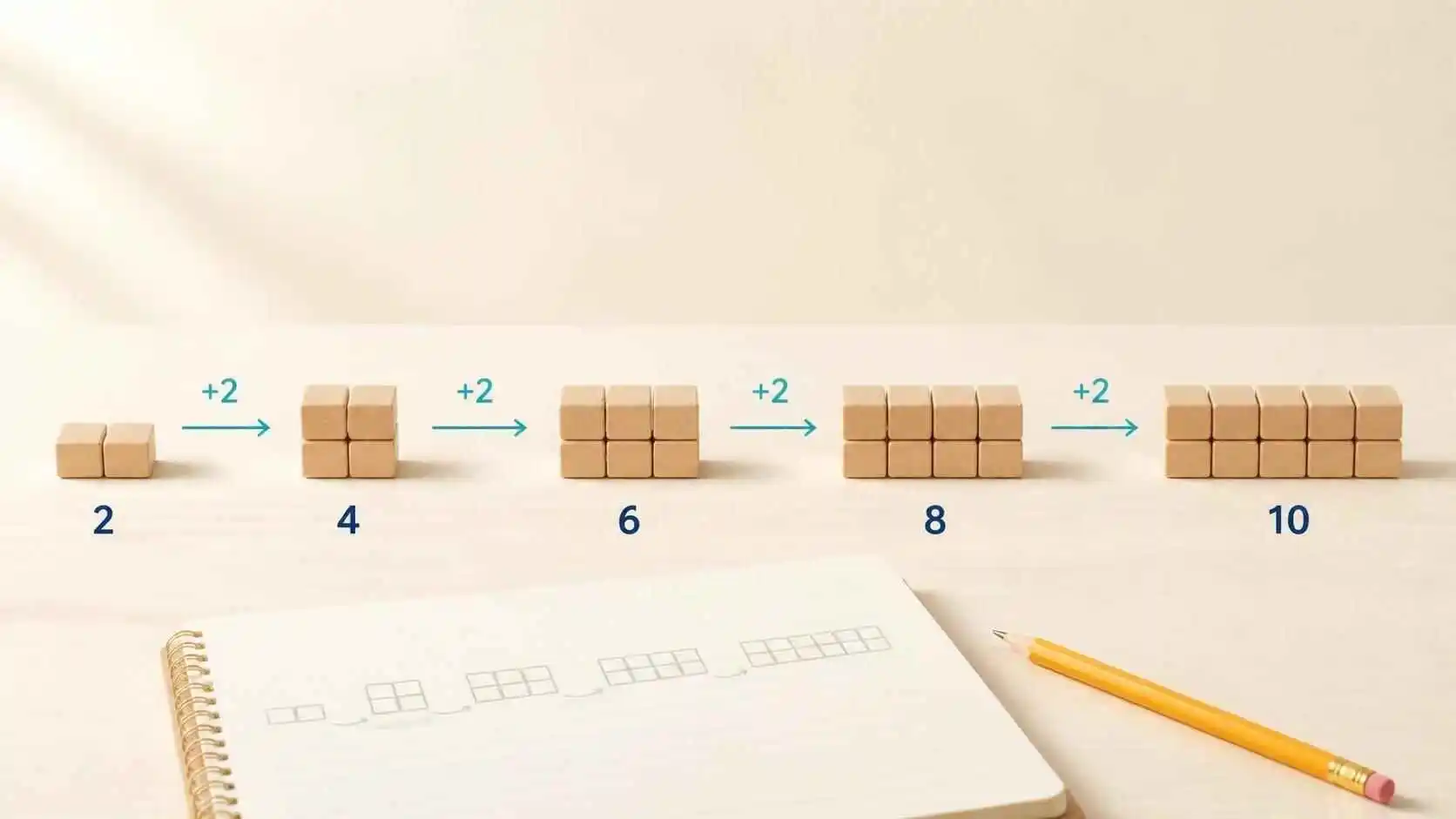
Arithmetic Progressions Made Simple: Worked Examples, Mock Questions, and Detailed Answers
You save ₹100 in your first week, ₹150 in your second, and ₹200 in your third. Each week, you put aside ₹50 more than the week before.
Now comes the interesting question: how much will you save in week 20? And how much money will you have altogether?
You could write out twenty numbers and add them. But there is a faster way—and understanding it is far more useful than memorizing a formula.
That is where arithmetic progressions come in. They turn patterns with equal increases or decreases into calculations you can manage confidently.
This guide explains arithmetic progressions from the ground up, including their formulas, practical applications, worked examples, and a mock test with detailed solutions. You will also find 30 FAQs covering the small details that often cause the biggest confusion.
Understanding Arithmetic Progressions: Start with the Pattern
What is an arithmetic progression?
An arithmetic progression, usually shortened to AP, is a sequence in which the difference between consecutive terms stays constant. That fixed change is called the common difference.
Consider:
4, 7, 10, 13, 16,…4, 7, 10, 13, 16,…
Subtract each term from the one immediately after it:
7−4=3,10−7=3,13−10=37−4=3,10−7=3,13−10=3
Every step adds 3, so this is an AP.
Now look at:
20, 16, 12, 8,…20, 16, 12, 8,…
Here:
16−20=−4,12−16=−416−20=−4,12−16=−4
This is also an AP. Arithmetic progressions do not have to increase; a constant decrease works just as well.
Think of an AP as a staircase with equally sized steps. The steps may lead upward or downward, but their size does not change.
The notation you need
Before solving arithmetic progression questions, get comfortable with these symbols:
| Symbol | Meaning | Example in 5,9,13,17,…5,9,13,17,… |
| aa | First term | 55 |
| dd | Common difference | 44 |
| nn | Position or number of terms | 44 for the fourth term |
| anan | Term in position nn | a4=17a4=17 |
| ll | Last term of a finite AP | 1717, if the sequence ends there |
| SnSn | Sum of the first nn terms | S4=44S4=44 |
Some books use TnTn instead of anan. Both refer to the nth term.
The important distinction is between a term’s position and its value. In this example, the fourth term is 17: its position is 4, not 17.
How to check whether a sequence is an AP
Use this simple test:
- Subtract the first term from the second.
- Subtract the second term from the third.
- Continue through all available consecutive pairs.
- Check whether every difference matches.
For example:
2, 5, 9, 142, 5, 9, 14
The differences are:
3, 4, 53, 4, 5
They are not equal, so the sequence is not an AP.
One matching pair is not enough. Check all the consecutive differences supplied.
Positive, negative, and zero common differences
| Sequence | Common difference | Behaviour |
| 3,8,13,18,…3,8,13,18,… | 55 | Increasing |
| 15,12,9,6,…15,12,9,6,… | −3−3 | Decreasing |
| 7,7,7,7,…7,7,7,7,… | 00 | Constant |
| 0.5,1,1.5,2,…0.5,1,1.5,2,… | 0.50.5 | Increasing with decimal terms |
Fractions and negative numbers work too. For instance:
−12, 0, 12, 1,…−21, 0, 21, 1,…
has common difference 1221.
The defining feature is equal differences—not positive numbers, whole numbers, or increasing values.
The Arithmetic Progression Formula: Finding Any Term
Deriving the nth term of an AP
Suppose the first term is aa and the common difference is dd.
The terms are:
a,a+d,a+2d,a+3d,…a,a+d,a+2d,a+3d,…
Notice the pattern:
- The first term has no added difference.
- The second term has one added difference.
- The third term has two added differences.
- The nth term has n−1n−1 added differences.
Therefore:
an=a+(n−1)dan=a+(n−1)d
This is the standard formula for the nth term of an AP.
The n−1n−1 matters. There are nine gaps between the first and tenth terms, not ten.
Example 1: Find a term far along the sequence
Find the 25th term of:
6, 10, 14, 18,…6, 10, 14, 18,…
Step 1: Identify the values.
a=6,d=4,n=25a=6,d=4,n=25
Step 2: Substitute.
a25=6+(25−1)×4a25=6+(25−1)×4
Step 3: Calculate.
a25=6+96=102a25=6+96=102
The 25th term is 102.
A quick reasonableness check helps: 24 jumps of 4 add 96 to the starting value.
Example 2: Work with a decreasing AP
Find the 12th term of:
30, 26, 22,…30, 26, 22,…
Here:
a=30,d=−4a=30,d=−4
Therefore:
a12=30+11(−4)=−14a12=30+11(−4)=−14
A sequence can begin with positive numbers and later become negative. The formula does not change when the sequence crosses zero.
Example 3: Find a term’s position
Which term of 7,12,17,…7,12,17,… is 82?
Start with:
82=7+(n−1)582=7+(n−1)5
Subtract 7:
75=5(n−1)75=5(n−1)
Divide by 5:
15=n−115=n−1
Therefore:
n=16n=16
So 82 is the 16th term.
How to check whether a number belongs to an AP
Rearranging the nth-term formula gives:
n=x−ad+1n=dx−a+1
Here, xx is the proposed term and d≠0d=0.
For membership in a sequence indexed from its first term, nn must be a positive integer.
Is 84 a term of 7,12,17,…7,12,17,…?
n=84−75+1=16.4n=584−7+1=16.4
A term cannot occupy position 16.4. Therefore, 84 is not in this AP.
For a finite AP, there is another condition: the calculated position must not exceed the number of available terms.
Finding an AP from two known terms
Suppose:
a4=17,a10=41a4=17,a10=41
Write two equations:
a+3d=17a+3d=17
a+9d=41a+9d=41
Subtract:
6d=246d=24
Thus:
d=4d=4
Substitute into the first equation:
a+12=17a+12=17
So:
a=5a=5
The sequence is:
5, 9, 13, 17,…5, 9, 13, 17,…
The useful shortcut behind this method is:
aq−ap=(q−p)daq−ap=(q−p)d
The difference between two term values equals the number of gaps between their positions multiplied by the common difference.
The Sum of an Arithmetic Progression: Add Smarter
Finding one term and finding a total are different tasks.
For the savings example, the amount saved in week 20 is one term. The amount accumulated over twenty weeks is a sum.
Why the sum formula works
Consider:
3+7+11+15+193+7+11+15+19
Pair terms from opposite ends:
3+19=22,7+15=223+19=22,7+15=22
The middle term is 11, exactly half of 22.
More generally, write an AP sum forward and backward:
Sn=a+(a+d)+⋯+lSn=a+(a+d)+⋯+l
Sn=l+(l−d)+⋯+aSn=l+(l−d)+⋯+a
Adding vertically produces nn pairs, each equal to a+la+l:
2Sn=n(a+l)2Sn=n(a+l)
Therefore:
Sn=n2(a+l)Sn=2n(a+l)
In words: the sum equals the number of terms multiplied by the average of the first and last terms.
If the last term is unknown, substitute l=a+(n−1)dl=a+(n−1)d:
Sn=n2[2a+(n−1)d]Sn=2n[2a+(n−1)d]
Both formulas calculate the same total. Choose whichever matches the information available.
Example 1: Add a sequence with a known last term
Find:
8+12+16+⋯+808+12+16+⋯+80
First find how many terms there are:
80=8+(n−1)480=8+(n−1)4
72=4(n−1)72=4(n−1)
n=19n=19
Now calculate the sum:
S19=192(8+80)S19=219(8+80)
S19=19×44=836S19=19×44=836
The sum is 836.
The most important step was finding nn. Knowing the last term does not automatically tell you the number of terms.
Example 2: Return to the savings challenge
You save ₹100 in week 1 and increase your weekly saving by ₹50.
The amount saved in week 20 is:
a20=100+19(50)=1050a20=100+19(50)=1050
So you put aside ₹1,050 in that week.
Your total savings are:
S20=202[2(100)+19(50)]S20=220[2(100)+19(50)]
S20=10(200+950)=11500S20=10(200+950)=11500
You save ₹11,500 altogether, assuming no withdrawals, interest, or other changes.
This distinction prevents a common mistake: ₹1,050 is the final weekly deposit, not the accumulated balance.
Example 3: Sum a decreasing sequence
Find the sum of the first eight terms of:
25, 22, 19,…25, 22, 19,…
Here:
a=25,d=−3,n=8a=25,d=−3,n=8
Therefore:
S8=82[50+7(−3)]S8=28[50+7(−3)]
S8=4(29)=116S8=4(29)=116
Decreasing terms do not automatically produce a negative sum. What matters is the actual values included.
A compact AP formulas reference
| What you need | Formula | Important condition |
| Common difference | d=ak+1−akd=ak+1−ak | Use consecutive terms |
| Nth term | an=a+(n−1)dan=a+(n−1)d | Positions begin at 1 |
| Position of xx | n=x−ad+1n=dx−a+1 | d≠0d=0; validate nn |
| Sum using endpoints | Sn=n2(a+l)Sn=2n(a+l) | Know the number of terms |
| Sum using a,d,na,d,n | Sn=n2[2a+(n−1)d]Sn=2n[2a+(n−1)d] | Use the signed value of dd |
| Term from sums | an=Sn−Sn−1an=Sn−Sn−1 | n≥2n≥2; a1=S1a1=S1 |
The final identity works because subtracting the sum of the first n−1n−1 terms leaves only the nth term. It is not restricted to APs.
Arithmetic Progression Examples in Real Life—and Common Traps
Theatre seating: separating a row from the whole hall
Imagine a theatre with 18 seats in its first row. Each subsequent row contains two additional seats, and there are 15 rows.
The final row contains:
a15=18+14(2)=46a15=18+14(2)=46
The theatre’s total capacity is:
S15=152(18+46)=480S15=215(18+46)=480
The two answers describe different things:
- 46 seats in the final row.
- 480 seats across all rows.
Whenever a word problem mentions “the last,” “the tenth,” or “a particular row,” think about a term. When it asks “altogether” or “in total,” think about a sum.
Planned walking distances: check what changes equally
Suppose a fictional walking plan starts at 1 km and adds 0.2 km each day.
The planned distances are:
1, 1.2, 1.4, 1.6,…1, 1.2, 1.4, 1.6,…
The day-10 distance is:
a10=1+9(0.2)=2.8 kma10=1+9(0.2)=2.8 km
The planned total over ten days is:
S10=102(1+2.8)=19 kmS10=210(1+2.8)=19 km
This is a mathematical illustration, not an exercise prescription. The AP describes the proposed distances; it does not establish whether the plan suits a particular person.
Arithmetic progression versus geometric progression
The key question is whether the sequence changes by an equal amount or an equal factor. Arithmetic progressions use a fixed difference; geometric progressions use a fixed ratio.
| Feature | Arithmetic progression | Geometric progression |
| Repeated operation | Add a fixed number | Multiply by a fixed number |
| Example | 4,7,10,13,…4,7,10,13,… | 4,8,16,32,…4,8,16,32,… |
| Main check | Consecutive differences | Consecutive ratios, where defined |
| Typical wording | “₹500 more each month” | “Twice as much each month” |
An increase of ₹100 each period suggests an AP. An increase of 10% of the previous amount generally does not.
Inserting arithmetic means
Insert three arithmetic means between 6 and 22.
The completed sequence has five terms:
6, □, □, □, 226, □, □, □, 22
Five terms create four equal gaps:
d=22−64=4d=422−6=4
Therefore:
6, 10, 14, 18, 226, 10, 14, 18, 22
The inserted arithmetic means are 10, 14, and 18.
In general, inserting kk arithmetic means between endpoints AA and BB creates k+1k+1 equal gaps:
d=B−Ak+1d=k+1B−A
Five mistakes worth catching early
- Using a+nda+nd. The correct formula is a+(n−1)da+(n−1)d.
- Dropping a negative sign. For 14,9,4,…14,9,4,…, d=−5d=−
- Confusing a term with a sum. a12a12 and S12S12 answer different questions.
- Accepting a fractional position. A calculated n=8.5n=8.5 is not a valid term position.
- Assuming an AP continues forever in a real setting. A declining stockpile or seating arrangement has practical limits.
A reliable solving routine is: identify the pattern, list the known values, choose the formula, calculate, and check the result against the question.
Arithmetic Progression Mock Questions and Answers
Try these twelve arithmetic progression questions before reading the solutions. They move from pattern recognition to equations, sums, and word problems.
Suggested practice format: allow about 30 minutes, show your working, and review any question where you chose the wrong formula—even if your arithmetic was correct.
Mock questions
- Is 11,7,3,−1,…11,7,3,−1,… an AP? State its common difference.
- Find the 18th term of 4,11,18,…4,11,18,….
- Which term of 9,14,19,…9,14,19,… is 104?
- Does 100 belong to 3,10,17,…3,10,17,…?
- Find the sum of the first 25 terms of 2,5,8,…2,5,8,….
- Find the sum 15+20+25+⋯+10015+20+25+⋯+100.
- The fifth term of an AP is 22 and its eleventh term is 46. Find its first term and common difference.
- Insert four arithmetic means between 3 and 28.
- The sum of the first nn terms is Sn=3n2+2nSn=3n2+2n. Find anan, the first term, and the common difference.
- A hall has 20 rows. The first row has 12 seats, and each next row has three more. Find the total seating capacity.
- How many terms of 5,8,11,…5,8,11,… have a sum of 185?
- Find three numbers in AP whose sum is 27 and whose product is 585.
Detailed answers
Question 1: Recognize the progression
Calculate the differences:
7−11=−4,3−7=−4,−1−3=−47−11=−4,3−7=−4,−1−3=−4
They match, so the sequence is an AP with:
d=−4d=−4
Takeaway: decreasing sequences still qualify.
Question 2: Find the 18th term
Here:
a=4,d=7a=4,d=7
Use:
a18=4+(18−1)7a18=4+(18−1)7
a18=4+119=123a18=4+119=123
Answer: 123.
Question 3: Find the position of 104
Set the term formula equal to 104:
104=9+(n−1)5104=9+(n−1)5
95=5(n−1)95=5(n−1)
n=20n=20
Answer: 104 is the 20th term.
Check: 19 jumps of 5 add 95 to the starting value 9.
Question 4: Test membership
For a=3a=3 and d=7d=7:
100=3+(n−1)7100=3+(n−1)7
n=1+977=1047n=1+797=7104
This is not an integer.
Answer: 100 does not belong to the AP.
Do not round the result. Rounding would change the question.
Question 5: Sum the first 25 terms
Here:
a=2,d=3,n=25a=2,d=3,n=25
Then:
S25=252[4+24(3)]S25=225[4+24(3)]
S25=252(76)=950S25=225(76)=950
Answer: 950.
Alternatively, find the last term, a25=74a25=74, then calculate 25(2+74)/225(2+74)/2.
Question 6: Sum to a specified endpoint
First find the term count:
100=15+(n−1)5100=15+(n−1)5
85=5(n−1)85=5(n−1)
n=18n=18
Now:
S18=182(15+100)S18=218(15+100)
S18=9(115)=1035S18=9(115)=1035
Answer: 1,035.
The endpoint 100 is a term value, not the number of terms.
Question 7: Recover the first term and difference
The supplied terms give:
a+4d=22a+4d=22
a+10d=46a+10d=46
Subtract:
6d=24⇒d=46d=24⇒d=4
Substitute:
a+16=22⇒a=6a+16=22⇒a=6
Answer: a=6a=6, d=4d=4.
The AP begins 6,10,14,18,22,…6,10,14,18,22,….
Question 8: Insert four arithmetic means
There will be six terms altogether and five equal gaps:
d=28−35=5d=528−3=5
The completed AP is:
3, 8, 13, 18, 23, 283, 8, 13, 18, 23, 28
Answer: 8, 13, 18, and 23.
Count gaps rather than just the missing numbers.
Question 9: Recover terms from a sum formula
Use:
an=Sn−Sn−1an=Sn−Sn−1
First expand:
Sn−1=3(n−1)2+2(n−1)Sn−1=3(n−1)2+2(n−1)
Sn−1=3n2−4n+1Sn−1=3n2−4n+1
Therefore:
an=(3n2+2n)−(3n2−4n+1)an=(3n2+2n)−(3n2−4n+1)
an=6n−1an=6n−1
This also gives a1=5=S1a1=5=S1. The sequence begins:
5, 11, 17,…5, 11, 17,…
Answer: an=6n−1an=6n−1, a=5a=5, and d=6d=6.
Question 10: Calculate seating capacity
Identify:
a=12,d=3,n=20a=12,d=3,n=20
The last row has:
a20=12+19(3)=69a20=12+19(3)=69
Total capacity:
S20=202(12+69)=810S20=220(12+69)=810
Answer: 810 seats.
Check that the answer uses seats across all twenty rows, not just the final row.
Question 11: Find the number of terms from a sum
Use the sum formula:
185=n2[10+3(n−1)]185=2n[10+3(n−1)]
Simplify:
370=n(3n+7)370=n(3n+7)
3n2+7n−370=03n2+7n−370=0
Factor:
(n−10)(3n+37)=0(n−10)(3n+37)=0
The roots are 1010 and −37/3−37/3. Only the positive integer is valid.
Answer: 10 terms.
Check:
S10=5(10+27)=185S10=5(10+27)=185
Question 12: Find three unknown AP terms
Write the numbers symmetrically:
x−d,x,x+dx−d,x,x+d
Their sum is 27:
3x=27⇒x=93x=27⇒x=9
Use the product:
(9−d)9(9+d)=585(9−d)9(9+d)=585
9(81−d2)=5859(81−d2)=585
81−d2=6581−d2=65
d2=16d2=16
Thus d=±4d=±4.
Answer: the numbers are 5, 9, and 13, or the same numbers in reverse order.
This symmetric setup makes the sum immediate and keeps the algebra manageable.
FAQs
- What does AP stand for in mathematics?
AP stands for arithmetic progression: a sequence whose consecutive terms have a constant difference. The abbreviation describes the pattern, not a particular formula.
- Are arithmetic sequence and arithmetic progression the same?
Yes. These terms refer to the same kind of sequence. An arithmetic series, however, is the sum of its terms rather than the ordered list itself.
- What is the easiest way to recognize an AP?
Calculate consecutive differences. For 6,10,14,186,10,14,18, each difference is 4, so the list is an AP. Check every available adjacent pair.
- Can an arithmetic progression have negative terms?
Yes. The sequence −12,−8,−4,0,…−12,−8,−4,0,… is an AP with common difference 4. The signs of the terms do not determine whether the sequence is arithmetic.
- Can the common difference be zero?
Yes. A constant sequence such as 9,9,9,…9,9,9,… has d=0d=0. Its nth term is always 9, and the sum of its first nn terms is 9n9n.
- Can an AP contain decimals or fractions?
Yes. For example, 0.2,0.5,0.8,1.1,…0.2,0.5,0.8,1.1,… has common difference 0.3. AP formulas do not require whole-number term values.
- Why does the nth-term formula use n−1n−1?
Because there are n−1n−1 transitions from the first term to the nth term. Reaching the second term requires one jump; reaching the tenth requires nine.
- What is the difference between anan and SnSn?
The symbol anan means one term, while SnSn means the total of the first nn terms. In 2,4,6,…2,4,6,…, a3=6a3=6, but S3=12S3=12.
- How do I choose the correct sum formula?
Use Sn=n(a+l)/2Sn=n(a+l)/2 when you know the first term, last term, and term count. Use Sn=n[2a+(n−1)d]/2Sn=n[2a+(n−1)d]/2 when you know the first term, difference, and count.
- Does an AP always increase?
No. It increases when d>0d>0, decreases when d<0d<0, and remains constant when d=0d=0. Look at the signed difference, not just its size.
- Can zero be the first term?
Yes. For 0,4,8,12,…0,4,8,12,…, the first term is zero and the nth term is 4(n−1)4(n−1). Zero causes no problem in the formulas.
- How can I check whether my nth-term answer is sensible?
Compare it with nearby terms or estimate the accumulated change. If an increasing AP starts at 10, a later term below 10 signals a mistake.
- What if I calculate a fractional value of nn?
For ordinary term positions, a fractional nn is invalid. It usually means the proposed value is not a term, or the stated total cannot be reached using a whole number of terms.
- How do I find the number of terms in a finite AP?
When d≠0d=0, solve l=a+(n−1)dl=a+(n−1)d, giving n=(l−a)/d+1n=(l−a)/d+1. Check that the result is a positive integer.
- How do I handle a constant AP when finding positions?
If d=0d=0, every term equals aa. A value different from aa never occurs; the value aa occurs at every position that exists in the sequence.
- What is an arithmetic mean between two numbers?
It is the middle value that makes the three numbers an AP. Between 8 and 20, the arithmetic mean is (8+20)/2=14(8+20)/2=14.
- Why do three consecutive AP terms satisfy 2b=a+c2b=a+c?
Their equal differences give b−a=c−bb−a=c−b. Rearranging produces 2b=a+c2b=a+c, meaning the middle term is the average of its neighbours.
- How should I represent three unknown AP terms?
Use x−d,x,x+dx−d,x,x+d, particularly when their sum is known. Their sum becomes 3×3x, which often removes one unknown immediately.
- How should I represent four unknown AP terms?
A useful symmetric form is x−3r,x−r,x+r,x+3rx−3r,x−r,x+r,x+3r. Their sum is 4×4x, and their common difference is 2r2r, not rr.
- Can a finite AP have an odd number of terms?
Yes. The sum formula works for odd and even counts. With an odd count, the middle term equals the average of the first and last terms.
- How do I find the middle term?
For an odd number nn of terms, its position is (n+1)/2(n+1)/2. Its value is (a+l)/2(a+l)/2. For an even count, there are two central terms.
- What is the nth term from the end?
For a finite AP with last term ll and forward common difference dd, the kth term from the end is l−(k−1)dl−(k−1)d, provided that position exists.
- Is an AP still arithmetic when reversed?
Yes, for a finite AP. Reversing 2,5,8,112,5,8,11 gives 11,8,5,211,8,5,2, changing the common difference from 3 to −3−3.
- What happens if the same number is added to every term?
The sequence remains an AP with the same common difference. Adding 10 to 1,4,71,4,7 produces 11,14,1711,14,17, whose consecutive differences are still 3.
- What happens if every term is multiplied by a constant?
The result is another AP. Multiplying every term by kk multiplies the common difference by kk. If k=0k=0, the result is the constant zero sequence.
- Can an AP have a sum of zero?
Yes. For example, −6,−3,0,3,6−6,−3,0,3,6 sums to zero because opposite terms cancel. A zero total does not mean each term is zero.
- Can an arithmetic progression have an infinite sum?
A nonzero infinite AP has no convergent ordinary sum. For a series to converge, its terms must approach zero; only the identically zero AP meets that requirement among arithmetic progressions.
- Does a quadratic formula for SnSn always produce an AP?
If Sn=An2+BnSn=An2+Bn holds for every positive integer nn, then an=2An+(B−A)an=2An+(B−A), which is arithmetic with difference 2A2A. The absence of an added constant matters because S0=0S0=0.
- Can two different APs share some terms?
Yes. The APs 2,5,8,11,14,…2,5,8,11,14,… and 5,9,13,17,…5,9,13,17,… share values including 5 and 17. Shared terms do not imply identical starting values or differences.
- What is the best way to practise arithmetic progression problems?
Use mixed practice: identifying patterns, finding terms, testing membership, calculating sums, and solving word problems. For every mistake, identify whether the cause was interpretation, formula selection, algebra, or arithmetic.
Learn the Pattern, Not Just the Formula
Arithmetic progressions become easier when you recognize the structure behind the symbols: a starting value, an equal change, and a number of steps.
The nth-term formula tells you where those steps lead. The sum formula tells you how much accumulates along the way. Once you separate those two questions, many intimidating problems become straightforward.
Start with the twelve mock questions above. Solve them without looking at the answers, then revisit every error and explain why it happened. Being able to justify the method—not merely reproduce the calculation—is the clearest sign that you understand the topic.
Disclaimer: The content on this blog is for informational purposes only. The author’s opinions are personal and not endorsed. Efforts are made to provide accurate information, but completeness, accuracy, or reliability are not guaranteed. The author is not liable for any loss or damage resulting from the use of this blog. It is recommended to use the information on this blog at your own discretion.

