

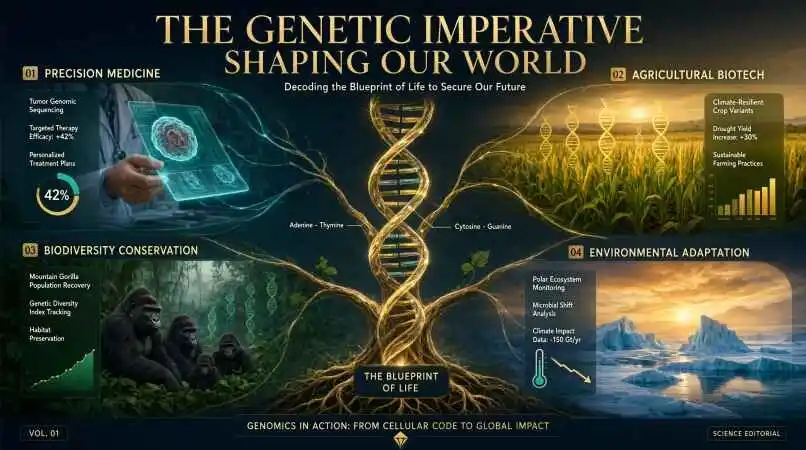
When Genes Meet the Real World: How Genetics and Evolution Shape Medicine, Food, Conservation and Climate
From antibiotic resistance and personalized cancer care to mountain gorillas, climate change and gene editing
Introduction: Where Genetics Stops Being Abstract
It decides which antibiotics still work. It shapes the cancer treatment a patient receives. It determines whether a nearly extinct animal can recover, how our food is grown, and which species may cope with a warming planet. For many of us, this is where genetics and evolution stop being a school topic and become relevant to decisions about health, food and the natural world.
Let’s walk through the practical side, one field at a time, then look at real cases and what may lie ahead.
Section 1: Practical Applications, Why Genetics and Evolution Matter Right Now
Medicine and Disease
Genetics and evolution together are changing healthcare.
Cancer is fundamentally an evolutionary process. The cells in your body are constantly mutating, and the immune system usually catches dangerous changes. Occasionally, though, a cell picks up mutations that let it evade the immune system and divide without limits. That is a tumor. As it grows, the cells inside it keep evolving, with some mutations giving advantages and others disadvantages. A tumor’s evolution often includes resistance to chemotherapy drugs.
Modern cancer treatment increasingly involves sequencing the tumor, identifying the specific mutations driving its growth, and targeting those mutations. It is evolution applied to medicine.
Hereditary diseases exist because harmful mutations are passed down through families. If you carry a mutation for cystic fibrosis or sickle cell anemia, you inherited it from your parents. Understanding the genetic basis of these conditions makes genetic counseling and prenatal testing possible, and eventually gene therapy, which edits the problem DNA directly.
Personalized medicine is arriving. Soon your treatment may be chosen based on your genetic profile. A drug that works well for most people can be ineffective or harmful for someone with a particular variant. Pharmacogenomics, the study of how genes affect drug response, is already changing prescribing practices.
Agriculture and Food Production
Almost everything you eat has been shaped by selective breeding, which is artificial evolution driven by human preferences.
Modern crop improvement leans increasingly on the genetics of yield, disease resistance and nutritional content. Scientists can identify genes that make plants use water more efficiently or resist pests, then breed those traits into new varieties. This is conventional breeding, but guided by genetic knowledge.
Genetic engineering goes further by introducing genes from other species directly. A tomato might receive a gene from a fish that helps it survive cold. Golden Rice carries genes that produce beta-carotene, a source of vitamin A, to tackle malnutrition in populations that depend heavily on rice.
The ethics of genetic engineering are genuinely complex. There are legitimate concerns about unintended consequences and corporate control of food supplies. But the science is sound: understanding genes lets us improve crops more precisely and, often, more sustainably.
Conservation and Biodiversity
Genetic diversity is crucial for a species’ survival. A population with little diversity is fragile, since a single disease or environmental shift can wipe it out. Conservation biologists increasingly use genetic analysis to:
- Identify which populations to prioritize for protection
- Manage zoo breeding programs to maintain genetic diversity
- Track migrations and detect poaching
- Assess whether a population can survive in a changing environment
The California condor was pulled back from the brink of extinction when only 27 birds existed in the world. Genetic analysis was crucial in managing the breeding program so that birds released into the wild were as genetically diverse as possible.
De-extinction efforts, which aim to bring back lost species, depend entirely on genetics. Scientists can extract DNA from fossils, reconstruct the genome of an extinct species and then try to use that genome to create a living organism. The woolly mammoth genome has been sequenced, and some scientists believe a mammoth-like creature could appear within decades.
Seeing a tumor’s mutations as evolutionary adaptations lets doctors identify its fitness advantage and take it away.
Evolutionary Medicine
Evolutionary medicine applies evolutionary thinking to modern health problems.
Why are we prone to back pain? Because our spine evolved for four-legged locomotion, and we now use it in ways it wasn’t optimized for.
Why do we struggle with obesity? Because our genes evolved in an environment of scarcity. Our bodies are tuned to store fat when food is available, a huge advantage when meals are unpredictable. In a world of caloric abundance, the same adaptation becomes a liability.
Why do many people have difficulty digesting lactose after childhood? Because lactose tolerance is a recent evolutionary adaptation, only about 10,000 years old. Most of the world’s population never evolved the ability to digest milk in adulthood because, historically, they had no access to it.
Knowing the evolutionary roots of these problems can point to solutions. For back pain, our evolutionary history might inform better ergonomic design. For obesity, it suggests that willpower alone isn’t the answer. We need to work with our biology, not against it.
Section 2: Real-World Scenarios
Scenario 1: The Rise of Antibiotic Resistance
Let’s trace how genetics and evolution combine in a problem affecting you right now.
The problem: Bacterial infections that once cleared up with penicillin now require multiple antibiotics. Some bacteria are resistant to nearly every available drug.
The genetic reality: Most antibiotic resistance genes existed in bacterial populations before antibiotics were discovered. Some bacteria naturally produced antibiotics as chemical weapons against competitors, and they also carried resistance genes to avoid poisoning themselves.
The evolutionary process: When we began using antibiotics widely, we created an environment where resistance was an advantage. Resistant bacteria survived while susceptible ones died. Because bacteria reproduce so fast, some every 20 minutes, the resistant ones became dominant within a few generations.
The genetic mechanism: Resistance often involves genes encoding enzymes that break down antibiotics or pump them out of the cell. Once a bacterium acquires such a gene, by mutation or by receiving it from another bacterium through horizontal gene transfer, it can pass the gene to its offspring.
What makes it worse: Bacteria don’t only evolve individually. They can swap genes sideways, even with unrelated species. Imagine taking a useful gene from your neighbor and installing it in your own cells. Bacteria can do this, which dramatically accelerates the spread of resistance across species.
The practical outcome: A patient is treated with antibiotic A. The resistant bacteria survive, multiply, and the infection returns, now resistant to A. The doctor prescribes antibiotic B, and the story repeats. Within a few years, the bacteria may resist several drugs, creating a “superbug.”
A real example: Staphylococcus aureus, a common bacterium that can cause serious infections, went from being easily treated with penicillin to producing strains like MRSA (methicillin-resistant Staphylococcus aureus), which need newer, more expensive and more toxic antibiotics. Some MRSA strains now show reduced susceptibility even to last-resort drugs like vancomycin.
What we’re learning: Overusing antibiotics, including giving them to livestock to promote growth, speeds this evolutionary process. The answer isn’t only to develop new antibiotics, since bacteria will eventually adapt to those too. It is to use antibiotics more judiciously, complete the prescribed course even when you feel better, and support research into alternatives that bacteria can’t easily evolve resistance to, such as bacteriophages, viruses that specifically target bacteria.
Scenario 2: Personalized Cancer Treatment
Sarah is 42 and has been diagnosed with breast cancer. Thirty years ago, her treatment would have been fairly standard: chemotherapy, radiation and perhaps surgery, regardless of the genetic character of her tumor.
Today’s approach: Her tumor is sequenced. The analysis shows that her cancer cells carry mutations in specific genes, perhaps in HER2, perhaps a BRCA mutation, or one that creates a particular vulnerability.
The genetic insight: These mutations are the result of evolution happening inside her body. A breast cell acquired changes that let it escape normal growth controls. Some cells in that tumor then picked up additional mutations that made them resistant to standard chemotherapy. But the same cell now has a weakness: it depends on a specific protein to survive, and that protein is encoded by one of the mutated genes.
The treatment: Instead of hitting her body with chemotherapy that harms healthy and cancerous cells alike, she receives a targeted drug that interferes with that particular protein. The cancer cells, which depend on it, die. Healthy cells, which don’t, are largely spared.
The evolutionary principle: By understanding the mutations driving the cancer, the adaptations the tumor made, oncologists can identify the “fitness advantage” the cancer cells have and remove it.
A real example: Trastuzumab (Herceptin) targets HER2-positive breast cancers. Before it was developed, HER2-positive cancers were aggressive and hard to treat. After its introduction, survival rates improved dramatically. It is a direct application of cancer genetics and evolutionary thinking.
Scenario 3: Conserving the Mountain Gorilla
Mountain gorillas in central Africa came close to extinction in the 1980s, with fewer than 300 remaining. Their disappearance looked inevitable.
The genetic challenge: In such a small population, genetic diversity was draining away. Inbreeding, meaning mating between relatives, was raising the frequency of harmful recessive alleles, and genetic drift was randomly eliminating beneficial ones.
The genetic solution: Researchers used genetic analysis to:
- Identify which individuals were the most genetically diverse
- Build pedigrees showing family relationships
- Guide breeding recommendations to maximize genetic diversity
- Monitor for signs of inbreeding depression, the reduced fitness of offspring
The evolutionary insight: Evolution works best in large, diverse populations. To preserve a small population’s evolutionary potential, you have to manage its genetics deliberately, keeping diversity up and avoiding the random loss of beneficial alleles.
The outcome: Through careful management and habitat protection, the mountain gorilla population has grown to over 1,000 individuals. It still faces challenges, and its genetic diversity remains lower than ideal, but it is no longer on the brink. Genetic knowledge helped make that recovery possible.
Section 3: Evolution in the Age of Climate Change
Understanding genetics and evolution isn’t merely interesting right now. It is practically urgent.
Species Facing Evolutionary Challenges
As climate change reshapes ecosystems quickly, many species face challenges they have never met. For a population to adapt through evolution, several things need to be true:
- Genetic variation must exist for traits relevant to the new environment
- Selection pressure must be strong enough to shift gene frequencies
- Generation time must be short enough for change to happen before the environment shifts again
Here is the problem. Some species meet all three criteria. Bacteria and insects, with short generation times and huge populations, can evolve quickly. But large mammals with long generation times, such as elephants, polar bears and orangutans, may not be able to evolve fast enough to match the pace of climate change.
Rapid Evolution Under Stress
Some organisms are surprising us with rapid adaptation.
Darwin’s finches in the Galápagos have evolved measurably in just a few years in response to drought conditions.
Mosquitoes have evolved resistance to insecticides in real time, sometimes within years.
Polar bears are the harder case. Researchers are studying genetic variation across bear populations to understand how much capacity for adaptation they hold, and the pace of Arctic warming is a serious concern.
The question is whether adaptation can keep pace with human-caused climate change. For many species the answer appears to be no. That is why conservation often involves protecting genetic diversity, maintaining habitat corridors for migration and, sometimes, assisted migration: moving organisms to new habitats before their current homes become uninhabitable.
The Role of Genetic Diversity
Populations with low genetic diversity have limited evolutionary potential. A group of 100 genetically identical individuals can’t adapt to changing conditions, because there is no variation for natural selection to act on.
This is why conservation biologists are so focused on genetic diversity. It is literally the raw material of evolution, and protecting endangered species means protecting not just individual animals but the genetic variation they carry.
Sample Question: Evolution in a Changing Environment
Question: A population of moths contains both light-colored and dark-colored individuals. When a forest fire blackens the tree bark, the proportion of dark moths rises from 30% to 75% within three generations. Explain what is happening in terms of natural selection and genetics.
Answer, the mechanism:
- Genetic variation: The population already contains alleles for both light and dark coloration.
- Environmental change: The fire blackened the trees.
- Differential survival: Dark moths are now harder for predators to see against black bark, so more of them survive to reproduce.
- Genetic shift: The surviving dark moths pass their dark-coloration alleles to offspring more often than light moths do.
- Population change: Over generations, the frequency of dark-coloration alleles rises.
Why it isn’t “adaptation” in the intentional sense: The moths didn’t become darker because they needed to. Alleles for dark coloration already existed in the population. The environmental change simply made them advantageous, so they became more common through natural selection.
Why it’s fast: Moths have short generation times, with several generations per year, so genetic change can be observed on human timescales. In longer-lived animals like elephants or humans, a similar shift might take thousands of years.
Section 4: The Future of Genetics and Evolution
Gene Editing and the Ethical Frontier
CRISPR-Cas9 and other gene-editing technologies have made it possible to modify DNA precisely in living organisms. That opens extraordinary possibilities:
- Eliminating genetic diseases before they manifest
- Creating disease-resistant crops that can withstand changing climates
- Resurrecting extinct species or preventing the extinction of endangered ones
It also raises profound questions. If we edit human genes, are we still letting evolution proceed naturally? What if an edit has unintended consequences that spread through a population? Should we edit germline cells, which pass changes to offspring, or only somatic cells, which don’t?
The scientific consensus is one of cautious optimism. Gene editing for medical purposes, treating disease, is increasingly accepted. Editing for enhancement, to make people taller, smarter or more athletic, is far more controversial. The concern is both practical, since we don’t fully understand every effect of our edits, and philosophical: do we want to move away from natural evolution?
Synthetic Biology and Evolution
Scientists are now creating entirely synthetic organisms with engineered DNA, organisms that don’t exist in nature because they were designed. As the field develops, we are learning how contingent evolution is. Small differences in genes can produce dramatically different organisms, which shows how much of evolution’s path depends on chance historical events.
Understanding Evolution at Scale
DNA sequencing has become so cheap and fast that we can now sequence entire populations and even entire ecosystems. Imagine mapping the genetic variation of every fish in a river or every plant in a forest. It is becoming possible. With that data, we can:
- Track how populations adapt in real time
- Predict which organisms will thrive or struggle as environments change
- Understand migration patterns and population movements
- Assess the evolutionary potential of endangered populations
This is genomic ecology, evolution studied at the scale of populations and ecosystems, and it is transforming conservation and evolutionary biology.
Key Takeaways
| Concept | 📝 Definition | 🏥 Real-World Application |
| Pharmacogenomics | Study of how a person’s genes affect their response to drugs | Choosing safer, more effective medicines and doses |
| Targeted Therapy | Treatment aimed at a specific mutation or protein driving a disease | Trastuzumab (Herceptin) for HER2-positive breast cancer |
| Antibiotic Resistance | Evolution of bacteria that survive drugs that once killed them | MRSA, superbugs, careful antibiotic use |
| Horizontal Gene Transfer | Direct movement of genes between bacteria, even of different species | Rapid spread of resistance genes |
| Genetic Diversity | Variety of alleles within a population; raw material for adaptation | Conservation breeding, condors, mountain gorillas |
| Inbreeding Depression | Reduced fitness caused by mating between close relatives | Managing small and endangered populations |
| Evolutionary Medicine | Applying evolutionary history to explain modern health problems | Back pain, obesity, lactose intolerance |
| CRISPR-Cas9 | Gene-editing tool that cuts and modifies DNA at chosen locations | Treating genetic disease, resilient crops |
| Assisted Migration | Moving species to new habitats ahead of climate change | Protecting species that cannot adapt fast enough |
| De-extinction | Using ancient DNA and genome engineering to revive lost traits or species | Woolly mammoth research |
| Genomic Ecology | Studying genetic variation at population and ecosystem scale | Predicting adaptation, tracking migration, anti-poaching |
Knowledge You Can Use
As healthcare moves toward personalized medicine, as agriculture faces climate pressure, as we confront antibiotic resistance, and as we try to protect biodiversity, understanding genetics and evolution is becoming essential rather than optional.
The more you understand how life changes and adapts at the genetic level, the better equipped you are to make informed decisions about your health, our food systems and our relationship with the natural world. The same few principles, variation, inheritance and selection, explain a tumor outsmarting chemotherapy, a bacterium shrugging off a drug, a gorilla population rebuilding itself and a finch beak changing in a drought.
That is the real lesson of this series. Genetics and evolution aren’t competing theories or controversial ideas. They are fundamental processes that explain the structure and function of the living world, and they are essential knowledge for informed citizenship in the 21st century.
Your Next Steps
If you’re passionate about conservation, support organizations working to preserve genetic diversity in endangered populations. Donate, volunteer, or simply learn about the conservation efforts affecting species you care about.
If you’re making decisions about agriculture or food, remember that genetic knowledge is being applied to create crops that are more nutritious, sustainable and resilient. Don’t dismiss genetic engineering out of hand, but do hold the industry accountable for safety and environmental impact.
If you’re thinking about your own health, take antibiotics exactly as prescribed, finish the course, and ask your doctor whether genetic testing is relevant to your treatment. Understanding how something works doesn’t diminish its wonder. If anything, knowing the genetic and evolutionary basis of life makes the living world more awe-inspiring, not less.
FAQs
Q1. Isn’t evolution just a theory about the origin of life?
No. Evolution explains how life diversified after it arose, not how life began. The origin of life is a separate field called abiogenesis. Saying evolution doesn’t explain life’s origin is like saying biology doesn’t explain chemistry: they are related but different domains.
Q2. Why haven’t humans stopped evolving?
We haven’t. Modern humans are still evolving, though perhaps more slowly because medicine and technology soften some environmental pressures. Evolution doesn’t require survival of the fittest, only differential reproduction. If some humans have more children than others and genes influence that, evolution continues.
Q3. Can evolution be reversed?
Partially. If pressures change, organisms can evolve back toward earlier traits, but it isn’t a simple rewind. The genes are different now. A population losing resistance to a toxin isn’t regaining an old version of a gene, it is evolving a new adaptation. The path is one-way even if the endpoint resembles the start.
Q4. Why is cancer described as an evolutionary process?
Because tumor cells mutate, compete and are selected inside the body. Cells with advantageous mutations out-reproduce others, and drug treatment then selects for resistant cells. That is variation, inheritance and selection, the same ingredients as evolution in the wild.
Q5. What is pharmacogenomics?
It is the study of how your genes influence how you respond to medicines. For example, variants in certain liver enzyme genes change how quickly a person processes some drugs, which can alter the right dose or whether a drug works at all. It is a core tool of personalized medicine.
Q6. If life evolved naturally, doesn’t that mean there’s no God?
That is a philosophical and theological question, not a scientific one. Many religious people accept evolution as the way life came to be. Evolution describes a mechanism, not whether that mechanism was designed or divinely guided. Science and religion answer different questions.
Q7. If I carry a gene variant linked to a disease, will I definitely get it?
Usually not. Most variants raise or lower risk rather than determine outcome, and lifestyle and environment play large roles. A few single-gene conditions are close to certain, which is why genetic counseling helps you interpret results in context.
Q8. How does antibiotic resistance spread between bacteria?
Through two routes. Resistant bacteria multiply and pass their genes to offspring, and bacteria can also transfer resistance genes to other bacteria, even other species, by horizontal gene transfer. The second route is why resistance can spread so quickly.
Q9. What can ordinary people do to slow antibiotic resistance?
Take antibiotics only when prescribed, complete the course, never share or reuse leftovers, and don’t demand antibiotics for viral illnesses like colds. Supporting responsible use in farming also matters, since overuse in livestock speeds resistance.
Q10. What are bacteriophages and can they replace antibiotics?
Bacteriophages are viruses that infect and kill specific bacteria. They are being studied as a complement to antibiotics, especially against resistant infections. Bacteria can evolve resistance to phages too, but the two defenses work in different ways, which gives doctors more options.
Q11. Why do we need a new flu vaccine every year?
Flu viruses mutate quickly, and strains that dodge existing immunity are favored by selection. Each year, scientists track circulating strains and update the vaccine to match. It is evolution playing out on a yearly cycle.
Q12. Why are we prone to obesity and back pain?
Both reflect a mismatch between our evolutionary history and modern life. Our bodies evolved to store energy when food was unpredictable, and our spines evolved for four-legged movement before being adapted to walking upright. Modern abundance and long hours of sitting expose those compromises.
Q13. Doesn’t the second law of thermodynamics contradict evolution?
No. The second law says entropy increases in a closed system, but Earth is not closed. It receives energy from the sun, and life uses that energy to build and maintain organization. You are more organized than a pile of carbon, but you are not a closed system: you take in food and release waste.
Q14. What is CRISPR and how does it work?
CRISPR-Cas9 is a gene-editing tool adapted from a bacterial defense system. A guide RNA directs the Cas9 enzyme to a chosen DNA sequence, where it cuts the strand. The cell’s repair process can then disable the gene or insert a corrected sequence. The first CRISPR-based therapy was approved in late 2023 for sickle cell disease.
Q15. What is the difference between germline and somatic gene editing?
Somatic editing changes cells in one person and isn’t passed to children. Germline editing changes eggs, sperm or embryos, so the change is inherited by future generations. That is why germline editing is far more ethically contested.
Q16. Doesn’t genetic engineering prove we can design better organisms than evolution?
It proves we can change organisms, not necessarily that we design them better. Evolution has been refining organisms for billions of years. Human engineers can make targeted improvements, but unintended consequences are common. Organisms are more interconnected than we realized: change one thing and multiple downstream effects follow.
Q17. Are genetically modified foods safe to eat?
Major scientific bodies have concluded that approved GM foods are not more risky to eat than their conventional counterparts. Separate concerns, such as environmental effects, herbicide use and corporate control of seeds, deserve real scrutiny and are different questions from food safety.
Q18. Doesn’t irreducible complexity disprove evolution?
No. “Irreducible complexity,” the idea that some structures can’t have evolved because every part is necessary, misunderstands how evolution works. Parts that are essential now may have evolved for different functions and been repurposed. The bacterial flagellum shares components with other bacterial structures, suggesting it arose by modification and combination of existing parts.
Q19. Why is genetic diversity so important for the survival of a species?
Diversity is the raw material for adaptation. A diverse population is more likely to contain individuals that can survive a new disease or climate shift. A population with little diversity can be wiped out by a single threat.
Q20. What is inbreeding depression?
It is the drop in survival and reproduction that follows mating between close relatives. Related parents are more likely to pass on two copies of the same harmful recessive allele, so offspring suffer more health problems. It is a major risk for small, isolated populations.
Q21. How did genetics help the California condor and the mountain gorilla recover?
Genetic analysis revealed relationships and diversity within tiny populations, so managers could guide breeding to keep as much variation as possible and avoid inbreeding. Combined with habitat protection and anti-poaching work, this helped both species rebuild.
Q22. What is de-extinction and is it realistic?
De-extinction means using ancient DNA and genome engineering to produce living animals that carry the traits of an extinct species. The woolly mammoth genome has been sequenced, and projects are working toward mammoth-like animals. Whether the results count as true revivals is debated, and ecological and ethical questions remain.
Q23. What is assisted migration?
It is deliberately moving a species to a new habitat that will suit it as the climate changes, before its current home becomes uninhabitable. It can save species that can’t move or evolve fast enough, but it carries risks, including harming the ecosystems they are moved into.
Q24. Can species evolve fast enough to keep up with climate change?
Some can. Species with short generations, large populations and plenty of genetic variation, like insects and bacteria, often adapt quickly. Long-lived animals with small populations are much more vulnerable, which is why protecting their diversity and habitat matters.
Q25. How can we identify which organisms are related if they look completely different?
Through genetic analysis. We compare DNA and protein sequences, and more differences generally mean a longer time since divergence. Genetic data often reveals relationships that body shape hides: some similar-looking organisms are distant relatives, and some very different ones are close cousins.
Q26. Can we observe speciation happening?
Yes, though “speciation” is fuzzy because species are human-defined categories. We have observed populations becoming genetically incompatible and unable to interbreed, a common species boundary. We can watch this in some organisms in real time and trace it in the geological record for others.
Q27. Doesn’t the inability to produce new species in the lab disprove evolution?
No. Speciation typically takes thousands or millions of years, so we would need organisms with extremely short generation times to see it in a lab. Bacteria have produced new lineages with reproductive isolation. The issue is the timescale, not the principle.
Q28. How do complex behaviors evolve if they can’t be seen by natural selection?
Behaviors are influenced by genes, so they are subject to natural selection. If a behavior increases reproductive success, the genes that influence it spread. Populations separated for generations can evolve different behaviors, and those differences have genetic bases.
Q29. Isn’t it a weakness that evolution relies on random events?
No. Random mutation provides variation and natural selection provides direction. That combination is incredibly powerful, allowing evolution to explore possibilities without any need for foresight or planning.
Q30. Could intelligent design and evolution both be true?
That is a philosophical and theological question. From a scientific viewpoint, intelligent design makes predictions that contradict observations. If a designer had optimized organisms, we would expect fewer vestigial structures and less genetic baggage. Evolution predicts what we actually see: evidence of past ancestry, inefficiencies and leftovers. Science can’t say whether a designer works through evolutionary mechanisms, but it can test whether biology shows signs of intelligent optimization, and it doesn’t.
⚠️ Disclaimer: This blog post is for educational purposes only and does not substitute professional scientific, academic, or medical advice. Simplifications have been made for clarity. Numerical values are approximate. Students should rely on their curriculum and instructors; professionals should verify against peer-reviewed sources. The author assumes no liability for errors or consequences arising from use of this information.

