

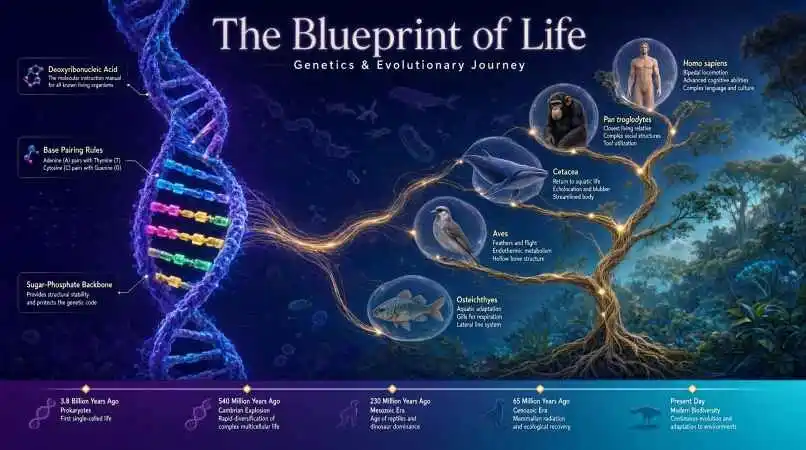
From Darwin’s Finches to Your DNA: How Genetics Powers Evolution
The science of DNA, mutation and natural selection, and the evidence that holds the whole story together
Introduction: The Mystery Hiding in Your Cells
You’ve probably heard “survival of the fittest” tossed around at the gym or in a competitive office. Most people hear it as survival of the strongest or the fastest. Evolution doesn’t work that way. Fitness is about how well an organism fits its environment, and that fit is written directly into its genetic code.
Take your eyes. They are built almost exactly like an octopus’s eyes, yet the two lineages arrived at that design independently. A bat’s wing rests on the same bones as your arm. None of this is coincidence. These are fingerprints, left by a process that has been running for millions of years, and the process runs on genetics: the instruction manual for life itself.
This knowledge isn’t just classroom material. It explains why your doctor asks about family history, why antibiotic-resistant bacteria keep hospitals on edge, why personalized medicine is becoming real, how conservationists pull species back from extinction, and how we can trace human migration through DNA.
Section 1: The Foundations of Genetics (and Why It Matters)
Start with the thing most people get wrong: genetics is not destiny. Your genes carry information that influences everything from your height to your disease risk, but they behave more like a recipe than a rigid blueprint. How that recipe gets expressed depends on your environment, your choices and, sometimes, plain luck.
Understanding DNA: The Instruction Manual of Life
At the molecular level, DNA (deoxyribonucleic acid) is a polymer built from four nucleotide bases: adenine (A), thymine (T), guanine (G) and cytosine (C). They pair in a fixed way, A with T and G with C, producing the famous double helix described by Watson, Crick, Franklin and Wilkins.
Picture a book written in a four-letter alphabet. The order of the letters determines how an organism develops and functions. Change a few and you might get a different eye color. Change more and you might get a disease. Rearrange whole chapters, and over enough time you are looking at the origin of a new species.
This is what makes DNA central to evolution: the book gets copied and handed down through generations. Now and then, through mutation, recombination or environmental pressure, the letters change. Most changes are neutral or harmful. Occasionally one gives an organism an edge in its surroundings, and that is where evolution steps in.
Genes, Alleles, and Variation
A gene is a specific stretch of DNA that codes for a particular protein or trait. Most humans carry two copies of each gene, one from each parent, and the two copies can differ slightly. Those different versions are called alleles.
Eye color makes a handy (if simplified) example. You might inherit an allele for brown eyes from one parent and an allele for blue eyes from the other. The brown allele is usually dominant, so you have brown eyes, but you still carry the blue allele. Pass it on, and blue eyes can turn up in the next generation even when both you and your partner have brown eyes.
That diversity in alleles is the raw material of evolution. Without it, natural selection has nothing to work with.
The Central Dogma: From DNA to Proteins
To see how genes do their job, you need the central dogma of molecular biology: DNA to RNA to protein. In simple terms:
- DNA holds the master blueprint.
- Transcription copies that blueprint into a temporary molecule called messenger RNA (mRNA).
- Translation reads the mRNA and assembles amino acids into proteins.
- Those proteins do almost all the work in your body: they build structures, regulate chemical reactions and carry out the instructions your genes encode.
If DNA is the library, mRNA is the photocopy you carry to the protein factory, and proteins are the workers who actually build the building.
The detail that matters for evolution is that this process is not perfectly accurate. Mistakes happen. Mutations occur during DNA replication, and while most are repaired by the cell’s proofreading machinery, some slip through. Those slips are the variations that, over generations, produce the diversity of life.
Section 2: The Mechanisms of Evolution
Here is where genetics and evolution collide. Evolution has no intention. It isn’t trying to build better organisms. It is the unavoidable result of three simple facts:
- Organisms produce more offspring than can possibly survive.
- There is variation among those offspring.
- The ones best suited to their environment are more likely to survive and reproduce.
Repeat that for thousands or millions of generations and you get the extraordinary diversity of life on Earth.
Natural Selection: The Engine of Evolution
Natural selection is evolution’s primary mechanism. Imagine a population of beetles in a forest, some brown and some green. Birds hunt them, and the green ones are easier to spot against brown bark, so more green beetles get eaten before they can breed.
Over time the population shifts toward brown. The beetles aren’t trying to adapt. The brown ones simply live longer, leave more offspring, and the effect compounds in every generation. The important point is that the environment does the selecting. The forest doesn’t care about producing better beetles. It just creates conditions in which brown beetles have a better chance of reproducing.
The same logic applies everywhere. In hospitals, antibiotics create an environment where resistant bacteria have the advantage. They survive and multiply while susceptible strains die out, and within years a miracle drug can become nearly useless. The bacteria did not decide to resist anything. That is evolution happening in real time, within our own lifetimes.
Genetic Variation: The Fuel for Evolution
Without variation there is nothing for selection to act on, and that variation comes from mutations: changes in DNA that arise spontaneously during replication. Most are harmful or neutral. A mutation that produces a malformed protein usually makes things worse. But some are beneficial. One might make an enzyme more efficient, let an organism digest a new food, or increase resistance to disease.
The probabilistic reality is that in a large population, beneficial mutations will occur. Some will spread and others will vanish. Across different environments, different mutations become advantageous, and this is how populations adapt.
Other Drivers of Evolution
Natural selection is the main driver, but it isn’t the only one.
Genetic drift happens in small populations, where random chance can make some alleles more common regardless of whether they help. Flip a coin ten times and you can easily get a lopsided result. Flip it a thousand times and the numbers even out. Small populations face the same randomness with their gene frequencies.
Gene flow occurs when organisms move and breed with a new population, introducing fresh alleles into its gene pool. When humans migrated across continents, they carried their genes along and changed the genetic makeup of the populations they met.
Sexual selection favors traits because they attract mates, not because they help survival. The peacock’s tail is the classic case. It is a burden in daily life, but peahens prefer it, so males with bigger tails father more offspring.
Section 3: Evidence for Evolution, the Case Built on Genetics
Evolution isn’t just an idea. It is among the most thoroughly documented processes in science, and modern genetics supplies some of the strongest evidence of all.
The Genetic Evidence: We’re All Related
The real turning point came in the 1960s, when scientists realized they could compare molecules directly between species, and later DNA itself. The implications were striking. Humans share about 98.8% of our DNA with chimpanzees, roughly 85% with mice, and about 60% with fruit flies. We even share about 50% with bananas, mostly genes for basic cellular housekeeping.
That is more than resemblance. It is evidence of common ancestry. Line up human and chimpanzee DNA and you can see exactly where the sequences diverged, which genes stayed nearly unchanged for millions of years, and which changed quickly.
Molecular clocks let scientists date when species split by measuring the rate of genetic change. If two species have accumulated twice as many differences as another pair, they diverged about twice as long ago. It is a little like counting tree rings, except you are counting mutations in DNA.
Fossil Records Meet Genetics
For over a century, paleontologists built evolutionary trees from fossils, comparing bones, dating rock layers and inferring relationships. When genetics arrived, it confirmed a remarkable amount of that work. Where skeptics once demanded the “missing link,” genetics showed something more precise: the actual order of branching events that led from one group of organisms to another.
Whales are a good example. Fossils show they evolved from land mammals, and their bodies and genomes still say so. Whales carry tiny, useless pelvic bones buried in their flesh, and their DNA contains the broken remains of genes their land-living ancestors used, including many related to the sense of smell.
Observed Evolution in Real Time
The most immediate evidence is evolution we can watch happening.
Peppered moths during the Industrial Revolution changed color within decades as soot darkened tree bark, then shifted back as pollution fell. Genetics explains the speed. The variation already existed in the population, and natural selection simply changed which alleles were common.
Darwin’s finches in the Galápagos Islands are still evolving in plain view. During drought years, birds with larger, stronger beaks survive better and leave more offspring. In wet years, when seeds are plentiful, smaller beaks do fine. Genetic analysis shows these swings translating directly into changes in gene frequencies from one generation to the next.
Antibiotic resistance is evolution on a human timeline. Bacteria carrying resistance genes survive the drug and pass those genes on. Hospitals have watched susceptible populations collapse within months as resistant strains took over, and genetic sequencing has pinpointed the exact genes responsible.
Comparative Anatomy: The Blueprint Reveals Itself
This one needs no microscope. Your arm, a bat’s wing, a whale’s flipper and a dog’s paw all share the same bone structure. The proportions differ, but the bones and their arrangement are the same.
That isn’t because it is the only way to build a limb. An engineer designing limbs from scratch would make different choices, and a flipper has no need to copy a paw. Evolution never starts from scratch. It works with what already exists. Diverse animals sharing one blueprint is powerful evidence that they inherited it from a common ancestor and then modified it for their own needs. Genetics supplies the reason: they inherited the genes that specify the blueprint.
Section 4: How Genetics Drives Evolutionary Change
Understanding evolution means understanding the specific genetic mechanisms that let populations change over time. There are three big ones.
Mutation: Variation’s Original Source
Every time DNA is copied there is a chance of error. Most cells have proofreading systems that catch mistakes, but not all, and some errors escape. They come in several forms:
- Point mutations change a single nucleotide. They are usually harmless, sometimes beneficial and occasionally devastating.
- Insertions and deletions add or remove chunks of DNA, and often have bigger effects than point mutations.
- Chromosomal rearrangements can flip, duplicate or delete entire sections of chromosomes.
The key idea: mutations are random with respect to fitness. They don’t happen because an organism needs them. They happen by chance, and natural selection then filters them. A mutation that makes a bacterium resistant to an antibiotic didn’t appear because the bacterium met the drug. It was already in the population long before. When the antibiotic arrives, a previously neutral mutation suddenly becomes an advantage.
Recombination: Shuffling the Genetic Deck
You carry two copies of each gene, and during sexual reproduction they get shuffled. You might inherit the “height” allele from one parent and the “eye color” allele from the other, creating a combination that never existed before.
Genetic recombination during meiosis, the process that creates sex cells, generates enormous variation without needing a single new mutation. It is why siblings can look so different despite having the same parents. You aren’t just inheriting your parents’ genes. You are inheriting a particular combination of them. For evolution this matters a great deal, because a beneficial combination of alleles can be assembled by recombination and then spread through a population if it pays off.
Gene Expression: The Same DNA, Different Results
One discovery changed how we think about genetics: the same DNA sequence can produce different results depending on how it is expressed.
Epigenetics studies how chemical modifications to DNA, without altering the sequence itself, switch genes on or off. A particular diet might activate inflammation-related genes in one person and leave them dormant in another. Environmental stress might silence protective genes. In some cases these regulatory changes can even be passed to offspring, not as changes to the DNA sequence, but as changes to how that DNA is regulated.
For evolution, epigenetics adds another layer. The same mutation can have different effects depending on the epigenetic landscape, so an organism’s response to its environment has a genetic component that natural selection can act on.
Section 5: Practice Questions with Worked Answers
Working through problems is the quickest way to make these ideas stick. Here are two classics.
Sample Questions : An Inheritance Pattern Problem
Question: In humans, brown eyes (B) are dominant to blue eyes (b). If both parents are heterozygous (Bb), what percentage of their children will have blue eyes?
Answer: Set up a Punnett square. Each parent can pass on either B or b, so the four equally likely combinations are BB, Bb, Bb and bb. That gives:
- 25% BB (brown eyes)
- 50% Bb (brown eyes, but carrying the blue allele)
- 25% bb (blue eyes)
Therefore, 25% of their children will have blue eyes. This assumes simple Mendelian inheritance, which eye color doesn’t follow perfectly because it is controlled by several genes, but the simplified model shows the principle clearly.
Why it matters: This is how traits pass through families. It explains why blue-eyed children can be born to brown-eyed parents and why traits can skip generations.
Sample Question: Mutations and Evolution
Question: Most mutations are harmful or neutral. If that’s true, how can evolution produce increasingly complex organisms?
Answer: It is a subtle but crucial point, and three arguments answer it.
The probabilistic argument. In a large population, even rare beneficial mutations will occur. If one gives even a 1% reproductive advantage, it will likely spread over time. It doesn’t matter that most mutations are neutral or harmful. The few that help are all evolution needs.
The timescale argument. Evolution has been running for billions of years. Millions of species have existed and quadrillions of organisms have lived and reproduced. At that scale, extremely rare beneficial mutations accumulate.
The complexity argument. Complex adaptations don’t come from single mutations. They come from many small ones, each giving a slight advantage. A protein becomes slightly more efficient, then more stable, then able to do something new. Over thousands or millions of years those tiny improvements add up to remarkable complexity.
A real example: The human eye is often cited as too complex to have evolved. But the fossil record and genetic evidence reveal the sequence: light-sensitive proteins, then clusters of light-sensitive cells, then simple eyes, then increasingly sophisticated ones. Every step helps. Detecting light is better than not detecting it, even if you can’t see detail, and having a lens is better than not having one, even if the image is blurry.
Key Takeaways
| Concept | Definition | Real-World Application |
| DNA | Molecule containing genetic instructions; four nucleotide bases form the code of life | Genetic testing, disease diagnosis, forensics |
| Gene | Segment of DNA coding for a protein or trait | Identifying disease risks, breeding programs |
| Allele | Variant form of a gene; different versions inherited from parents | Eye color inheritance, disease susceptibility |
| Mutation | Change in DNA sequence; source of genetic variation | Cancer development, antibiotic resistance, evolution |
| Natural Selection | Non-random survival and reproduction of organisms based on environmental fit | Antibiotic resistance, evolution of disease resistance |
| Genetic Drift | Random changes in gene frequency in small populations | Loss of genetic diversity in endangered species |
| Gene Flow | Movement of genes between populations | Species adaptation to new regions, biodiversity |
| Adaptive Radiation | Rapid diversification of species from a common ancestor | Darwin’s finches, cichlid fish in lakes |
| Homologous Structures | Similar structures in different species from a common ancestor | Human arm, whale flipper, bat wing: same bone structure |
| Speciation | Evolution of new species through reproductive isolation | Formation of new species over millions of years |
| Epigenetics | Gene regulation without DNA sequence changes; environmental influence | Gene activation, disease prevention, inheritance patterns |
You’re Not Just a Product of Evolution, You’re Evolution in Action
Genetics and evolution are not distant history. They didn’t happen millions of years ago and then stop. Evolution is going on right now: in your microbiome, where gut bacteria constantly evolve; in virus populations, which is why we need new flu vaccines every year; in cancer cells; in crop fields; and in wild populations adjusting to human-altered landscapes.
Your own genes are part of that continuing story. They come from thousands of ancestors stretching back through evolutionary time, and some are nearly identical to genes in bacteria that lived billions of years ago. Others were shaped by your ancestors’ encounters with diseases, foods and environments.
Seeing this changes how you see yourself. You aren’t a static entity. You are part of a dynamic process that has been running for billions of years, and traits like your eye color, your height and your susceptibility to certain diseases are echoes of that history.
Understanding it also gets more practical every year. In Part 2 of this series we follow these ideas into the clinic, the farm, the nature reserve and the climate crisis.
Your Next Steps
If you’re curious about your own genetics, consider a DNA testing service that reveals ancestry and genetic traits. Just remember that DNA is information, not destiny. A genetic predisposition to heart disease doesn’t mean you will develop it. It means you may benefit especially from exercise and careful diet.
If you’re interested in evolution, visit a natural history museum and see the fossil record for yourself. Standing in front of actual transitional fossils, organisms caught in the middle of evolutionary change, brings the abstract idea vividly to life.
Above all, recognize that genetics and evolution are not threats to meaning or purpose. They are explanations of mechanism, and understanding how something works doesn’t diminish its wonder. If anything, it makes the living world more awe-inspiring. The universe produced consciousness. It produced you. That is no less remarkable for our understanding how it happened. It is more remarkable.
FAQs
Q1. If humans evolved from apes, why are there still apes?
Evolution isn’t a straight line. Humans and modern apes didn’t evolve one from the other. We diverged from a common ancestor, humans taking one path and chimpanzees another. It’s like asking whether your cousin evolved from you. You share a grandparent, but neither of you descends from the other.
Q2. What is the difference between a theory and a law in science?
In everyday speech, “theory” means a guess. In science, a theory is an explanation supported by extensive evidence. Newton’s theory of gravity has been tested thousands of times and predicts how objects behave. Evolution is a theory in exactly that sense. Laws, like conservation of energy, describe what happens, while theories explain why it happens.
Q3. Is “survival of the fittest” an accurate summary of evolution?
Only if you define “fittest” correctly. In biology, fitness means reproductive success in a particular environment, not strength or speed. An organism that leaves more surviving offspring is fitter, even if it is smaller, slower or less impressive.
Q4. What’s the difference between evolution and natural selection?
Natural selection is the primary mechanism of evolution, but evolution also happens through genetic drift, gene flow and mutation. Natural selection is the non-random survival and reproduction of organisms based on their traits, which is why it is evolution’s main driver.
Q5. Does evolution have a direction or purpose?
No. Evolution isn’t trying to create “better” organisms or head toward a goal. It is the unavoidable outcome of variation, inheritance and selection. Sometimes it produces what we’d call progress, such as greater complexity, and sometimes it produces simpler organisms. If an environment favors simple life, simple organisms will evolve.
Q6. Can a single organism evolve?
No. Evolution is a population-level phenomenon. An individual is born with its genes and dies with them. Evolution describes how gene frequencies change in populations across generations.
Q7. How many genes do humans have, and how big is the human genome?
Humans have roughly 20,000 protein-coding genes spread across about 3 billion base pairs of DNA in a single set of chromosomes. Genes make up only a small fraction of that total. Much of the rest helps regulate when and where genes switch on.
Q8. What’s the difference between a gene and an allele?
A gene is a stretch of DNA that codes for a particular protein or trait. An allele is one specific version of that gene. You carry two copies of most genes, and the two alleles can be identical or different.
Q9. What does the central dogma of molecular biology actually say?
It describes the usual flow of genetic information: DNA is transcribed into messenger RNA, and the mRNA is translated into protein. There are exceptions, such as retroviruses that copy RNA back into DNA, but the dogma captures the main route from gene to function.
Q10. Can mutations ever be beneficial?
Absolutely, though only a small fraction are, and only in particular environments. Lactose tolerance spread through populations that herded dairy animals. Some variants give protection against malaria at a genetic cost. Mutations that let bacteria use new food sources or resist antibiotics are beneficial for the bacteria, if not for us.
Q11. Are all mutations passed on to children?
No. Only mutations in the germline, meaning the egg and sperm cells, can be inherited. Mutations that arise in other body cells, such as skin or liver cells, are somatic. They may matter for your own health but they stop with you.
Q12. How can random mutations produce such well-adapted organisms?
They aren’t perfectly adapted, only adequately adapted to their environment. And while mutations themselves are random, natural selection is not. Selection filters random variation, keeping what works and discarding what doesn’t. Random variation combined with non-random selection produces adaptation.
Q13. How do new proteins evolve if mutations usually break things?
Through several routes. In gene duplication, an existing gene is copied, and one copy can mutate toward a new function while the other keeps the original job. In domain shuffling, existing functional modules are recombined in new ways. In sub functionalization, duplicated genes split the original duties between them. This is why genomes contain so many similar genes: they are duplicates and variations of ancient ones.
Q14. Why do siblings with the same parents look so different?
Because each egg or sperm cell carries a different shuffled mix of a parent’s genes. Recombination during meiosis and the random sorting of chromosomes mean that two children of the same couple can inherit very different combinations of alleles.
Q15. What happens to harmful recessive alleles? Don’t they get eliminated?
Not necessarily. A harmful recessive allele only causes problems in people with two copies. Someone with one copy has no symptoms but can pass it on. In small populations, carriers may mate and produce affected children. In large populations, a harmful recessive allele can persist at low frequency indefinitely.
Q16. Can you have evolution without natural selection?
Yes, through genetic drift and gene flow. But natural selection is the most powerful driver because it directly links traits to reproductive success. In large populations under consistent conditions, it dominates.
Q17. What is genetic drift and why does it matter more in small populations?
Genetic drift is random change in allele frequencies from one generation to the next. In a large population, chance events average out. In a small one, an allele can rise or vanish purely by luck, which is why drift can quickly erode the diversity of endangered species.
Q18. What is gene flow?
Gene flow is the movement of alleles between populations when individuals migrate and breed. It introduces new variation and tends to make neighboring populations more alike. Human migration across continents is a large-scale example.
Q19. What is sexual selection, and why do traits like the peacock’s tail exist?
Sexual selection favors traits that improve success in attracting mates or competing for them. The peacock’s tail may hurt survival, but peahens prefer it, so the genes behind it are passed on. It is selection by mate choice rather than by predators or climate.
Q20. Does epigenetics mean acquired traits can be inherited?
Not in the old Lamarckian sense. Epigenetic marks change how genes are switched on or off without changing the DNA sequence. In some organisms, certain marks can pass to the next generation, but in humans the evidence is limited and still debated. It doesn’t rewrite the genetic code.
Q21. How do we know evolution happens if it takes millions of years?
We observe it directly in organisms with short generation times, such as bacteria and insects. We see it in the fossil record. And we infer it from genetics, since comparing DNA shows the relationships between species and how long ago they diverged. The convergence of these independent lines of evidence is what makes the case so strong.
Q22. What’s the difference between microevolution and macroevolution?
There is only evolution. “Microevolution” describes small changes within a population, meaning shifts in allele frequency. “Macroevolution” describes larger changes such as speciation and new structures. Macro is simply micro accumulated over time, and no known mechanism allows one but forbids the other.
Q23. What are homologous structures?
They are body parts in different species that share an underlying structure because they were inherited from a common ancestor. The bones of a human arm, a bat wing and a whale flipper are the classic example.
Q24. Why do we still have vestigial structures if evolution is so efficient?
Because evolution doesn’t start from scratch. It modifies what exists. Humans have a tailbone that serves little function, inherited from vertebrate ancestors, and wisdom teeth sized for a larger jaw than we now have. These are evolutionary baggage and evidence of our history.
Q25. Why do we find fossils that look transitional?
Because they are transitional. Archaeopteryx has reptile-like features alongside bird-like ones because it lived during the evolution of birds from dinosaurs. Tiktaalik is a fish with limb-like fins from the transition toward land. They aren’t “missing links.” They are real organisms from real evolutionary transitions.
Q26. If humans and chimps share about 98% of their DNA, why are we so different?
That small difference matters, and it isn’t the whole story. The same genes can produce very different results depending on gene regulation (when and where genes are expressed), gene interactions, epigenetics and developmental timing. A small change in a gene controlling brain development, active at the right moment, can produce enormous differences in the final organism.
Q27. Why do humans share DNA with bananas?
Because all life descends from common ancestors and relies on the same basic cellular machinery. Genes for processes like copying DNA, building proteins and producing energy have been conserved for billions of years. Roughly half of banana genes have recognizable counterparts in humans, mostly in these core functions.
Q28. What is a molecular clock?
It is a method of estimating when two species diverged by counting genetic differences between them and applying a typical rate of change. More differences generally mean a longer time since a common ancestor. Fossils are often used to calibrate the clock.
Q29. What did peppered moths and Darwin’s finches show?
Both are textbook cases of natural selection observed in real time. Peppered moths shifted from light to dark and back as pollution came and went. Finches on the Galápagos changed beak size across drought and wet years, tracked by decades of field research.
Q30. How do we know our interpretation of genetic data is correct?
Through multiple independent lines of evidence. Genetic data is consistent with the fossil record, observed evolution, embryological development and the geographic distribution of species. We also test predictions: if an interpretation is right, specific things should be found, and they are.
⚠️ Disclaimer: This blog post is for educational purposes only and does not substitute professional scientific, academic, or medical advice. Simplifications have been made for clarity. Numerical values are approximate. Students should rely on their curriculum and instructors; professionals should verify against peer-reviewed sources. The author assumes no liability for errors or consequences arising from use of this information.

