

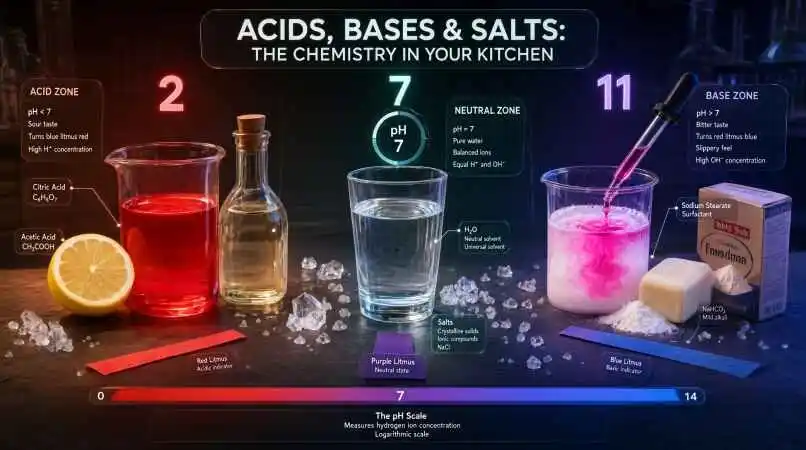
Acids, Bases, and Salts: The Chemistry That’s Sitting in Your Kitchen Cabinet Right Now
You squeezed lemon into your tea this morning. Acid.
You brushed your teeth with that white paste. Base.
You sprinkled salt on your eggs. Salt.
Without knowing it, you ran three chemistry experiments before breakfast — and your body ran thousands more just digesting it all.
Acids, bases, and salts are arguably the most personal topic in all of chemistry. They’re in your stomach (hydrochloric acid, pH 1.5–3.5), your blood (a tightly regulated pH of 7.35–7.45), your soap, your fertilizer, your antacid tablet, your baking soda, and the very soil that grows your food.
Yet ask most people what an acid actually is — beyond “it burns” — and the room goes quiet.
That ends today. This post breaks down acids, bases, and salts the way I wish someone had explained it to me: with real examples, honest explanations, practical applications you’ll actually recognize, and exam-ready questions at the end.
Let’s get into it.
What Are Acids, Bases, and Salts? (The Three Families of Chemistry)
Think of chemistry as a city full of compounds. Almost every inorganic compound you meet belongs to one of three families:
🔹 Acids — the proton donors, the sour-faced troublemakers 🔹 Bases — the proton acceptors, the slippery peacekeepers 🔹 Salts — the offspring produced when acids and bases meet
Acids: The Hydrogen Donors
An acid is a substance that releases hydrogen ions (H⁺) when dissolved in water.
Everyday examples:
- Citric acid — lemons, limes, oranges
- Acetic acid — vinegar (about 5% concentration)
- Lactic acid — sour milk, yogurt, sore muscles after workouts
- Carbonic acid — the fizz in your soda (CO₂ dissolved in water)
- Ascorbic acid — Vitamin C
- Hydrochloric acid — your stomach juice
- Tartaric acid — baking powder, tamarind, grapes
The word itself tells a story. “Acid” comes from the Latin acidus, meaning sour. Ancient chemists quite literally tasted compounds to classify them (please never do this — that’s how people lost lives, not just taste buds).
Common properties of acids:
- Taste sour (in dilute, safe food forms)
- Turn blue litmus paper red
- pH less than 7
- React with metals (above hydrogen in reactivity series) to release hydrogen gas
- React with carbonates and bicarbonates to release CO₂
- Conduct electricity in solution (they’re electrolytes)
- Corrosive in concentrated forms
Bases: The Hydroxide Squad
A base is a substance that releases hydroxide ions (OH⁻) in water — or, more broadly, accepts H⁺ ions.
Soluble bases are called alkalis (like NaOH and KOH). All alkalis are bases, but not all bases dissolve in water (CuO, Fe₂O₃ are insoluble bases).
Everyday examples:
- Sodium hydroxide (NaOH) — drain cleaners, soap making
- Magnesium hydroxide (Mg(OH)₂) — milk of magnesia, the antacid in your medicine cabinet
- Calcium hydroxide (Ca(OH)₂) — lime water, whitewash on walls
- Ammonia (NH₃) — household glass cleaners, fertilizer production
- Sodium bicarbonate (NaHCO₃) — baking soda
- Antacid tablets — calcium carbonate and magnesium hydroxide blends
Common properties of bases:
- Taste bitter
- Feel slippery or soapy (they react with skin oils to form soap-like substances — that slipperiness is literally saponification happening on your fingers)
- Turn red litmus paper blue
- pH greater than 7
- React with acids to form salt and water
- Conduct electricity in solution
- Caustic in concentrated forms (NaOH can dissolve glass slowly at high temperature — and skin much faster)
Salts: The Neutral Offspring
A salt forms when the hydrogen of an acid is replaced by a metal (or ammonium) ion — most commonly through a neutralization reaction:
Acid + Base → Salt + Water
HCl + NaOH → NaCl + H₂O
That’s hydrochloric acid + sodium hydroxide → table salt + water. The most famous chemical “marriage” in history.
But “salt” is a family name, not just table salt. Every salt is an ionic compound formed from a cation (positive ion) and an anion (negative ion):
- NaCl — table salt
- CaSO₄ — gypsum (in plaster and drywall)
- NaHCO₃ — baking soda
- CaCO₃ — limestone, marble, chalk, antacids
- MgSO₄ — Epsom salt
- KNO₃ — saltpeter (fertilizer, food preservation, historically gunpowder)
The Three Theories That Define Acids and Bases (And Why We Need All Three)
Here’s a question students always ask: “Which definition is the right one?”
All of them. Each theory is a wider camera lens on the same landscape.
Arrhenius Theory (1884) — The Water-Based View
Acid: Produces H⁺ ions in water Base: Produces OH⁻ ions in water
HCl → H⁺ + Cl⁻ (acid) NaOH → Na⁺ + OH⁻ (base)
Strengths: Simple, intuitive, perfect for describing everyday aqueous chemistry.
Limitation: It only works in water. It can’t explain why ammonia (NH₃) — which contains no hydroxide — is a base. It also treats H⁺ as if it floats free, when in reality it latches onto water molecules to form H₃O⁺ (hydronium).
Brønsted-Lowry Theory (1923) — The Proton Transfer View
Acid: A proton (H⁺) donor Base: A proton (H⁺) acceptor
HCl + NH₃ → NH₄⁺ + Cl⁻
HCl donates a proton (acid). NH₃ accepts it (base). No water needed. No hydroxide needed. Problem solved.
The beautiful bonus concept — conjugate pairs:
Every acid, after losing its proton, becomes a conjugate base. Every base, after gaining one, becomes a conjugate acid.
- HCl (acid) → Cl⁻ (conjugate base)
- NH₃ (base) → NH₄⁺ (conjugate acid)
Why this matters: Strong acids have weak conjugate bases, and vice versa. This single idea explains buffer systems, antacid action, and why your blood pH barely moves even when you drink a cola.
Lewis Theory (1923) — The Electron Pair View
Acid: An electron-pair acceptor Base: An electron-pair donor
This is the widest lens of all. No protons required at all.
BF₃ + NH₃ → F₃B←NH₃
BF₃ accepts an electron pair (Lewis acid). NH₃ donates it (Lewis base).
Why we need it: It explains acid-base behavior in reactions with no hydrogen whatsoever — metal complex formation, catalyst chemistry, and most of organic reaction mechanisms. When your organic chemistry professor says “the carbonyl carbon is electrophilic,” they’re speaking Lewis acid language.
The takeaway: Arrhenius ⊂ Brønsted-Lowry ⊂ Lewis. Each theory contains the previous one and extends it. Use Arrhenius for kitchen chemistry, Brønsted-Lowry for solutions and titrations, Lewis for mechanisms.
The pH Scale: Chemistry’s Speedometer
The pH scale measures how acidic or basic a solution is — from 0 (brutally acidic) through 7 (neutral) to 14 (brutally basic).
The formula: pH = −log₁₀[H⁺]
What that actually means: Each pH unit is a 10× jump in strength. A solution at pH 3 is ten times more acidic than pH 4 — and one hundred times more acidic than pH 5. This logarithmic behavior is the most misunderstood thing about the scale.
The pH Ladder (Where Real Substances Sit):
| pH | Substance |
| 0 | Battery acid (H₂SO₄) |
| 1–2 | Stomach acid (HCl), gastric juice |
| 2–3 | Lemon juice, vinegar |
| 3–4 | Orange juice, soda, wine |
| 5 | Black coffee, normal rain |
| 5.5–6.5 | Urine, milk |
| 7.0 | Pure water (neutral) |
| 7.35–7.45 | Human blood |
| 8 | Sea water, baking soda solution |
| 9–10 | Soap, baking powder solution |
| 10–11 | Milk of magnesia, ammonia solution |
| 12–13 | Lime water, bleach |
| 14 | Drain cleaner (NaOH) |
Three Facts About pH That Change How You See It:
- Your blood runs the tightest pH security system in biology. Blood pH must stay between 7.35 and 7.45. Drop to 6.8 or climb to 7.8, and you die. Your body maintains this using buffer systems — chiefly the bicarbonate buffer (H₂CO₃/HCO₃⁻) — which absorb excess acid or base like molecular shock absorbers. That “alkaline water” wellness trend? Your body buffers it into irrelevance within minutes.
- Your stomach is a battlefield. Gastric acid (pH 1.5–3.5) is strong enough to dissolve metal razor blades in lab tests. It kills pathogens, activates pepsin for protein digestion — and your stomach survives it because its lining regenerates itself every few days and secretes a protective bicarbonate-rich mucus layer. When that defense fails, you get an ulcer.
- Acid rain is a pH shift you can hear in forests. Normal rain is slightly acidic (pH 5.6) due to dissolved CO₂. Pollution adds sulfur and nitrogen oxides, dropping rain to pH 4 or lower — which sounds trivial until you remember the logarithmic scale. pH 4 is ~40× more acidic than normal rain, enough to dissolve marble statues, acidify lakes, and strip nutrients from soil.
Indicators: The Color Spies of Chemistry
Indicators are weak acids or bases whose molecules change color depending on whether they’ve donated or accepted a proton. They’re how chemists “see” pH without a meter.
- Litmus: Red in acid, blue in base (the classic)
- Methyl orange: Red below pH 3.1, yellow above 4.4
- Phenolphthalein: Colorless below pH 8.2, hot pink above 10 (the titration favorite)
- Universal indicator: A blend that shows the whole rainbow from red (pH 0) to purple (pH 14)
Nature got there first: Red cabbage juice is a working universal indicator. Boil a chopped cabbage, soak the water, and test it — red in vinegar, purple in water, green in baking soda solution, yellow in ammonia. It’s the best kitchen science experiment on Earth.
Neutralization Reactions: Where Acids and Bases Call a Truce
Acid + Base → Salt + Water
This is the single most applied reaction in the chemistry of daily life. Trace the proton: the acid’s H⁺ meets the base’s OH⁻, they form water, and the leftover ions pair up as a salt.
Ionic form: H⁺(aq) + OH⁻(aq) → H₂O(l)
That one microscopic event — a proton finding a hydroxide — is responsible for an astonishing slice of modern civilization:
🔬 Neutralization in Your Body
- Antacids: Mg(OH)₂ and CaCO₃ neutralize excess stomach acid. The fizz of some antacid tablets is a secondary neutralization — carbonate plus acid releasing CO₂ gas.
- Toothpaste: Bacteria in plaque produce acids that erode enamel. Toothpaste bases neutralize them and rebuild enamel with fluoride.
- Insect stings: Bee stings are acidic (formic acid) — treat with a mild base like baking soda. Wasp stings are alkaline — treat with a mild acid like vinegar. (Yes, the old home-remedy folklore is actually redox… sorry, neutralization chemistry, and it is directionally correct.)
🏭 Neutralization in Industry and Environment
- Flue gas scrubbing: Power plants pass exhaust through limestone slurry (CaCO₃), neutralizing sulfuric acid precursors before they ever leave the stack. This single application is why acid rain has retreated in North America and Europe.
- Agriculture: Over-fertilized soils turn acidic; farmers spread lime (CaCO₃ or Ca(OH)₂) to restore pH. Crop yields live and die by this.
- Wastewater treatment: Industrial effluent is neutralized to pH 6–9 before release — dumping pH 2 waste into a river would kill it outright.
- Swimming pools: Pool operators dose sodium carbonate or muriatic acid to hold water near pH 7.2–7.8 — too low corrodes pipes and stings eyes, too high clouds the water and kills chlorine’s disinfecting power.
🧪 Acid-Base Titration: Neutralization as a Measuring Tool
Titration is neutralization weaponized for measurement. You have an unknown acid concentration. You drip in a base of exactly known concentration until the indicator flips. From the volume used, you calculate the unknown — via the golden formula:
N₁V₁ = N₂V₂ (or M₁V₁/a = M₂V₂/b for normality/acidity basics)
Worked example: 25.0 mL of HCl is titrated with 0.10 M NaOH. It takes 20.0 mL of NaOH to reach the phenolphthalein endpoint. Find the HCl molarity.
M(HCl) × 25.0 = 0.10 × 20.0 M(HCl) = 2.0 / 25.0 = 0.08 M
Titration is how pharmaceutical companies verify drug concentrations, how wineries measure acidity, how environmental labs test water — it’s one of the highest-value skills in practical chemistry.
Salts: The Family Tree (More Interesting Than You Think)
All salts are not created equal. Depending on their parent acid-base marriage, they behave very differently in water.
The Four Types of Salts:
- Neutral salts (strong acid + strong base): NaCl, K₂SO₄ → Solution pH ≈ 7. Neither ion reacts with water.
- Acidic salts (strong acid + weak base): NH₄Cl, CuSO₄ → Solution pH < 7. The cation hydrolyzes, releasing H⁺. (This is why ammonium chloride fertilizer acidifies soil over time.)
- Basic salts (weak acid + strong base): Na₂CO₃, CH₃COONa → Solution pH > 7. The anion hydrolyzes, releasing OH⁻. (This is why washing soda feels slippery and cleans grease so well.)
- Double salts and complex salts: Alums (KAl(SO₄)₂·12H₂O, used in water purification) and complexes like potassium ferrocyanide.
The Salt Hydrolysis Quick Rule:
- Strong + Strong → Neutral (pH 7)
- Strong acid + Weak base → Acidic (pH < 7)
- Weak acid + Strong base → Basic (pH > 7)
- Weak + Weak → Depends on Ka vs Kb (the rare wildcard)
Salts in Everyday Life — The A-List:
- NaCl (table salt): Not just flavor — it’s iodized (with KI) to prevent goiter, used in saline IV drips, and preserves food by dehydrating bacteria through osmosis
- NaHCO₃ (baking soda): The leavening in every cake — it decomposes with acid and heat to release CO₂ bubbles that make batter rise. Also your fridge’s odor absorber and a mild antacid
- CaCO₃ (calcium carbonate): The stuff of limestone, marble, chalk, eggshells, and seashells. Antacid, building material, blackboard chalk
- MgSO₄ (Epsom salt): Muscle soaks, laxative, plant nutrient for tomatoes
- Na₂CO₃ (washing soda): Hard water softener, glass manufacturing, heavy-duty grease cutting
- CaSO₄·2H₂O (gypsum): Plaster of Paris, drywall, setting broken bones in orthopedic casts
- KNO₃ (saltpeter): Fertilizer, cured meats, food preservation
- AgBr (silver bromide): The light-sensitive heart of photographic film
- BaSO₄ (barium sulfate): The “barium meal” — drank before X-rays because it’s radio-opaque AND insoluble (so it doesn’t poison you like other barium salts would)
Real-Life Applications Roundup: The Chemistry You’ve Already Used Today
In the kitchen:
- Baking soda + buttermilk (an acid) = fluffy pancakes (CO₂ leavening)
- Marinating meat in yogurt or lemon (acids tenderize proteins)
- Adding vinegar to boiled beets or greens keeps their color vivid (pH shifts pigment molecules)
In medicine:
- ORS (oral rehydration salts) — the WHO formulation credited with saving over 50 million lives from diarrheal dehydration
- Zwitterionic buffering — amino acids acting as both acid and base keep blood chemistry stable
- Aspirin is itself a weak acid (acetylsalicylic acid) — its absorption depends on stomach pH
In your home:
- Soap (sodium salts of fatty acids) — the original base chemistry
- Cement and mortar (calcium carbonate and hydroxide chemistry)
- Silica gel with pH indicator (orange when dry, green when wet — Cobalt chloride-free versions)
In nature:
- Ocean acidification — dissolved CO₂ is lowering seawater pH, which dissolves coral skeletons (CaCO₃ + acid → Ca²⁺ + 2HCO₃⁻). This is neutralization chemistry running in the wrong direction for marine life.
- Limestone caves — rainwater + CO₂ forms carbonic acid, which dissolves limestone over millennia, carving caverns and stalactites
Sample Questions and Answers (Exam-Ready Practice)
Q1: Why does dry HCl gas not turn blue litmus red, but HCl solution does?
Answer: Acids show acidic properties only when they ionize in water. Dry HCl gas contains molecular HCl with no free H⁺ ions — nothing to turn litmus red. In water, HCl ionizes: HCl + H₂O → H₃O⁺ + Cl⁻. The hydronium ion is the actual acid species. No water, no ionization, no acidity. (This is also why the Brønsted-Lowry definition defines acids as proton donors to something — there must be a receiver.)
Q2: While diluting concentrated sulfuric acid, why must acid be added to water and never water to acid?
Answer: Dilution of concentrated H₂SO₄ is violently exothermic. When you add acid to water, the relatively large volume of water absorbs and distributes the heat safely. Add water to acid instead, and the small amount of water at the contact zone boils instantly and ejects corrosive acid droplets outward — spattering acid on you. The rule: “Do as you oughta — add acid to water.”
Q3: A solution turns phenolphthalein pink and has a soap-like feel. What is its likely pH, and identify its chemical family.
Answer: Phenolphthalein is pink above pH ~8.2, so the solution is basic — and the slippery feel is characteristic of hydroxide-rich solutions (they saponify skin oils). Family: base/alkali, pH likely between 9 and 12 depending on concentration.
Q4: Write the balanced equation for the reaction of sodium bicarbonate with hydrochloric acid, and name the gas evolved.
Answer: NaHCO₃ + HCl → NaCl + H₂O + CO₂↑
The gas is carbon dioxide — it turns limewater milky (Ca(OH)₂ + CO₂ → CaCO₃ + H₂O), the standard confirmatory test.
Q5: Explain why an aqueous solution of ammonium chloride is acidic while sodium carbonate solution is basic.
Answer: Salt hydrolysis. NH₄Cl comes from a strong acid (HCl) and weak base (NH₃). The NH₄⁺ ion donates protons to water: NH₄⁺ + H₂O ⇌ NH₃ + H₃O⁺ — releasing H₃O⁺, so pH < 7. Na₂CO₃ comes from a weak acid (H₂CO₃) and strong base (NaOH). The CO₃²⁻ ion accepts protons from water: CO₃²⁻ + H₂O ⇌ HCO₃⁻ + OH⁻ — releasing OH⁻, so pH > 7.
Q6: 20 mL of 0.5 M NaOH exactly neutralizes 50 mL of HCl. Find the molarity of the acid.
Answer: Using M₁V₁ = M₂V₂ (both are monoprotic/monobasic): M(HCl) × 50 = 0.5 × 20 M(HCl) = 10 / 50 = 0.2 M
Q7: Plaster of Paris and gypsum — what’s the relationship, and why does Plaster of Paris set?
Answer: Gypsum is CaSO₄·2H₂O. Heating it to ~100°C drives off water of crystallization, giving Plaster of Paris: CaSO₄·½H₂O. When mixed with water again, the reverse reaction occurs — crystals of gypsum interlock as they grow, hardening the mass. That’s why it sets (and why it’s used for fracture casts and wall plaster). It must be stored dry — ambient moisture starts the setting reaction in the bag.
FAQs
Q1: What is the simplest definition of an acid?
An acid is a substance that releases hydrogen ions (H⁺) in water, donates a proton to another species, or accepts an electron pair — depending on which of the three theories (Arrhenius, Brønsted-Lowry, Lewis) you’re using. The practical everyday version: acids turn blue litmus red and have pH below 7.
Q2: What is the difference between a base and an alkali?
All alkalis are bases, but not all bases are alkalis. An alkali is a base that dissolves in water to release OH⁻ ions (NaOH, KOH, NH₃). Insoluble bases like copper oxide or metal carbonates are bases but not alkalis.
Q3: Why is the pH scale logarithmic and what does that mean in practice?
pH = −log₁₀[H⁺], so each whole number change is a 10× change in hydrogen ion concentration. Practically: pH 2 lemon juice isn’t “a bit more acidic” than pH 4 orange juice — it’s 100× more acidic. This is why small pH shifts in blood or oceans are catastrophic.
Q4: Is water an acid or a base?
Both — water is amphiprotic. It can donate a proton (forming OH⁻) or accept one (forming H₃O⁺). In pure water, tiny self-ionization occurs: 2H₂O ⇌ H₃O⁺ + OH⁻, with equal concentrations, making it neutral at pH 7 (at 25°C).
Q5: Why do acids conduct electricity but pure water barely does?
Conduction requires mobile charged particles. Acids ionize in water, producing mobile H₃O⁺ and anions. Pure water self-ionizes only minimally (about 1 in 10 million molecules), so it carries almost no current. Add salt to water and it conducts well for the same reason — mobile ions.
Q6: What makes an acid “strong” vs “concentrated”?
Strength and concentration are independent. A strong acid (HCl, H₂SO₄, HNO₃) fully ionizes in water. A concentrated acid has a lot of acid per liter of solution. You can have a dilute strong acid (0.001 M HCl) or a concentrated weak acid (17 M acetic acid in glacial form). Strength = degree of ionization; concentration = amount per volume.
Q7: Why does lemon juice not damage skin the way HCl does, when both are acids?
Lemon juice contains citric acid — a weak acid that only partially ionizes (~8%), so free H⁺ concentration is low. Hydrochloric acid fully ionizes — a small volume packs an enormous H⁺ punch. Additionally, concentrated strong acids dehydrate and hydrolyze tissue proteins aggressively. It’s the H⁺ concentration and ionization behavior that burns, not the “acid” label.
Q8: What exactly happens during neutralization at the ionic level?
The acid’s H⁺ (as H₃O⁺) and the base’s OH⁻ combine to form covalent water molecules: H₃O⁺ + OH⁻ → 2H₂O. The spectator ions (e.g., Na⁺ and Cl⁻) remain dissolved and become the salt on evaporation. Neutralization is fundamentally the formation of water from its ions — which is why it’s always exothermic (~57 kJ/mol).
Q9: Why is baking soda used in baking instead of washing soda, when both are sodium salts?
Baking soda (NaHCO₃) decomposes gently at oven temperatures releasing just enough CO₂ to leaven — and its mild alkalinity is neutralized by dough acids. Washing soda (Na₂CO₃) is far more alkaline (pH ~11.6), tastes caustic, and would ruin food texture and taste. Right salt, right job.
Q10: How do antacid tablets work so fast?
They deliver hydroxide or carbonate bases directly into stomach acid: Mg(OH)₂ + 2HCl → MgCl₂ + 2H₂O, or CaCO₃ + 2HCl → CaCl₂ + H₂O + CO₂. The neutralization is immediate on contact — which is also why carbonates fizz (CO₂ release) and why some antacids cause belching.
Q11: What is the pH of human blood and why is it so tightly regulated?
7.35–7.45, maintained by the bicarbonate buffer system, phosphate buffer, and protein buffers. Enzymes — which catalyze every biochemical reaction — are exquisitely pH-sensitive; even 0.2 pH deviation causes acidosis or alkalosis with serious symptoms. Your body would rather alter your breathing rate (to expel CO₂, an acid precursor) than let blood pH drift.
Q12: Why does milk turn sour, chemically speaking?
Lactose-fermenting bacteria (Lactobacillus) convert lactose to lactic acid. As acid accumulates, pH drops toward 4.6 — the isoelectric point of casein protein — at which casein micelles lose charge, clump, and curdle. Same principle makes yogurt: controlled souring, controlled curdling.
Q13: What is the difference between litmus and phenolphthalein as indicators?
Litmus gives a broad, two-color response (red acid / blue base) around pH 4.5–8.3 — good for yes/no classification. Phenolphthalein is colorless below pH 8.2 and vivid pink above 10 — a sharp, high-contrast switch used to detect exact endpoints in titrations of weak acids with strong bases. Different indicators “switch” at different pH ranges — you match the indicator to the titration.
Q14: Why is ocean acidification a problem if the ocean is still basic (pH ~8.1)?
Because the direction matters. Seawater has shifted from ~8.2 to ~8.1 — a ~30% increase in H⁺ concentration since industrialization. That shift reduces carbonate ion availability, which corals, shellfish, and plankton need to build CaCO₃ skeletons. They don’t need the ocean to be acidic to suffer — just less basic.
Q15: Can a salt be acidic?
Yes. Salts of strong acids and weak bases (NH₄Cl, FeCl₃, CuSO₄) hydrolyze to release H₃O⁺, giving pH < 7. “Salt” describes the ionic structure, not guaranteed neutrality.
Q16: Why do we add gypsum to cement or soil?
In cement, gypsum (CaSO₄·2H₂O) retards the too-fast setting caused by C₃A (tricalcium aluminate), giving workers time to place concrete. In agriculture, gypsum improves soil structure, supplies calcium and sulfur without changing pH, and remediates sodic (high-sodium) soils by displacing Na⁺ with Ca²⁺.
Q17: What is the reaction between an acid and a metal carbonate, and why is it important?
Acid + carbonate → salt + water + CO₂. Example: CaCO₃ + 2HCl → CaCl₂ + H₂O + CO₂. Importance: it’s the basis of antacid fizz, geological weathering (caves, sinkholes), the limewater test for CO₂, and the destruction of marble monuments by acid rain.
Q18: Why does a strong acid have a weak conjugate base?
A species that holds and donates protons very readily (strong acid) is, once it loses that proton, energetically unwilling to take it back. HCl dumps its proton completely — so Cl⁻ has essentially zero tendency to accept one. Inverse relationship: Ka × Kb = Kw for conjugate pairs.
Q19: What are buffer solutions and why do they matter?
Buffers are mixtures of a weak acid + its conjugate base (or weak base + conjugate acid) that resist pH change when small amounts of acid or base are added. They matter because biology is pH-fragile: blood bicarbonate buffer, cellular phosphate buffer, and even your shampoo’s citrate buffer all keep environments stable where enzymes and proteins can function.
Q20: Why is toothpaste basic and what happens if your mouth stays acidic?
Toothpaste contains mild bases (and fluoride) to neutralize plaque acids and push remineralization of enamel (hydroxyapatite). In persistent acidity, enamel demineralizes — calcium and phosphate leach out — leading to cavities. That’s why dentists warn about sipping sugary/acidic drinks all day: you’re holding your mouth at enamel-dissolving pH for hours.
Q21: What is the chemical difference between baking powder and baking soda?
Baking soda is single-ingredient NaHCO₃ — needs an external acid (buttermilk, yogurt, lemon) to release CO₂. Baking powder is self-contained: NaHCO₃ + a dry acid (cream of tartar or sodium aluminum sulfate) + starch (moisture barrier). Add liquid, the internal acid-base reaction fires. Double-acting powders react once on mixing and again on oven heat.
Q22: Why is plaster of Paris stored in airtight containers?
Plaster of Paris (CaSO₄·½H₂O) absorbs atmospheric moisture and sets into hard gypsum inside the bag — making it unusable. Airtight storage blocks the premature hydration reaction.
Q23: How does the caustic feel of a strong base differ from a strong acid burn?
Strong bases (NaOH) saponify lipids and liquefy tissue — damage penetrates deeper and keeps worsening (liquefactive necrosis), often less painful initially because nerves are numbed. Strong acids coagulate proteins, forming a scar that can self-limit the burn. Both are emergencies; base burns are notoriously deceptive because they look mild while spreading.
Q24: What is the role of pH in swimming pool maintenance?
Ideal: 7.2–7.8. Too acidic → corrodes pipes, etches plaster, stings eyes, chlorine burns off fast. Too basic → cloudy water, scale formation, chlorine becomes sluggish (HOCl ⇌ OCl⁻ balance shifts to the weaker disinfectant). Operators dose sodium carbonate (up) or muriatic acid (down) to hold the window.
Q25: Why does vinegar clean hard water stains?
Hard water deposits CaCO₃ and MgCO₃ scale. Acetic acid reacts: CaCO₃ + 2CH₃COOH → Ca(CH₃COO)₂ + H₂O + CO₂. The calcium acetate product is water-soluble — the scale dissolves. Same chemistry dissolves kettle limescale with citric acid.
Q26: What is the difference between organic and mineral acids?
Mineral (inorganic) acids — HCl, H₂SO₄, HNO₃ — derive from minerals, are generally strong and highly water-soluble. Organic acids — citric, acetic, lactic, formic, tartaric — contain carbon skeletons, are generally weak (partial ionization), and are common in food and metabolism. Strength doesn’t map to the label: formic acid (organic) is still strong enough to sting; sulfuric acid (mineral) is a heavyweight.
Q27: How do you test whether an unknown solution is an acid or a base at home (safely)?
Red cabbage juice indicator: boil chopped red cabbage, use the purple water. Acidic solutions turn it red/pink; neutral stays purple; basic turns green/yellow. Turmeric is another kitchen indicator — it stays yellow in acid and turns red-brown in base. Both are safe, cheap, and genuinely scientific.
Q28: Why is NaCl neutral while Na₂CO₃ is basic, when both are sodium salts?
Neutrality depends on the anion’s parent acid. Cl⁻ comes from HCl — a strong acid — so Cl⁻ is too weak a base to pull H⁺ from water. CO₃²⁻ comes from H₂CO₃ — a weak acid — so CO₃²⁻ is strong enough to grab H⁺ from water, releasing OH⁻. The sodium ion is a spectator either way; the anion calls the pH.
Q29: What happens when you mix an acid and a base in the wrong proportions?
You don’t get full neutralization — you get a buffer-like mixture or leftover excess. Excess acid → final solution is acidic with the salt dissolved in it. Excess base → basic solution. Only at the exact stoichiometric point (equivalence point) do you get the theoretically “clean” salt-and-water result. That’s exactly what titration locates.
Q30: Are all salts soluble in water?
No. Useful solubility shortcuts: all nitrates dissolve; all sodium/potassium/ammonium salts dissolve; most chlorides dissolve (exceptions: AgCl, PbCl₂); most sulfates dissolve (exceptions: BaSO₄, PbSO₄, CaSO₄ partially); most carbonates, phosphates, and sulfides do NOT dissolve (except with Group 1 or ammonium). These rules underpin qualitative analysis — the classic “identify the salt” lab work.
You Were Always a Chemist — Now You Have the Vocabulary
Here’s the thing about acids, bases, and salts: you were fluent in their chemistry long before you learned their names.
Every time you calmed a spicy mouth with milk instead of water (capsaicin is fat-soluble, and milk’s neutral pH helps), you were doing chemistry. Every time you squeezed lemon on fish to tame the smell (amines are basic; acids neutralize them into odorless salts), you were doing chemistry. Every antacid, every soap, every cake that rose in your oven — neutralization reactions, all of them.
What changed today isn’t your capability. It’s your awareness. You can now look at a fizzing antacid, a souring glass of milk, a chalk-white limestone cliff, or a swimming pool test strip — and see the acid-base chemistry humming underneath.
Your next step: Do the red cabbage experiment this week. Seriously — it takes 15 minutes, costs nothing, and it will permanently wire the pH rainbow into your memory better than any textbook diagram. Boil the cabbage, pour the indicator into five glasses, and test vinegar, water, baking soda solution, soap, and lemon juice side by side.
Chemistry isn’t confined to a lab. It’s the operating system of your kitchen, your body, and the ground you walk on. Now you can read it.
If this post finally made acids, bases, and salts click for you, share it with a student, a parent, or a friend who still thinks chemistry is only for people in lab coats. Knowledge compounds — pass it on.
⚠️ Disclaimer: This blog post is for educational purposes only and does not substitute professional scientific, academic, or medical advice. Simplifications have been made for clarity. Numerical values are approximate. Students should rely on their curriculum and instructors; professionals should verify against peer-reviewed sources. The author assumes no liability for errors or consequences arising from use of this information.

