

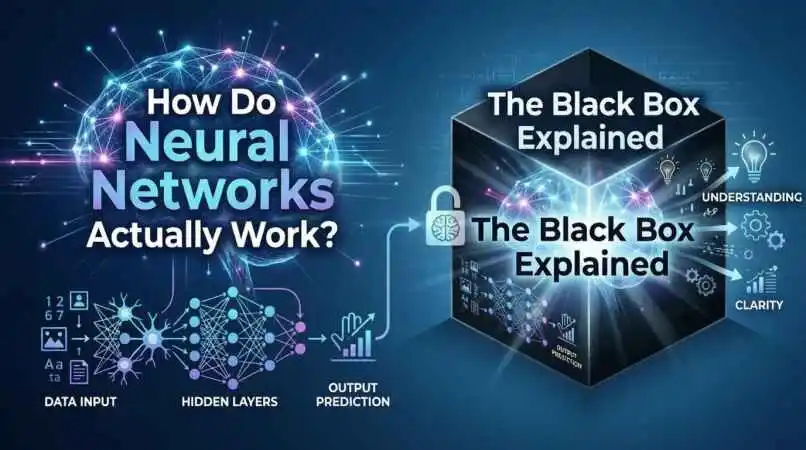
Demystifying the Black Box: A Human’s Guide to How Neural Networks Actually Work
You unlock your phone with your face. You ask Alexa to turn off the lights. You scroll through a feed of posts that feels like it was curated by someone reading your mind.
Behind all of these everyday miracles is a single, heavily hyped technology: the neural network.
If you read the tech blogs, you’d think neural networks are some kind of digital sorcery. They are painted as mysterious “black boxes” that even their creators don’t fully understand. The jargon doesn’t help. Backpropagation. Gradient descent. Activation functions. It sounds less like computer science and more like a foreign language designed to keep outsiders out.
But here is the secret the data science community doesn’t always advertise: neural networks are not magic. They are just highly structured math, and the core intuition behind them is surprisingly human.
You do not need a PhD in calculus to understand how a machine learning neural network actually learns, thinks, and makes decisions. You just need the right analogies.
Let’s strip away the dense notation and the hype. We’re going to build a mental model of how these systems work, from a single artificial neuron up to a massive, image-recognizing powerhouse. By the end, you won’t just know the buzzwords; you’ll understand the machinery.
The Intuition: Thinking in Teams, Not Equations
To understand why we even use neural networks, we have to understand the limits of traditional programming.
The If/Else Trap
For decades, we programmed computers using explicit rules. If you want a program to sort emails, you write: If the subject contains “Viagra,” move to Spam. If the sender is unknown, move to Spam.
This works fine for logic puzzles. It fails completely for pattern recognition. Think about recognizing your mother’s face. Try writing an if/else rule for that. If the nose is 2cm long, AND the eyes are brown, AND the hair is gray… But what if she’s wearing sunglasses? What if the photo is from the side? What if she aged ten years?
You can’t code human perception with rules because the variations are infinite. Artificial intelligence fundamentals shift the paradigm: instead of giving the computer the rules, we give it the answers and let it figure out the rules.
The Committee Analogy
A biological neuron is simple. It receives signals, adds them up, and if the total is strong enough, it fires its own signal. An artificial neuron in a neural network architecture does the exact same thing, just with numbers instead of chemicals.
Imagine you are trying to decide if an image is a “cat” or “not a cat.” You don’t make the decision yourself. You assemble a massive committee of thousands of tiny, simple workers (neurons).
- Worker 1 only looks at the top-left 3×3 pixels. He votes “cat.”
- Worker 2 only looks at the curve of the ears. She votes “not a cat” (they look pointy, like a fox).
- Worker 3 looks at the texture of the fur. He votes “cat.”
These workers pass their votes up to a middle management layer, which combines the votes and looks for higher-level patterns (ears + fur + whiskers). Middle management then passes a summary to the CEO (the output neuron), who makes the final call: “It’s a cat.”
A single worker is useless. But millions of simple workers, organized in layers, create a system capable of staggering intelligence. This is the deep learning models approach.
The Architecture: Bricks, Mortar, and Activation
Let’s look at the blueprint of a neural network. The structure is always the same: an input layer, one or more hidden layers, and an output layer.
The Flow of Data
- Input Layer: This is where the raw data enters. If you are analyzing a 28×28 pixel image of a handwritten digit, the input layer has 784 neurons—one for each pixel’s brightness.
- Hidden Layers: This is where the magic happens. The data passes through one or more intermediate layers of neurons. A network with many hidden layers is “deep,” which is where “deep learning” comes from.
- Output Layer: The final layer delivers the verdict. If we are classifying digits (0-9), the output layer has 10 neurons. The neuron with the highest activation “wins” and dictates the prediction.
Weights and Biases: The Volume Knobs
Not all inputs are created equal. When a signal travels from one neuron to the next, it is multiplied by a weight.
Think of a weight as a volume knob controlling how much attention the next neuron pays to the current one. If the weight connecting “ear shape” to “cat prediction” is high, the network cares a lot about ear shape. If it’s low, it ignores it.
A bias is a baseline tendency. It’s like a neuron saying, “I’m going to lean toward firing even if I don’t get strong inputs.” Weights and biases are the actual “knowledge” of the network. When a network “learns,” it is simply adjusting millions of these volume knobs and baselines.
The Bouncer: Activation Functions
If neurons just added up signals and passed them along, the network would be one giant, linear math equation. It could never learn the complex, curvy, messy patterns of the real world.
We need to introduce non-linearity. Enter the activation function in neural networks.
An activation function is a bouncer at the door of the neuron. It takes the sum of the inputs, weights, and biases, and decides if the neuron gets to “fire” or not, and by how much.
| Function | How it Works (Simplified) | Best Used For |
| Sigmoid | Squashes any number into a range between 0 and 1. Like a probability. | Binary classifications (Yes/No) |
| Tanh | Squashes numbers between -1 and 1. Zero-centered. | Hidden layers (often better than Sigmoid) |
| ReLU | If the number is negative, make it 0. If positive, leave it alone. | The default. Fast, efficient, works almost everywhere. |
ReLU (Rectified Linear Unit) is the workhorse of modern AI. It’s brutal—if a neuron’s input is negative, ReLU kills it dead. This aggressive pruning is exactly what allows massive networks to train efficiently.
The Different Breeds: CNNs, RNNs, and the Rest
Not all neural networks are built the same way. The neural network architecture changes depending on the type of data you are feeding it.
Convolutional Neural Networks (CNNs)
Data: Images. Problem: If you flatten an image into a long line of pixels and feed it to a standard network, you destroy the spatial relationships. A pixel of a dog’s nose is next to pixels of its snout—that local context matters.
Convolutional neural networks solve this by using “filters.” Imagine a magnifying glass sliding across the image, looking at small 3×3 patches at a time. The network learns to detect edges in the first layer, then shapes (circles, squares) in the next, then complex objects (eyes, wheels) in the next. This sliding window approach preserves spatial geometry and is the reason your phone can recognize your face.
Recurrent Neural Networks (RNNs)
Data: Sequences (Text, Time-series, Speech). Problem: Standard networks have no memory. If you feed them the word “bank,” they don’t remember the word “river” that came three words before. They can’t understand context.
Recurrent neural networks have a loop inside them. The output of a neuron at time-step t is fed back in as an input at time-step t+1. The network literally passes a “sticky note” of context forward to itself. This allows them to understand that “I grew up in France…” makes the next word likely to be a French word.
The Modern King: Transformers
RNNs are slow to train and forget things over long sequences. Transformers (the “T” in ChatGPT) solve this with a mechanism called “Self-Attention.” Instead of reading text sequentially, they look at the entire sentence at once and calculate how much attention every word should pay to every other word. They are parallelizable, incredibly fast, and currently dominate the field of large language models.
The Training Room: How They Actually Learn
An untrained neural network is a blank slate of random weights and biases. It’s useless. The neural network training process is how we turn that blank slate into a functioning intelligence.
Let’s walk through the process using a supervised learning neural network (the most common type, where we have data with the correct answers already labeled).
Step 1: The Forward Pass (The Guess)
We show the network an image of a cat. The data flows through the input layer, through the hidden layers, and out the output layer. The output neuron for “Dog” fires at 0.8, and the neuron for “Cat” fires at 0.2.
The network is 80% confident this is a dog. It is catastrophically wrong.
Step 2: The Loss Function (The Scorecard)
We need to measure how wrong it is. We use a Loss Function (often called a Cost Function). It compares the network’s prediction (0.8 Dog) to the ground truth (1.0 Cat). The difference is the “Loss.” A high loss means the network is terrible; a loss of zero means it’s perfect.
Step 3: The Backpropagation Algorithm (The Blame Game)
This is the crown jewel of neural network math. How do we know which of the millions of weights to adjust, and by how much?
The backpropagation algorithm works backward from the output layer to the input layer, asking: “Who is to blame for this error?”
It looks at the final “Dog” neuron and asks, “You fired too high. Which neurons in the previous layer sent you strong signals? They are partly to blame.” It goes to those neurons and asks the same question, propagating the blame all the way back to the inputs. It calculates the exact gradient—the slope—of the error for every single weight in the network.
Step 4: Gradient Descent Optimization (The Step Down)
Now we know which direction to adjust each weight to reduce the error. But by how much?
Imagine you are standing on a foggy, mountainous terrain, blindfolded, trying to find the lowest valley (the minimum error). You feel the slope of the ground with your feet. If it slopes down to the left, you take a step left.
This is gradient descent optimization. The “Learning Rate” is the size of your step. Too big, and you overshoot the valley and bounce up the other side. Too small, and it takes you a century to reach the bottom.
The Loop: Forward Pass -> Calculate Loss -> Backpropagate Blame -> Adjust Weights via Gradient Descent -> Repeat.
A network training on a million images will run this loop billions of times. Slowly, the weights shift. The volume knobs turn. The network starts recognizing edges, then shapes, then cats. The loss drops. The intelligence emerges.
From Lab to Life: Real-World Implementation
Understanding the theory is one thing; seeing it work is another. Here is where these architectures actually touch your life.
- Medical Imaging: Convolutional neural networks are reading X-rays, MRIs, and retinal scans, often spotting tumors or anomalies faster and more accurately than human radiologists. They do this by being trained on millions of labeled images.
- Language Translation: Transformers and RNNs power Google Translate. They don’t just swap words; they understand the grammatical structure of the source sentence and generate a new sentence in the target language.
- Predictive Maintenance: Machine learning neural network models analyze vibration and temperature data from factory machines to predict when a part will fail before it actually breaks, saving millions in downtime.
- Generative AI: Models like Midjourney and ChatGPT are massive neural networks predicting the next pixel or the next word, respectively. They generate novel outputs by learning the statistical patterns of their training data.
The Hardware Reality
Training a massive neural network requires computing power that would have seemed absurd ten years ago. We use GPUs (Graphics Processing Units) because the matrix multiplications required for forward passes and backpropagation are highly parallelizable. A CPU does math one step at a time; a GPU does thousands of math steps simultaneously. Without GPUs, the modern AI boom simply wouldn’t exist.
FAQS
- What is a neural network in simple terms?
It is a computer system built of layers of simple, interconnected calculators (neurons) that learn to recognize patterns in data by adjusting the strength of their connections, rather than by following hardcoded human rules.
- Why is it called a neural network?
Because the architecture is loosely inspired by the biological brain, where neurons receive signals, process them, and fire outputs to other neurons. However, the similarity is largely metaphorical; biological brains work very differently in practice.
- What is the difference between AI, Machine Learning, and Deep Learning?
AI is the broad concept of machines acting intelligently. Machine Learning is a subset of AI where machines learn from data. Deep Learning (using neural networks) is a subset of Machine Learning using specific multi-layered architectures.
- What is a “Black Box” and are neural networks one?
A black box is a system where you can see the inputs and outputs, but not the internal logic. Neural networks are often called black boxes because with millions of weights, it is nearly impossible for a human to trace exactly why the network made a specific decision, though explainability tools are improving.
- How much data do you need to train a neural network?
It depends on the complexity of the task. Simple tasks might need thousands of examples. State-of-the-art image or language models are trained on billions of data points. Generally, deep learning requires vastly more data than traditional machine learning.
- What happens if a neural network gets the answer wrong during training?
That is the whole point of training. The loss function calculates the error, backpropagation assigns blame, and gradient descent adjusts the weights so it is slightly less wrong next time. Learning is just a process of making fewer mistakes over time.
- Can neural networks learn without labeled data?
Yes. This is called Unsupervised Learning. Instead of being told “this is a cat,” the network is just shown thousands of images and learns to cluster similar images together, discovering patterns like edges and textures on its own.
- What is Overfitting?
Overfitting is when a network memorizes the training data perfectly but fails to generalize to new, unseen data. It’s like a student who memorizes the practice test but fails the real exam because the questions are slightly different.
- How do you prevent Overfitting?
Common techniques include Dropout (randomly turning off neurons during training so the network doesn’t rely too heavily on any single one) and Early Stopping (stopping the training process before it starts memorizing noise).
- What is a Weight in a neural network?
A weight is a number that determines the strength and sign (positive or negative) of the connection between two neurons. It dictates how much influence one neuron has over another.
- What is a Bias in a neural network?
A bias is a constant added to the input of a neuron before the activation function is applied. It shifts the activation threshold, allowing the neuron to fire even if its weighted inputs are zero.
- Why is ReLU the most popular activation function?
Because it is computationally cheap (just setting negatives to zero) and it avoids the “Vanishing Gradient Problem,” where early layers of deep networks stop learning because the gradients become too small to make updates.
- What is the Vanishing Gradient Problem?
In very deep networks using Sigmoid or Tanh activations, the error gradients get multiplied by fractions as they are backpropagated. Over many layers, these fractions shrink to nearly zero, meaning the early layers learn extremely slowly or stop learning entirely.
- What is the difference between a CNN and an RNN?
A CNN uses spatial sliding filters and is designed for grid-like data like images. An RNN uses temporal loops and is designed for sequential data like text or time-series, where past context matters for current predictions.
- Can a neural network write code?
Yes. Large language models (which are neural networks) like GPT-4 can generate functional code by predicting the next token based on the vast amount of code they were trained on.
- How long does it take to train a neural network?
It ranges from minutes on a laptop for simple models, to weeks or months on clusters of hundreds of GPUs for massive foundation models like GPT-4 or Midjourney.
- What is Transfer Learning?
Instead of training a network from scratch, you take a pre-trained model (that has already learned general features like edges and shapes) and fine-tune it on your specific dataset. This saves massive amounts of compute and data.
- Why do we need GPUs for neural networks?
Because the core operation of a neural network—matrix multiplication—is highly parallel. CPUs process tasks sequentially (one at a time), while GPUs process thousands of simple math tasks simultaneously, drastically speeding up training.
- What is a Learning Rate?
It is a hyperparameter that controls how much the weights are adjusted during gradient descent. It’s the “step size” the algorithm takes down the error mountain.
- Can neural networks be used for regression (predicting numbers)?
Yes. If you want to predict house prices, the output layer would have a single neuron with a linear activation function that outputs a continuous number rather than a probability.
- What is a Hyperparameter?
A parameter whose value is set before the training begins, as opposed to parameters (weights and biases) which are learned during training. Examples: Learning rate, number of layers, number of neurons per layer.
- What is Batch Size?
The number of training examples processed in one iteration before updating the weights. Processing the entire dataset at once is often too memory-intensive, so we process it in “batches.”
- What is an Epoch?
One Epoch means the entire training dataset has been passed through the neural network exactly once. Training usually requires hundreds or thousands of epochs.
- Are neural networks deterministic?
No, they are inherently stochastic. The random initialization of weights, the shuffling of data, and the use of algorithms like Dropout mean that if you train the exact same network twice, you will likely get slightly different results.
- What is a Loss Function?
A mathematical function that measures the difference between the network’s prediction and the actual true value (ground truth). The goal of training is to minimize this loss.
- Can neural networks understand causality?
Currently, no. Neural networks are masters of correlation (finding patterns in data), but they struggle with causation (understanding that A caused B). This is a major limitation in scientific discovery.
- What is the difference between a shallow and a deep network?
A shallow network has only one hidden layer. A deep network has two or more. Deep networks can learn hierarchical representations (edges -> shapes -> objects), making them far more powerful for complex data.
- Do neural networks ever stop learning?
Yes, when the loss function stops decreasing (convergence), or when the programmer halts the training loop, usually to prevent overfitting.
- Can I build a neural network without knowing math?
Yes, using high-level libraries like TensorFlow, Keras, or PyTorch. They abstract the calculus away. However, understanding the math (gradient descent, backprop) is essential for debugging and optimizing models when they don’t work as expected.
- Will neural networks replace human programmers?
Not entirely. While they can write boilerplate code, the architecture, data pipelines, and debugging of the models themselves require human logic, domain expertise, and systems thinking that current networks lack.
Neural networks are not a monolithic deity of artificial intelligence. They are simply a clever way of organizing simple mathematical operations—multiplications, additions, and threshold checks—into a structure that can iteratively reduce its own errors.
The next time you hear someone talk about backpropagation or deep learning as if it’s mystical, remember the analogies. It’s just a committee voting. It’s just a bouncer at a door. It’s just walking down a foggy hill to find the bottom of a valley. The scale is massive, the math is complex, but the fundamental logic is something anyone can grasp.
If you want to stop watching the AI revolution from the sidelines and start participating, pick up a framework like PyTorch, build a simple 3-layer network to classify handwritten digits (the MNIST dataset), and watch it train. Seeing that loss curve drop for the first time—watching a blank slate learn to see—is an experience you won’t forget.
What’s the biggest misconception you had about neural networks before reading this? Drop a comment below—I read every single one.
Disclaimer: The content on this blog is for informational purposes only. The author’s opinions are personal and not endorsed. Efforts are made to provide accurate information, but completeness, accuracy, or reliability are not guaranteed. The author is not liable for any loss or damage resulting from the use of this blog. It is recommended to use the information on this blog at your own discretion.

