

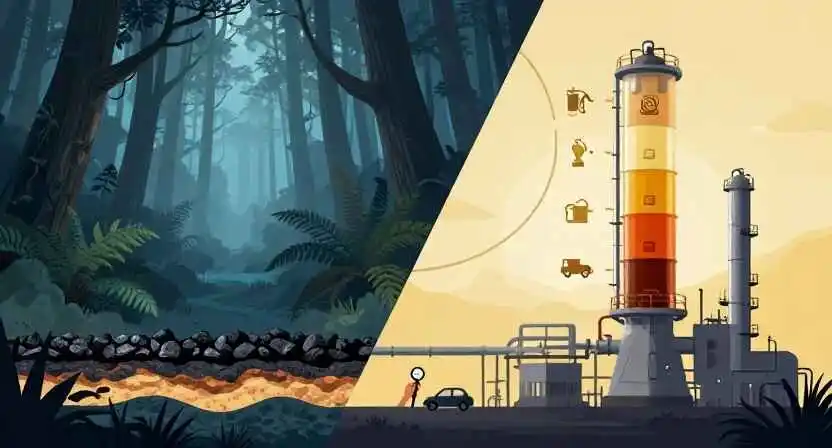
Your Petrol Used to Be Sea Life: The Real Story of Coal and Petroleum, and How to Waste Less of It
You pull up to the petrol pump, watch the digits spin, and wince. The nozzle clicks off. A few minutes later your nephew, who is in Class 8 and has a science test on Monday, asks the question that stops the whole car: “Where does petrol actually come from?”
You say, “From oil wells.” He says, “Yes, but before that.” And you start muttering something about dinosaurs. That’s the answer most of us were handed growing up, and it’s mostly wrong. We’ll fix it shortly.
Here’s the thing. Coal and petroleum are the reason your lights come on, the reason the gas cylinder shows up at your door, the reason the road outside is black and smooth, and the reason your toothbrush bristles exist. Yet the picture most of us carry from school is fuzzy: something about old plants, something about a tall tower, something about saving fuel.
This guide rebuilds that picture properly. We’ll start with natural resources and sort out what runs out and what doesn’t. Then coal, and how a swamp turned into a power plant. Then petroleum, and the genuinely elegant trick called fractional distillation that turns one dark, smelly liquid into a dozen useful products. Finally we’ll look at PCRA, the Petroleum Conservation Research Association, and the very practical habits it has been pushing since 1978.
Whether you’re a student, a parent helping with homework, or simply someone who’d like to understand the thing you keep paying for, you should leave with clear answers, a few numbers worth remembering, and some habits that will lower your fuel bill.
Natural Resources: Sorting the Planet’s Pantry
Anything nature provides that people use counts as a natural resource. Air, water, soil, sunlight, forests, minerals, wildlife, coal, petroleum. The list is endless, and the useful way to sort it isn’t by what each thing is. It’s by how fast it comes back.
Two buckets, and a messy middle
| Type | What it means | Examples |
| Inexhaustible | Not used up by human activity at any realistic scale; the supply is effectively endless | Sunlight, air, wind, flowing water (the water cycle refills it) |
| Exhaustible | A limited stock that we use far faster than nature replaces it | Coal, petroleum, natural gas, metal ores and other minerals |
| In between | Renewable, but only if we use them slower than they regrow | Forests, groundwater, fisheries, wildlife |
That third row deserves a second look. A forest is renewable on paper, but cut it faster than it regrows and it behaves like an exhaustible natural resource. Coal and petroleum are in a different league. Nature isn’t regrowing them on any timescale that matters to us. Building a new coal seam takes hundreds of millions of years. We burn through the same stored energy in a couple of centuries.
Why coal and petroleum are called fossil fuels
Both come from the remains of living things that died, got buried, and were slowly transformed by heat and pressure. Plant matter became coal. Microscopic sea organisms became oil and gas. Because they began as once-living material, we call them fossil fuels.
The easiest way to picture it is a savings account. Plants and plankton collected sunlight long ago and locked it into their bodies as chemical energy, and the Earth stored it. We’ve been making withdrawals for roughly two hundred years, and fast, with no deposits coming in.
Three numbers that explain why this matters
- Roughly four-fifths of the world’s primary energy still comes from fossil fuels (coal, oil and gas combined).
- India imports around 85 percent of the crude oil it uses, which makes every litre saved a small piece of national economics.
- Coal produces the majority of India’s electricity, so the switch on your wall is, more often than not, a coal story.
Hold on to those three. They’ll come back when we reach conservation.
Spot the fossil fuels in your ordinary day
Try this at home. Before breakfast, your tea may have been boiled on LPG. The electricity running the fan likely began as burning coal. The bus you take runs on diesel or CNG, the road under it is bitumen, and the plastic bottle in your bag started as naphtha. Even the soles of your shoes and the polyester in your shirt trace back to a refinery. Once you start looking, it’s hard to find a room that has no coal or petroleum in it.
Coal: A Swamp Forest That Spent 300 Million Years Under Pressure
Rewind to the Carboniferous period, roughly 300 million years ago. Warm, wet, swampy forests of giant ferns and towering trees covered huge stretches of the planet. Nobody was around to cut them down. They simply grew, died and fell over.
How coal forms: the slow-cooker story
When those trees toppled into swamp water, there was very little oxygen to help them rot. So the wood didn’t vanish. It piled up as a thick, soggy mat. Floods and shifting land eventually buried that mat under layers of mud, sand and clay.
Then came the pressure and the heat. Deep burial squeezed out water and gases and left behind material richer and richer in carbon. This slow conversion of plant matter into coal is called carbonisation. The longer and deeper the cooking, the higher the carbon content, and the more energy you get per kilogram.
That cooking produces a ladder of stages, and each rung has a name.
| Stage | Approx. carbon | What it’s like | Where it’s used |
| Peat | ~50-60% | Brown, spongy and wet; the youngest stage | Local fuel in some regions; soil improvement |
| Lignite | ~60-70% | Brown, soft and crumbly | Power plants close to the mine (Neyveli in Tamil Nadu is the well-known Indian example) |
| Bituminous | ~70-86% | Black, harder, and the most widely used | Power generation; the coking coal used in steel making |
| Anthracite | ~86-97% | Hard, glossy, burns with very little smoke | Specialised high-heat uses; rare in India |
Those figures are rounded, and different sources draw the lines slightly differently, so treat them as ballpark. What matters for an exam, or a dinner-table argument, is the direction: more carbon, more heat, harder coal.
Where India gets its coal
India sits on some of the world’s largest coal reserves, mostly in the eastern and central belt. The names worth knowing: Jharia in Jharkhand, Raniganj in West Bengal, Korba in Chhattisgarh, Singrauli on the Madhya Pradesh and Uttar Pradesh border, and Talcher in Odisha. Shallow seams are dug from huge open pits (opencast mining). Deeper ones need underground tunnels, which are slower, costlier and more dangerous for the people who work in them.
Destructive distillation: what happens when you heat coal without air
Light a lump of coal in open air and it simply burns, giving you heat, carbon dioxide and ash. Heat it strongly, to around 1,000 °C, inside a closed oven with no air, and something more interesting happens. The coal breaks down into several useful substances. This is the destructive distillation of coal, and “destructive” means exactly that: the coal itself is chemically broken apart.
| Product | What it is | What it’s used for |
| Coke | A tough, porous, black solid that is almost pure carbon | Fuel and reducing agent in steel making and metal extraction; burns without smoke |
| Coal tar | A thick, black, foul-smelling liquid containing about 200 substances | Separated into benzene, toluene, phenol, naphthalene and more, which feed dyes, drugs, explosives, perfumes, plastics, paints and roofing material |
| Coal gas | A mixture mainly of hydrogen, methane and carbon monoxide | Industrial fuel near coal processing plants; once used for street lighting in cities |
Next time you open an old cupboard and catch the sharp smell of mothballs, that’s naphthalene, and it started life in coal tar. Funny how a swamp from 300 million years ago ends up protecting your woollens.
Exam tip: Destructive distillation is for coal. Fractional distillation is for petroleum. Mix them up and you’ll lose marks that were already yours. A side-by-side comparison comes later in this guide.
The honest ledger
Coal powered the Industrial Revolution and still keeps millions of homes lit. It’s also the dirtiest of the fossil fuels. Burning it releases carbon dioxide (the main driver of global warming), sulphur dioxide and nitrogen oxides (which cause acid rain and breathing trouble), and fine particles that settle deep in the lungs. The fly ash left behind isn’t useless, since cement and brick makers use it, but it needs careful handling.
Washing coal, fitting scrubbers to chimneys, building more efficient plants and converting coal to gas all help. None of them make coal clean. They make it cleaner, and that’s a different thing.
There’s also a human side that rarely makes it into textbooks. Coal regions such as Jharia depend on mining for jobs, schools and small businesses, and underground fires have burned there for decades. Any honest conversation about moving away from coal has to include those communities, not just the chimneys. A shift that ignores the people digging the coal tends not to last.
Petroleum: Tiny Sea Life, Heavy Burial and a Lot of Patience
Where crude oil really comes from
The word petroleum comes from Latin: petra for rock and oleum for oil. Rock oil. And about those dinosaurs. It’s the standard answer, and it’s mostly wrong. Petroleum began as microscopic sea plants and animals, mainly plankton, not as giant reptiles.
Here’s the sequence. Millions of years ago, these tiny organisms died and sank to the sea floor, where they mixed with sand and clay. More sediment piled on top. Cut off from oxygen and squeezed under rising temperature and pressure, the organic material slowly turned into crude oil and natural gas. Then it didn’t stay put. The oil and gas seeped upward through porous rock until something stopped them: a layer of impervious rock acting like a lid.
Picture a layered drink under a stone lid. Water sits at the bottom, oil floats above it, and gas collects at the top, simply because that’s the order of their densities. Drillers aim for the top of that stack.
Finding it and getting it out
Geologists map likely structures with seismic surveys (sound waves bounced off underground rock layers), and exploratory wells then confirm what’s really down there. When oil is found, production wells bring it up, onshore or offshore. Pipelines and tankers carry the crude to refineries.
In India the names to remember are Mumbai High (offshore in the Arabian Sea), Assam (home to Digboi, one of the oldest oilfields in Asia), Gujarat, and the Krishna-Godavari basin on the east coast. Together they cover only a fraction of national demand, which is why that 85 percent import figure sits where it does.
A little history puts the scale in perspective. Commercial oil drilling is barely 160-odd years old, with the first well in the United States dating to 1859, and India’s Digboi field started producing before the end of the nineteenth century. In other words, humanity has been running its entire modern economy on a resource it learned to tap only a few generations ago.
Why you can’t just pour crude into a car
Raw crude is a dark, sticky, smelly mixture of hundreds of hydrocarbons, from tiny gas-like molecules to heavy tar-like ones. Pour it into an engine and you’d clog and wreck it. Its value is hidden inside. The job of a refinery is to separate that mixture into useful parts, and that process, petroleum refining, is where things get clever.
Natural gas, the neighbor that came along
Natural gas is usually found alongside petroleum and is mostly methane. It’s stored as CNG (compressed natural gas) under high pressure for vehicles, and piped to homes as PNG. It’s also the raw material for fertiliser plants making urea, and a fuel for power stations. Compared with coal and petrol, it releases less carbon dioxide for the same energy and almost no soot, which is why Delhi moved its buses and autos to CNG in the early 2000s to fight air pollution.
Two terms get tangled all the time, so here’s the clean split:
- CNG is natural gas compressed for vehicles. It’s mostly methane and comes from gas fields.
- LPG is liquefied petroleum gas, mainly propane and butane, and largely a product of refining. The cylinder in your kitchen is LPG.
Fractional Distillation: How One Dark Liquid Becomes a Dozen Products
The idea in plain language
Crude oil is a crowd of hydrocarbon molecules of very different sizes. Small molecules are light and slippery, and they boil at low temperatures. Large ones are heavy and clingy, and they need far more heat before they turn to vapour. Fractional distillation exploits exactly that difference. It sorts the crowd by boiling point, and each group that comes out together is called a fraction.
A good mental image is a tall apartment building where the temperature drops floor by floor. Every molecule, once it’s vapour, rides up the building until the air is cool enough for it to turn back into liquid, and then it gets off. Light molecules ride to the top floors. Heavy ones get off in the lobby.
Step by step: what happens inside a refinery
- Crude oil is pumped through a furnace and heated to roughly 350-400 °C. Most of it turns to vapour.
- The hot mix is fed in near the bottom of a tall steel fractionating column, which can stand dozens of metres high. It’s hottest at the bottom and coolest at the top.
- The vapours climb the column and cool as they go.
- Each fraction turns back into liquid at the height where the column’s temperature drops below its boiling point.
- Perforated trays inside the column catch the liquids, and side pipes draw each fraction off.
- The heaviest material never vaporises. It collects at the bottom and is usually processed further in a vacuum distillation unit.
- Fractions are treated to remove impurities such as sulphur, then blended into the final products.
Textbooks call this separation of petroleum into its useful constituents petroleum refining, and the plants that do it, in places like Jamnagar, Panipat and Mathura, turn crude into nearly everything fuel-related you buy.
What comes out, and what it’s used for
| Fraction | Approx. boiling range | Common uses |
| Petroleum gas (LPG) | Below ~40 °C | Cooking gas, heating |
| Petrol and naphtha | ~40-200 °C | Motor and aviation fuel (petrol); solvents and dry cleaning; naphtha as petrochemical raw material |
| Kerosene | ~150-250 °C | Stove and lamp fuel, jet fuel |
| Diesel | ~250-350 °C | Trucks, buses, trains, tractors, generators |
| Lubricating oil | ~350 °C and above | Lubricating engines and machinery |
| Paraffin wax | From heavy fractions; solid at room temperature | Candles, vaseline, ointments, wax paper |
| Bitumen | Residue | Road surfacing, waterproofing, paints |
The ranges are approximate and shift between refineries and crude types. What stays constant is the order: gas at the top, then petrol, kerosene, diesel, lubricating oil, and the heavy residue at the bottom.
Why lighter fractions rise higher
It comes down to molecule size. LPG molecules have just three or four carbon atoms. Petrol runs roughly five to ten, kerosene around ten to sixteen, diesel up to about twenty, and lubricating oils and waxes carry many more. Bitumen is a tangle of very large molecules. The bigger the molecule, the stronger the pull between neighbours, and the more heat it takes to separate them into vapour. That’s why LPG is a gas at room temperature, why petrol evaporates if you leave the cap off, and why bitumen has to be heated before it can be spread on a road.
Follow one drop of crude through the tower
Imagine a single drop of crude entering the furnace. Inside it are tiny molecules and enormous ones, all tangled together. At 350-400 °C the small ones are already vapour and the big ones are sluggish, thick liquid. The vapour streams up. The first molecules to drop out, on the lower trays, are the heavy diesel and lubricating-oil types. Higher up, the kerosene molecules condense. Near the top, petrol vapour finally cools enough to liquefy, and the lightest gases slip out of the very top without condensing at all, ready to be captured as LPG.
Nothing is thrown away. Even the gases that can’t be sold are often burnt as fuel to heat the furnace, which keeps the whole operation running on its own by-products.
After the tower: cracking and petrochemicals
Refineries have a supply problem. A barrel of crude naturally contains more heavy fractions than the market wants, and less petrol and diesel than it needs. So refiners use cracking: heating heavy molecules, often with a catalyst, until they split into smaller, more valuable ones.
And not everything leaves the refinery as fuel. Naphtha and refinery gases are raw material for the petrochemical industry, which makes polythene, PVC, polyester, nylon, synthetic rubber, detergents, paints, and ingredients in many medicines and cosmetics. Every polyester shirt, plastic bucket and tube of paint has some petroleum in its family tree. That’s a good reason to burn less of it. Once it’s burnt, it can’t become anything else.
Fractional vs destructive distillation, side by side
| Point | Fractional distillation | Destructive distillation |
| Applied to | Crude oil (and coal tar, later on) | Coal |
| Basic idea | Separate a mixture by boiling point | Heat strongly with no air so the material breaks down |
| Type of change | Mostly physical separation | Chemical decomposition |
| Air | Not the point | Excluded |
| Main outputs | LPG, petrol, kerosene, diesel, lubricating oil, wax, bitumen | Coke, coal tar, coal gas |
And three slips that cost students marks every year:
- Treating petrol as the only product. It’s one of about seven major fractions.
- Placing bitumen at the top. The heaviest fraction sits at the bottom, always.
- Forgetting that coal tar itself is later separated by fractional distillation. The two processes work in sequence there.
PCRA: The Organization Teaching India to Waste Less Fuel
Who they are
The Petroleum Conservation Research Association (PCRA) was set up in 1978, in the shadow of the 1970s oil shocks, when countries that depended on imported crude discovered how fragile that dependence was. It works under the Ministry of Petroleum and Natural Gas, Government of India, from New Delhi. Its job is simple to state: help people and industries use petroleum products more efficiently, and make conservation a habit rather than a slogan.
In practice that means public awareness campaigns, training for drivers and industrial staff, technical advice for factories and farms, and a steady flow of school programmes. Less glamorous than drilling. Arguably more cost-effective.
Saksham: conservation as a festival
PCRA’s best-known campaign is Saksham (short for Sanrakshan Kshamta Mahotsav), an annual fuel conservation drive usually held in the early months of the year. Expect driver workshops, cooking demonstrations, school quizzes and drawing competitions, cyclathons and rallies. If your child has come home with a poster-making assignment on saving fuel, there’s a decent chance Saksham is behind it.
On the road: where most of your fuel disappears
| Habit | Why it works |
| Switch off the engine at long red lights and rail crossings | An idling engine burns fuel and covers zero distance |
| Keep tyres at the recommended pressure and check monthly | Soft tyres increase rolling resistance, so the engine works harder |
| Service the vehicle on schedule | A clean air filter, fresh oil and good spark plugs keep combustion efficient |
| Accelerate and brake smoothly | Hard acceleration and sudden braking waste energy you just paid for |
| Cruise at a steady, moderate speed in the highest suitable gear | Engines are most efficient in a middle band; PCRA guidance is often quoted as roughly 40-60 km/h |
| Don’t rest your foot on the clutch or ride the brake | Both cause needless wear and wasted energy |
| Clear out the boot and remove unused roof racks | Extra weight and drag cost fuel on every kilometre |
| Combine errands, carpool, or use metro, bus or cycling for short trips | The cheapest litre is the one you never burn |
None of these is dramatic alone. Stacked together, they add up.
Some old habits deserve retirement too. Revving the engine “to warm it up” for several minutes wastes fuel, since modern engines warm up faster while being driven gently. Racing to the next red light only means you brake harder and burn more. And topping up the tank to the brim in the heat isn’t a saving either, because fuel expands and can spill or evaporate. Small corrections, but they’re the ones most drivers never question.
A quick sum. A car that does 15 km per litre and runs 1,000 km a month burns about 67 litres. If correct tyre pressure, smoother driving and a no-idling rule trim that by just 10 percent, you save around 6-7 litres a month. At an illustrative ₹100 a litre, that’s roughly ₹8,000 a year, for no investment at all.
In the kitchen: LPG habits that add up
- Keep everything chopped, measured and ready before you light the burner.
- Use a pressure cooker wherever the dish allows; it cuts cooking time sharply.
- Cover pots and pans so the heat stays in.
- Soak dals, rajma and channa beforehand. Soaked pulses cook much faster.
- Match the burner to the vessel, and keep the flame under the base so it doesn’t lick up the sides.
- Prefer flat-bottomed, wide vessels, and wipe them dry before they go on the flame.
- Take frozen food out ahead of time so it thaws before cooking.
- Keep burners clean. A steady blue flame means efficient burning; a yellow, flickering one means trouble.
A safety note, because it matters more than any saving: switch off the regulator at night, check the rubber tube for cracks, and if you ever smell gas, don’t touch any electrical switch. Open the windows, shut the regulator, and call your distributor’s emergency number.
At work and in industry
Industries and large fleets burn fuel in quantities no household can match, so small percentage gains turn into large savings. Insulating steam pipes, fixing leaks, tuning boilers, recovering waste heat and replacing old diesel pump sets with efficient ones all show up directly on the bill. A simple energy audit often pays for itself quickly, and PCRA runs training and advisory program for exactly this. For a shop or workshop owner the same logic applies at miniature scale: turn off what isn’t in use, maintain what is.
What Comes After the Black Stuff
None of this is an argument that fossil fuels must vanish tomorrow, and anyone promising that is selling something. Coal and petroleum still run railways, power grids, farms, ships and aircraft. Replacing them is a decades-long job.
What’s changing is the mix. Solar and wind are adding capacity faster than ever, electric vehicles are spreading, and India has pushed ethanol blending in petrol to trim crude imports. Biofuels, green hydrogen and better batteries are all in the pipeline. Meanwhile petroleum is also the raw material for plastics, fibers and medicines, so even in a cleaner future we’ll want some barrels for chemistry rather than combustion.
Which brings us back to conservation. It’s the one option available today that needs no new technology and starts paying the moment you adopt it. A tyre gauge costs a few hundred rupees. A pressure cooker lasts a decade. Neither will headline a conference, but both work.
FAQs
- What are natural resources?
Natural resources are materials and energy sources that nature provides and people use, such as air, water, soil, sunlight, forests, minerals, coal and petroleum. They are usually grouped as inexhaustible (effectively unlimited) or exhaustible (limited stock).
Q2. What is the difference between exhaustible and inexhaustible natural resources?
Inexhaustible resources, like sunlight and air, are not depleted by human use. Exhaustible resources, like coal, petroleum and minerals, exist in limited quantities and take millions of years to form, so we consume them far faster than they can be replaced.
- Why are coal and petroleum called fossil fuels? They formed from the remains of dead plants and tiny sea organisms that were buried and transformed over millions of years. Since they originate from once-living matter, they are called fossil fuels.
Q4. How is coal formed?
Dead vegetation in ancient swamps was buried under mud and clay. Over millions of years, heat and pressure removed water and gases and left behind carbon-rich coal. The process is called carbonization.
- What is carbonization?
Carbonization is the slow conversion of buried plant material into coal through heat and pressure. It moves through the stages of peat, lignite, bituminous coal and anthracite, with carbon content rising at each step.
- What are the main types of coal, and which is best?
The four stages are peat, lignite, bituminous coal and anthracite. Anthracite has the highest carbon content and burns hottest with the least smoke, so it is considered the highest grade, though it is rare in India.
7.What is the destructive distillation of coal?
It is the strong heating of coal in the absence of air, which breaks it down into coke, coal tar and coal gas. The term “destructive” signals that the coal is chemically decomposed, not just separated.
- What is coke used for?
Coke is a nearly pure carbon fuel that burns without smoke. Its biggest role is in steel making and in extracting metals from their ores, where it acts as both fuel and reducing agent.
Q9. What is coal tar, and why is it valuable?
Coal tar is a thick, black liquid containing around 200 substances. Its components, including benzene, toluene, phenol and naphthalene, are raw materials for dyes, drugs, explosives, perfumes, plastics, paints and roofing material.
- What is coal gas?
Coal gas is a mixture mainly of hydrogen, methane and carbon monoxide released during destructive distillation. It was widely used for street lighting in the past and is now mostly an industrial fuel near coal processing plants.
Q11. Why is petroleum called black gold?
Because it is dark in colour and enormously valuable. Crude oil yields fuels, lubricants and chemical raw materials that support transport, industry and modern daily life.
- How is petroleum formed?
marine organisms settled on the sea floor and were buried under sediment. Without oxygen, and under high pressure and temperature over millions of years, they changed into crude oil and natural gas, which then collected beneath impervious rock.
Q13. Does petroleum come from dinosaurs?
No. That is a popular myth. Most petroleum comes from microscopic marine plants and animals, mainly plankton, that lived in ancient seas.
- Why can’t crude oil be used directly as fuel?
Crude is a thick mixture of hundreds of hydrocarbons with very different properties. Used directly, it would burn poorly, foul engines and release more pollutants. Refining separates it into fractions suited to specific uses.
- What is petroleum refining?
Refining is the process of separating crude oil into its useful constituents, such as LPG, petrol, kerosene, diesel, lubricating oil, wax and bitumen, and then treating them. It is done at refineries, mainly through fractional distillation.
- What is fractional distillation?
Fractional distillation separates a liquid mixture into groups called fractions according to boiling point. In a refinery, heated crude enters a tall column that is hot at the bottom and cool at the top, and each fraction condenses at a different height.
- Why do different fractions come out at different heights?
Each fraction condenses where the column’s temperature falls below its boiling point. Small, light molecules boil at low temperatures and rise to the top. Big, heavy molecules condense low down, and the heaviest stay at the bottom as residue.
Q18. Which products come from fractional distillation, and what are they used for?
The main ones are LPG for cooking, petrol for cars, kerosene for stoves and jets, diesel for heavy vehicles, lubricating oil for machines, paraffin wax for candles and ointments, and bitumen for roads. Naphtha feeds the petrochemical industry.
- What remains at the bottom of the fractionating column?
A thick, black residue made of very large molecules. It is processed further into bitumen, heavy fuel oil and other products, and some of it is cracked into lighter fractions.
Q20. What is the difference between LPG and CNG?
LPG is liquefied petroleum gas, mainly propane and butane, mostly obtained during refining and sold in cylinders. CNG is compressed natural gas, mostly methane, used chiefly in vehicles and supplied from gas fields.
- What is natural gas?
Natural gas is a fossil fuel found with or near petroleum deposits and consisting mostly of methane. It is used for power generation, fertilizer production, cooking (as PNG) and vehicle fuel (as CNG).
Q22. Why is CNG considered cleaner than petrol or diesel?
It burns more completely, producing less carbon dioxide per unit of energy and far fewer particles and soot. That is why several Indian cities moved public transport to CNG to reduce urban air pollution.
- What is cracking in petroleum refining?
Cracking breaks large, heavy hydrocarbon molecules into smaller, lighter ones, usually with heat and a catalyst. It lets refiners produce more petrol and diesel than the crude would naturally yield.
- What are petrochemicals?
Petrochemicals are chemicals made from petroleum or natural gas. They are the raw materials for plastics, synthetic fibres like polyester and nylon, detergents, paints, synthetic rubber and many pharmaceuticals.
- What does PCRA stand for, and when was it established?
PCRA stands for Petroleum Conservation Research Association. It was set up in 1978 under the Ministry of Petroleum and Natural Gas, Government of India, to promote efficient use of petroleum products.
- What does PCRA actually do?
It runs awareness campaigns, trains drivers and industrial staff, offers technical guidance on fuel efficiency to industry, agriculture and transport, and works with schools to build conservation habits early.
Q27. What is Saksham?
Saksham is PCRA’s annual fuel conservation campaign, short for Sanrakshan Kshamta Mahotsav. It brings together workshops, competitions, demonstrations and public events to promote everyday fuel saving.
- How can I save petrol or diesel while driving?
Switch off the engine at long stops, keep tyres properly inflated, service the vehicle regularly, drive smoothly at a steady moderate speed, avoid carrying unnecessary weight, and combine trips. Each habit is small, but together they improve mileage noticeably.
Q29. How can I save LPG at home?
Prepare ingredients before lighting the stove, use a pressure cooker, cover vessels, soak pulses, match the burner to the pot, keep the flame below the vessel’s edges, and keep burners clean. Always switch off the regulator when the stove isn’t in use.
- How long will coal and petroleum last, and what are the alternatives?
Estimates vary with demand, technology and new discoveries, but reserves are finite and extraction gets harder over time. Alternatives include solar, wind, hydro, biofuels, nuclear power, electric vehicles and green hydrogen. Conservation is the fastest lever available to everyone right now.
The Barrel You Don’t Burn
So, back to the petrol pump. Where does petrol come from? Now you can tell your nephew the real story: from microscopic sea life buried for millions of years, slow-cooked under rock, pumped up through a well, and sorted by temperature in a tower alongside LPG, kerosene, diesel, wax and the bitumen under your tyres. Coal has its own tale, a swamp forest turned into coke, tar and gas.
Both are stored sunlight, both are limited, and both are caught in an energy transition that will take decades. The one thing fully within your control today is how much of them you use.
The cheapest barrel of oil is the one you never burn.
Your move this week: check your tyre pressure, switch the engine off at the next long red light, and soak the dal before you cook it. Then share this guide with someone who has a science test coming up, or who just pays too much for fuel, and keep exploring explainers like this on matrixtecheducare.com
Disclaimer: The content on this blog is for informational purposes only. The author’s opinions are personal and not endorsed. Efforts are made to provide accurate information, but completeness, accuracy, or reliability are not guaranteed. The author is not liable for any loss or damage resulting from the use of this blog. It is recommended to use the information on this blog at your own discretion.

