

Tapeworms Explained: The Different Types, Where They Come From, and How to Protect Your Family
You finish a meal, feel perfectly fine, and then weeks later notice something unusual: small, pale, rice-like segments in your stool. It is unsettling. Many people immediately assume they have a serious illness, while others dismiss it as undigested food. Both reactions are understandable—but neither is the right way to handle a possible tapeworm infection.
Tapeworms are flat, ribbon-like intestinal parasites that can enter the human body through contaminated food, water, animals, or poor hygiene. Some cause only mild digestive symptoms. Others, especially when their larvae travel beyond the intestine, can affect the brain, eyes, liver, or muscles. The good news is that most tapeworm infections are preventable, diagnosable, and treatable when handled promptly.
This guide explains the major types of tapeworms that infect humans, their sources, symptoms, diagnosis, treatment, and practical prevention steps. It is written for everyday readers, but it keeps the medical detail clear enough to help you make informed decisions.
What Exactly Is a Tapeworm?
A tapeworm is a parasitic flatworm belonging to a group called cestodes. Adult tapeworms live in the intestines of their host, attaching themselves to the intestinal wall with tiny suckers or hooks on their head, called a scolex.
Behind the head is a chain of segments called proglottids. Each segment contains reproductive organs and eggs. As the worm grows, older segments break away and pass out of the body in stool. This is why some people notice white, yellowish, or grain-like pieces in their stool or on underwear.
Tapeworm infections usually occur in two forms:
- Intestinal tapeworm infection: The adult worm lives in the intestine. This form is often mild and may cause few symptoms.
- Larval or invasive infection: Tapeworm larvae form cysts in tissues such as muscle, brain, eyes, or liver. This form can be much more serious.
The intestinal form is commonly called taeniasis when caused by Taenia species. When larvae of the pork tapeworm invade body tissues, the condition is called cysticercosis. The World Health Organization identifies Taenia solium, Taenia saginata, and Taenia asiatica as the three main species that cause taeniasis in humans.
How Tapeworms Enter the Human Body
Most people acquire tapeworms through food. But the exact route depends on the species.
The usual chain of infection
Tapeworms often need more than one host to complete their life cycle.
- An animal—such as a cow, pig, or fish—swallows tapeworm eggs or larvae.
- Larvae develop into cysts in the animal’s muscle or organs.
- A person eats raw or undercooked meat or fish containing those cysts.
- The larva matures into an adult tapeworm in the person’s intestine.
- The worm releases egg-filled segments that leave the body through stool.
For some species, humans can also become an accidental intermediate host. This happens when a person swallows tapeworm eggs rather than larval cysts. The eggs hatch inside the body, and larvae migrate into tissues, forming cysts.
Common sources
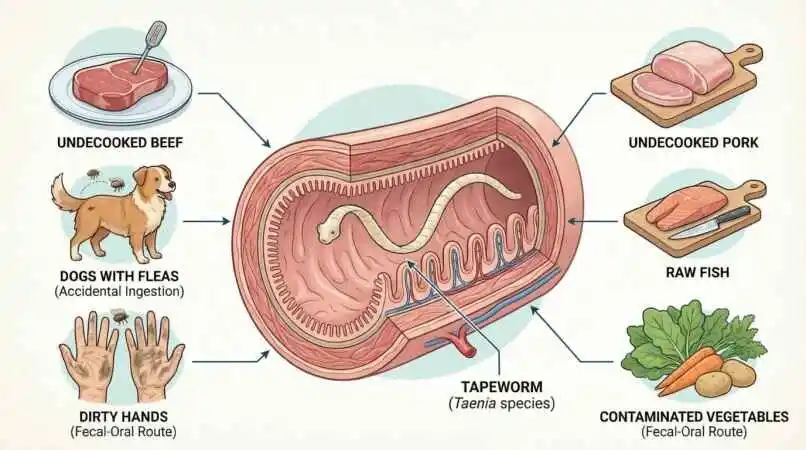
| Source | How infection can happen |
| Undercooked beef | May contain cysticerci of the beef tapeworm, Taenia saginata. |
| Undercooked pork | May carry the pork tapeworm, Taenia solium, or Asian tapeworm, Taenia asiatica. |
| Raw or undercooked fish | Can transmit broad or fish tapeworms, including Dibothriocephalus latus. |
| Contaminated water or food | Can spread dwarf tapeworm eggs, particularly where sanitation is poor. |
| Poor hand hygiene | A person carrying T. solium eggs can infect themselves or others through fecal-oral contamination. |
| Contaminated environment | Open defecation and poor sewage systems allow eggs to contaminate soil, water, crops, and animal feed. |
The important distinction is this: eating larvae usually causes an adult worm in the intestine, while swallowing eggs—especially T. solium eggs—can lead to tissue cysts.
Major Types of Tapeworms in Humans
There are several tapeworm species that can infect people. Some are common, while others are rare or geographically limited. Below are the most important ones to know.
- Beef tapeworm: Taenia saginata
The beef tapeworm is one of the most widespread human tapeworms. People acquire it by eating raw or undercooked beef containing larval cysts.
Once inside the intestine, the worm can grow very long—sometimes several meters. Despite its size, many people have no obvious symptoms. When symptoms occur, they may include mild abdominal discomfort, nausea, changes in appetite, or passing visible segments in stool.
A key point: T. saginata does not usually cause cysticercosis in humans. Its larval stage infects cattle, not people. So the main concern is the intestinal adult worm.
Primary source: Raw, rare, or undercooked beef.
- Pork tapeworm: Taenia solium
The pork tapeworm is medically more concerning because it can cause both intestinal infection and tissue invasion.
A person can develop intestinal taeniasis after eating undercooked pork containing larval cysts. But if that person swallows T. solium eggs—through contaminated hands, food, or water—the eggs can develop into larvae that form cysts in the body. This condition is called cysticercosis.
Cysticercosis can affect muscles, eyes, and the brain. Neurocysticercosis, the brain form, is a major cause of acquired seizures in some regions where the parasite is common. The WHO emphasizes that prevention requires hygiene, sanitation, safe pork handling, and measures that address both human and pig health.
Primary sources: Undercooked pork, fecal contamination from a human carrier, contaminated food or water.
- Asian tapeworm: Taenia asiatica
The Asian tapeworm is closely related to the pork tapeworm and is found mainly in parts of Asia. Like T. solium, it is linked to eating raw or undercooked pork.
It generally causes intestinal infection rather than the severe tissue disease associated with T. solium. However, because it can look similar to other tapeworms, accurate laboratory identification matters.
Primary source: Raw or undercooked pork, particularly in regions where the parasite circulates.
- Fish tapeworm: Dibothriocephalus latus or Diphyllobothrium latum
Often called the broad fish tapeworm, this is among the largest tapeworms that infect humans. Infection occurs after eating raw or undercooked freshwater fish—or sometimes fish that has not been properly frozen or cooked.
This tapeworm deserves special attention because it can cause vitamin B12 deficiency. The worm absorbs B12 in the intestine, and over time this may lead to megaloblastic anemia. Symptoms can include fatigue, weakness, pale skin, shortness of breath, and neurological changes.
People who eat sushi, sashimi, ceviche, smoked fish, or lightly pickled fish should pay attention to sourcing and preparation. Freezing fish at appropriate temperatures and cooking it thoroughly greatly reduces risk.
Primary sources: Raw or undercooked freshwater fish; improperly prepared fish dishes.
- Dwarf tapeworm: Hymenolepis nana
The dwarf tapeworm is one of the most common tapeworms worldwide, especially among children. Unlike many other tapeworms, it can complete its entire life cycle in humans.
Infection can occur through accidental swallowing of eggs from contaminated food, water, hands, or surfaces. Because the parasite can reinfect the same person, infections may persist if hygiene is poor.
It is more common in settings with crowded living conditions, inadequate sanitation, or close contact with contaminated environments.
Primary sources: Contaminated food, water, hands, and surfaces; fecal-oral transmission.
- Dog tapeworm: Dipylidium caninum
This tapeworm commonly infects dogs and cats. Humans, especially young children, can become infected after accidentally swallowing an infected flea.
The flea acts as an intermediate host. A child may touch a pet, then touch their mouth, or accidentally ingest a flea while playing closely with an animal. The infection is usually mild but may cause anal itching, mild abdominal symptoms, or visible segments in stool.
Primary sources: Infected fleas from dogs or cats; close pet contact without flea control.
- Echinococcus tapeworms: Echinococcus granulosus and E. multilocularis
These are small tapeworms that live in the intestines of dogs, foxes, wolves, and other canids. Humans are accidental intermediate hosts.
Infection occurs when a person swallows eggs shed in the feces of an infected animal. This can happen through contact with dogs, contaminated soil, unwashed vegetables, or water. The larvae form fluid-filled cysts, most often in the liver or lungs. This disease is called echinococcosis or hydatid disease.
Unlike intestinal tapeworms, echinococcosis can be serious and may require long-term medication, drainage, or surgery.
Primary sources: Dog feces, fox or wild-canid feces, contaminated soil, unwashed produce, and contaminated water.
- Rodent and other less common tapeworms
Several other tapeworms can occasionally infect humans, including species associated with rodents, beetles, or other intermediate hosts. These infections are less common but may occur in specific environments or through accidental ingestion of infected insects or contaminated material.
While they are not the main public-health concern for most households, they show an important point: tapeworm risk is not limited to meat. Food hygiene, pest control, and sanitation all matter.
Tapeworms and Their Main Sources at a Glance
| Tapeworm | Common name | Main source | Major risk |
| Taenia saginata | Beef tapeworm | Undercooked beef | Intestinal infection |
| Taenia solium | Pork tapeworm | Undercooked pork; eggs from human carriers | Intestinal infection and cysticercosis |
| Taenia asiatica | Asian tapeworm | Undercooked pork | Intestinal infection |
| Dibothriocephalus latus | Fish or broad tapeworm | Raw or undercooked fish | B12 deficiency and anemia |
| Hymenolepis nana | Dwarf tapeworm | Contaminated food, water, hands | Intestinal infection, reinfection |
| Dipylidium caninum | Dog or flea tapeworm | Accidental swallowing of infected fleas | Mild intestinal infection |
| Echinococcus species | Hydatid tapeworms | Eggs from dog or wild-canid feces | Cysts in liver, lungs, or other organs |
Symptoms: What a Tapeworm Infection Can Feel Like
Many intestinal tapeworm infections cause no symptoms at all. People may carry an adult worm for months without realizing it. When symptoms do appear, they are often mild and easy to blame on indigestion, food intolerance, or a stomach bug.
Common intestinal symptoms include:
- Stomach pain or cramps
- Nausea or upset stomach
- Diarrhea or loose stools
- Gas and bloating
- Appetite changes
- Unexplained weight loss
- Fatigue
- Visible white or pale-yellow worm segments in stool
Mayo Clinic notes that intestinal tapeworm infection may cause symptoms such as nausea, abdominal pain, reduced appetite, diarrhea, weight loss, gas, and hunger pains.
Signs that need urgent medical attention
Seek medical care promptly if you develop:
- Seizures
- Severe or persistent headache
- Vision changes
- Confusion
- Weakness or numbness
- Yellowing of the skin or eyes
- Severe abdominal pain
- High fever
- Blood in stool
- Signs of significant dehydration
These symptoms do not confirm a tapeworm infection, but they may indicate a complication or a different condition that needs assessment.
Larval infection symptoms
When tapeworm larvae form cysts outside the intestine, symptoms depend on the organ involved.
- Brain: Seizures, headaches, vision changes, balance problems, or neurological symptoms.
- Eyes: Blurred vision, floaters, retinal problems, or vision loss.
- Liver: Abdominal pain, swelling, jaundice, or a palpable mass.
- Lungs: Cough, chest pain, breathing difficulty, or coughing blood in severe cases.
- Muscles: Lumps, pain, or weakness.
Cleveland Clinic distinguishes between intestinal tapeworm infections and invasive larval infections, noting that infections outside the intestine may cause seizures, nerve pain, or organ-related symptoms.
How Doctors Diagnose Tapeworm Infections
If you suspect a tapeworm, do not rely on home remedies or wait for the worm to “come out on its own.” A clinician can confirm the infection and identify the species, which matters because treatment and follow-up differ.
Common diagnostic methods
- Stool examination: A laboratory looks for tapeworm eggs or segments. Multiple samples may be needed because eggs are not always shed consistently.
- Identification of proglottids: If you pass a segment, your clinician may ask you to bring it in a clean container for identification.
- Blood tests: These may check for anemia, vitamin B12 deficiency, inflammation, or antibodies in certain invasive infections.
- Imaging: Ultrasound, CT, or MRI may be used when cysticercosis, echinococcosis, or other tissue infections are suspected.
- Endoscopy: Rarely needed, but it may help in selected cases.
Do not try to retrieve a worm yourself in a way that could contaminate surfaces or spread eggs. If you find a segment, place it in a sealed clean container, wash your hands thoroughly, and contact a healthcare professional.
Treatment: What Actually Works
Tapeworm infections are treatable, but the right treatment depends on the species and whether the infection is intestinal or invasive.
For intestinal tapeworms, clinicians commonly use antiparasitic medicines such as praziquantel, albendazole, nitazoxanide, or niclosamide. Mayo Clinic lists praziquantel, albendazole, and nitazoxanide among treatments for intestinal tapeworm infection.
Important treatment points
- Do not self-medicate with animal dewormers. Medications and doses for pets are not safe or appropriate for humans.
- Follow the full prescription. Even if symptoms improve quickly, complete the treatment as directed.
- Practice strict hygiene during treatment. Wash hands with soap and water after using the toilet and before preparing food. This helps prevent spreading eggs, especially with T. solium.
- Attend follow-up testing. Your clinician may repeat stool testing to confirm the infection has cleared.
- Invasive cysts may need specialist care. Neurocysticercosis and echinococcosis can require neurologists, infectious-disease specialists, surgeons, or other specialists.
Treatment for larval cyst infections may include antiparasitic drugs, surgery, or other procedures depending on the location and severity of the cysts.
Prevention: The Most Reliable Protection
Prevention is simpler than treatment. The core habits are cooking food properly, washing hands, controlling fleas, and improving sanitation.
- Cook meat thoroughly
Cook beef, pork, and other meats until they reach a safe internal temperature. Avoid tasting meat while it is still raw or undercooked. This is especially important for pork, beef, and wild game.
The CDC identifies cooking meat to safe temperatures as a key way to prevent taeniasis.
- Be careful with fish
If you enjoy sushi, sashimi, ceviche, or gravlax, choose reputable suppliers and follow safe preparation practices. Freezing fish at appropriate temperatures can kill parasites, but home freezers may not always reach or maintain the required conditions.
When in doubt, cook fish thoroughly.
- Wash hands properly
Wash with soap and clean water:
- After using the toilet
- After changing diapers
- After handling pets or cleaning pet waste
- After gardening or touching soil
- Before cooking
- Before eating
- After handling raw meat or fish
The WHO specifically recommends handwashing with soap and clean water after toilet use and before handling food.
- Wash fruits and vegetables
Wash produce under clean running water, especially if it will be eaten raw. This is particularly important for leafy greens, herbs, and vegetables grown in areas where human or animal waste may contaminate soil or irrigation water.
- Improve kitchen safety
Use separate cutting boards and utensils for raw meat and ready-to-eat foods. Clean knives, boards, sinks, and countertops with hot soapy water after preparing raw meat or fish.
Avoid rinsing raw meat in a way that splashes contaminated water around the kitchen.
- Control fleas and deworm pets
If you have dogs or cats, use veterinarian-recommended flea prevention and deworming schedules. Clean pet bedding regularly and dispose of pet feces safely.
Children should be taught not to put their hands in their mouths after touching pets and to wash hands after animal contact.
- Support sanitation
At a community level, safe toilets, sewage treatment, clean water, and proper disposal of human waste reduce the spread of tapeworm eggs. The WHO highlights improved sanitation and ending open defecation as important control measures.
Tapeworm Myths Worth Correcting
“You always lose weight if you have a tapeworm.”
Not true. Some people lose weight, but many have no weight change at all. Using a tapeworm as a weight-loss method is dangerous and completely inappropriate.
“If you eat pork, you will get a tapeworm.”
No. Properly cooked pork from a reliable source is not the problem. The risk comes from raw or undercooked infected meat, poor hygiene, and environmental contamination.
“Sushi always causes tapeworm infection.”
No. The risk depends on fish species, sourcing, freezing, handling, and preparation. Still, raw fish carries more parasitic risk than cooked fish, so choose carefully.
“You can see a whole tapeworm in the toilet.”
Sometimes people see segments, but an entire worm may pass only occasionally. Lack of visible worms does not rule out infection.
“Home remedies can cure tapeworms.”
There is no reliable evidence that garlic, papaya seeds, pumpkin seeds, coconut, or herbal cleanses reliably cure a confirmed tapeworm infection. Some may have mild antimicrobial properties, but they are not substitutes for medical diagnosis and treatment.
When to See a Doctor
Contact a healthcare professional if you:
- Notice worm segments in stool
- Have persistent digestive symptoms after eating raw or undercooked meat or fish
- Have unexplained anemia, fatigue, or B12 deficiency
- Develop neurological symptoms such as seizures or severe headache
- Have traveled to or lived in an area where tapeworm infections are common
- Have a weakened immune system and possible exposure
Early diagnosis matters most for invasive infections. An intestinal tapeworm may be inconvenient, but a larval cyst in the brain, eye, liver, or lungs can have lasting consequences if ignored.
FAQS
- What is a tapeworm?
A tapeworm is a flat, segmented parasitic worm that can live in the human intestine. Some species can also form larval cysts in body tissues.
- How do humans get tapeworms?
Most people get them by eating raw or undercooked meat or fish containing tapeworm larvae. Some species spread through eggs in contaminated food, water, hands, or soil.
- Can you get a tapeworm from beef?
Yes. The beef tapeworm, Taenia saginata, can be acquired by eating undercooked beef containing larval cysts.
- Can you get a tapeworm from pork?
Yes. Taenia solium and Taenia asiatica can be acquired from raw or undercooked pork.
- Can you get a tapeworm from fish?
Yes. Fish tapeworms, including Dibothriocephalus latus, can infect people who eat raw or undercooked fish.
- Can you get a tapeworm from sushi?
Possibly, if the fish is raw, improperly sourced, or not frozen or prepared safely. Cooking fish eliminates the risk of fish tapeworm infection.
- Can tapeworms spread from person to person?
Yes, in some cases. A person infected with Taenia solium can shed eggs in stool. If hygiene is poor, those eggs can contaminate food, hands, or surfaces and infect others.
- Can you get a tapeworm from your dog?
Usually not directly from the dog itself. The dog tapeworm, Dipylidium caninum, is transmitted when a person accidentally swallows an infected flea.
- Can pets give humans tapeworm eggs?
Dogs and cats can carry certain tapeworms, and their fleas can transmit Dipylidium caninum. Echinococcus eggs can also be shed by infected dogs, so hygiene and veterinary care are important.
- What do tapeworm segments look like?
They often look like small white, cream, or pale-yellow grains of rice. They may move briefly and may be seen in stool, toilet water, or underwear.
- Do tapeworms always cause symptoms?
No. Many intestinal infections cause no symptoms or only mild digestive complaints.
- Can a tapeworm make you hungry?
Some people report increased hunger, but others experience reduced appetite. Symptoms vary widely and are not reliable for diagnosis.
- Can a tapeworm cause weight loss?
Yes, but not always. Weight loss can occur with some intestinal infections, but many people have no noticeable weight change.
- Can tapeworms cause anemia?
Yes. The fish tapeworm can contribute to vitamin B12 deficiency, which may lead to megaloblastic anemia.
- What is cysticercosis?
Cysticercosis is an infection caused by larvae of the pork tapeworm, Taenia solium, forming cysts in body tissues. It can affect the brain, muscles, or eyes.
- How does someone get cysticercosis?
By swallowing T. solium eggs, usually through fecal contamination of food, water, or hands. It is not caused by eating larval cysts in pork.
- Can tapeworms reach the brain?
Yes. Larvae of Taenia solium can form cysts in the brain, causing neurocysticercosis. This can lead to seizures and other neurological symptoms.
- Are tapeworms dangerous?
Intestinal tapeworms are often mild, but invasive larval infections can be serious. Echinococcosis and neurocysticercosis may require specialist treatment.
- How are tapeworms diagnosed?
Doctors commonly use stool tests to find eggs or segments. Imaging and blood tests may be needed for suspected tissue infections.
- Can a stool test miss a tapeworm?
Yes. Eggs and segments are not shed continuously, so more than one stool sample may be needed.
- What is the treatment for intestinal tapeworms?
Antiparasitic medicines such as praziquantel, albendazole, nitazoxanide, or niclosamide may be prescribed, depending on the infection and clinical situation.
- Can tapeworms go away without treatment?
An adult tapeworm may eventually die and pass out of the body, but you should not rely on that. Diagnosis and treatment are safer and more reliable.
- Are home remedies effective for tapeworms?
No reliable home remedy cures a confirmed tapeworm infection. Medical treatment is recommended.
- Can you prevent tapeworms by freezing meat?
Freezing can kill some parasites under proper time-and-temperature conditions, but cooking is the most dependable household method for meat.
- Does washing meat remove tapeworm risk?
No. Washing raw meat does not reliably remove parasitic cysts and can spread bacteria around the kitchen. Cooking is what matters.
- Can unwashed vegetables transmit tapeworms?
Yes, especially if they were grown or washed with contaminated water or handled after fecal contamination. This is particularly relevant for eggs shed by humans or animals.
- Are children more at risk?
Children can be more vulnerable to dwarf tapeworm and flea-transmitted tapeworm infections because of hand-to-mouth behavior and close contact with pets or contaminated environments.
- Can you exercise or eat normally during treatment?
Most people can follow their usual routine unless their clinician advises otherwise. Follow the medication instructions and stay hydrated if diarrhea occurs.
- How long does treatment take?
Intestinal tapeworm treatment is often short, but follow-up testing may be needed. Invasive cyst infections can require weeks to months of treatment or procedures.
- When should I go to the emergency department?
Seek urgent care for seizures, severe headache, confusion, vision loss, severe abdominal pain, high fever, blood in stool, or difficulty breathing.
Final Thought
Tapeworms sound frightening, but knowledge takes away much of that fear. Most infections come from a short list of preventable sources: undercooked beef, pork, or fish; contaminated water or produce; poor hand hygiene; and contact with infected animals or fleas.
The practical takeaway is not to avoid food or pets. It is to respect food safety. Cook meat and fish properly, wash your hands and produce, keep pets free of fleas and worms, and seek medical advice if you notice suspicious symptoms. A small habit—like checking that pork is fully cooked or washing your hands before dinner—can prevent weeks of discomfort and, in rare cases, a far more serious illness.
If you suspect a tapeworm infection, speak with a qualified healthcare professional rather than relying on symptoms alone. Early testing gives you clarity, protects the people around you, and makes treatment much simpler.
⚕️Medical Disclaimer:
The information provided on this website is for general educational and informational purposes only and is not intended as a substitute for professional medical advice, diagnosis, or treatment. Always seek the advice of your physician or other qualified health provider with any questions you may have regarding a medical condition. Never disregard professional medical advice or delay in seeking it because of something you have read on this website.

