

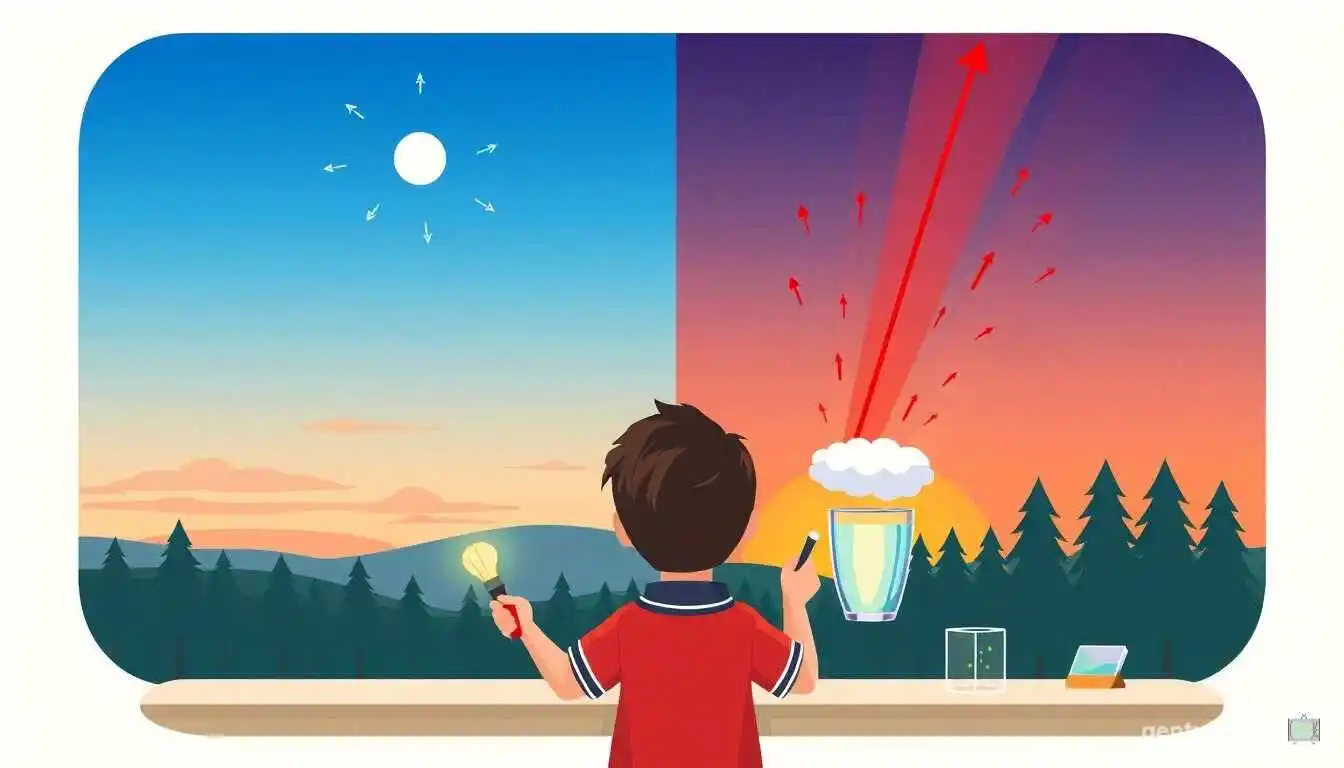
Why Is the Sky Blue but the Sunset Red? The Everyday Magic of Scattering of Light
The Question That Stopped My Whole Class
Let me tell you about a question I could not answer in one sentence, even after fifteen years of teaching.
A few years ago, I was teaching Class 10 science. We had just finished a lesson on white light and its seven colors. I had said, quite proudly, “Sunlight looks white, but it is a mixture of many colors.” A girl I will call Ananya (not her real name) raised her hand slowly. “Ma’am, if sunlight is white, why is the sky blue? Why isn’t the sky white too?”
Before I could reply, a boy at the back added, “And why does the sun turn red in the evening? Did it change color?”
Then a third voice joined in. “Why are clouds white and not blue?”
Suddenly forty students were looking at me. I could have said, “It is because of scattering of light,” and moved on. Honestly, that line would have earned a mark in many exams. But I saw their faces. They did not want a one-line answer. They wanted to understand.
So I closed my textbook and said, “Today’s homework is not a worksheet. Look at the sky at noon and again at sunset, and write down what you see. Tomorrow, I will show you how to catch a sunset inside a glass of water.”
The next day, the classroom was buzzing. Students arrived with notes, sketches, and arguments. One boy insisted the sky was blue because it reflects the sea. A girl said the air itself is blue. They were wrong, and they were also doing exactly what scientists do: making a guess and being ready to test it.
That small moment taught me something. Scattering of light is not just a chapter in a book. It is the reason for the colors above your head every single day. Once you understand it, a sunset stops being only pretty and becomes a puzzle you can solve.
In this post, I will explain scattering of light the same way I explain it in class: slowly, clearly, and with plenty of real examples. No heavy math. No scary terms without a simple meaning. By the end, you will know why the sky is blue, why sunsets are red, why clouds are white, and how to explain all of it confidently in an exam or a conversation. Let us begin.
What Is Scattering of Light?
The Simple Definition
Scattering of light is what happens when light hits tiny particles or molecules and gets sent off in different directions instead of continuing in a straight line.
Imagine rolling a cricket ball straight down a smooth pitch. It keeps going in one direction. Now imagine the pitch is covered with small stones. The ball bounces off in all sorts of directions. Light behaves somewhat like that when it meets particles in the air, in water, or in smoke. Some of it goes straight through, and some of it is knocked sideways.
Here is the one-line version I ask my students to write in their notebooks: scattering of light means light being spread out in many directions by particles in its path.
How Scattering Is Different From Reflection, Refraction, and Dispersion
Students often mix these four ideas, so let us separate them clearly:
- Reflection: light bounces off a surface in a regular way, like your face in a mirror.
- Refraction: light bends when it passes from one material into another, like a straw that looks bent in a glass of water.
- Dispersion: white light splits into its colors, as it does in a prism or a rainbow.
- Scattering: light is sent off in many directions by tiny particles, and different colors may be scattered by different amounts.
These ideas often work together, but they are not the same. When you keep them apart in your mind, many exam questions become much easier.
Three Things That Decide What Happens
Whenever light scatters, three simple things matter:
- The size of the particles. Are they tiny, like air molecules, or large, like water droplets in a cloud?
- The color (wavelength) of the light. Blue light and red light are scattered differently by very small particles.
- How much stuff the light passes through. A short path through clean air looks very different from a long path through hazy air.
Keep these three ideas in your pocket. We will use them again and again in Part 2.
A Short Story of the Scientists Behind It
Many curious people have studied scattering. In the 1800s, an Irish scientist named John Tyndall shone beams of light through mixtures of tiny particles and noticed the beam became visible, with a bluish tint from the side. That is now called the Tyndall effect. Around 1871, the British scientist Lord Rayleigh worked out why small particles scatter blue light more than red light. We now call this Rayleigh scattering. In 1908, a German physicist named Gustav Mie explained what happens when particles are larger, which we call Mie scattering.
And here is a story that makes every Indian student smile. In 1921, a young scientist named C. V. Raman was traveling by ship and wondered why the sea looked so deep blue. He did not accept the popular answer that the sea simply copies the color of the sky. He began studying how water molecules scatter light. That curiosity led him to discover a new kind of scattering, now called the Raman effect, and he received the Nobel Prize in Physics in 1930. A simple question about color changed the world of science. Your questions can be that powerful too.
Why Scattering of Light Matters More Than You Think
“Will this come in the exam?” I hear that question every year. Often, yes. Many school boards include scattering of light and the Tyndall effect in Class 10 science. But the better reason to learn it is that scattering shapes the world you see every day.
It Paints the Sky
The blue of the noon sky, the orange of a sunrise, the pink of an evening cloud: all of these colors come from scattering. Without it, the sky would look black even in the daytime, with a bright white sun in the middle, just like it does for astronauts on the Moon.
It Keeps Us Safe
Red light scatters the least, so it travels farthest through air, fog, and dust. That is why danger signals, traffic stop lights, and warning lamps use red. When a signal needs to be seen from a long way off, red is the smart choice.
It Shapes Weather and Climate
Clouds scatter sunlight in all directions, which is why they look bright white from above and gray underneath when they are thick. Tiny particles in the air, such as dust and smoke, also scatter sunlight and change how much of it reaches the ground. Scientists study this to understand weather and climate.
It Helps Doctors and Engineers
When light travels through skin and other body tissue, it scatters. Researchers use special kinds of light and the way it scatters to look inside tissues without cutting them open. Engineers also study scattering to design better camera sensors, screens, and fog lights for vehicles.
It Helps Photographers and Artists
Photographers love the “golden hour,” the time just after sunrise or before sunset, because scattering gives the light a warm, soft glow. Painters use the same idea when they mix a hazy, bluish color for faraway hills to make them look distant. Understanding scattering helps you see why that trick works.
It Builds Your Scientific Thinking
Scattering of light teaches you to ask “why,” to make a guess, to test it, and to change your mind when the evidence says so. That habit helps you in physics, chemistry, biology, and even in everyday decisions.
Core Concepts: How Scattering of Light Really Works
Let us build this idea one small step at a time. Read each step, picture it in your mind, and only then move to the next.
Step 1: Light Travels in Straight Lines, Until It Meets Something
In empty space, light travels in a perfectly straight line. In air, it also travels straight as long as nothing gets in its way. But air is not empty. It is full of tiny gas molecules, such as nitrogen and oxygen, plus dust, water droplets, and smoke. When light meets these, some of it gets scattered.
Step 2: White Light Is a Mixture of Colors
Sunlight looks white, but it is really a blend of many colors, from violet through blue, green, yellow, and orange, to red. Each color has its own wavelength, which is the distance between two neighboring peaks of the light wave. Violet and blue have short wavelengths, about 400 to 450 nanometers. Red has a long wavelength, about 700 nanometers. A nanometer is one billionth of a meter, which is incredibly small.
Here is a simple memory trick: blue is short, red is long. Keep that in mind, because it is the key to almost everything that follows.
Step 3: Rayleigh Scattering, The Reason for the Blue Sky
When light meets particles that are much smaller than its wavelength, such as the gas molecules in air, we get Rayleigh scattering. And here is the important rule: shorter wavelengths scatter much more strongly than longer ones.
How much more? Scientists found that the amount of scattering is proportional to one divided by the fourth power of the wavelength. You do not need to remember that formula for most school exams. But you can understand the result: blue light (around 450 nanometers) is scattered roughly six times more strongly than red light (around 700 nanometers). That is a big difference.
So when sunlight enters the atmosphere, the blue part gets bounced all over the sky by air molecules. Wherever you look, some of that scattered blue light reaches your eyes. The sky looks blue because blue light is being sent toward you from every direction. The red and orange parts mostly travel straight through.
Step 4: But Wait, Why Not Violet?
This is the question my sharpest students always ask, and I love it. Violet has an even shorter wavelength than blue, so it should scatter even more. So why is the sky not violet?
There are three reasons. First, sunlight contains less violet than blue to begin with. Second, some violet light is absorbed high up in the atmosphere. Third, and this is very important, our eyes are much less sensitive to violet than to blue. Our eyes have cells that respond best to red, green, and blue light, so a sky with lots of blue and a little violet looks blue to us. So the sky is not violet because of how sunlight, air, and our own eyes work together.
Step 5: Why the Sun Turns Red at Sunrise and Sunset
At noon, the sun is high above you, and its light takes a fairly short path through the atmosphere. Only some of the blue is scattered away, so the sun looks white or slightly yellow.
At sunrise and sunset, the sun is near the horizon. Its light has to travel through many times more air to reach you. Along that long path, most of the blue and green light gets scattered out of the beam, sent off in other directions. What remains is mostly orange and red light, which reaches your eyes. So the sun does not change color. The light reaching you has simply lost its blue along the way.
Here is a way to picture it. Imagine a long queue of people where each person takes a few blue candies out of your bag as you walk by. By the end of a long queue, your bag has mostly red candies left. A longer path means fewer blue candies and a redder sun.
Step 6: Mie Scattering, When Particles Get Bigger
Not all particles in the air are tiny. Dust, pollen, smoke, and fine water droplets can be about the same size as the wavelength of light. When that happens, we get Mie scattering.
Mie scattering does not favor blue as strongly as Rayleigh scattering does. It scatters many colors in a more even way, and it sends a lot of light forward. This is why a hazy day makes the sky look pale and whitish, and why the sky near the horizon often looks lighter than the sky straight above you. Light gets scattered many times by many particles, and the colors mix back toward white.
Step 7: Non-Selective Scattering, Why Clouds Are White
Cloud droplets are much larger than the wavelength of light. When light hits such big droplets, all the colors are scattered in nearly equal amounts. When every color is scattered equally, the mixture looks white. That is why clouds are white, and why fog and mist look white or gray too.
Thick, tall rain clouds look dark gray from below because so many droplets scatter the light that very little of it makes it through to the ground. From above, the same cloud looks brilliant white in sunshine. Same cloud, different view, and scattering explains both.
Step 8: The Tyndall Effect, Scattering You Can See
The Tyndall effect is the scattering of light by very small particles spread through a mixture, such as dust in air, fine droplets in a fog, or milk particles in water. These mixtures are called colloids. The particles are small enough not to settle quickly, but big enough to scatter light and make the beam visible.
You have seen the Tyndall effect many times without knowing its name:
- A beam of sunlight streaming through a gap in a window and lighting up the dust in a room.
- Sunlight coming through the leaves of a dense forest, with misty rays visible in the air.
- Headlights of a car making a visible beam on a foggy night.
- A torch beam going through a glass of water with a few drops of milk.
Notice that in a clear glass of plain water, the torch beam is hard to see from the side. That is because there is nothing in the way to scatter the light toward your eyes. Add a few particles, and the beam suddenly shows up. Scattering makes the invisible path of light visible.
Step 9: Scattered Skylight Is Partly Polarized
Here is a bonus fact. The light that comes from the blue sky is partly polarized, which means its waves wiggle more in one direction than another. That is why polarizing sunglasses and camera filters can make the sky look deeper blue. Some insects, like bees, use this pattern to find direction. It is another example of how scattering quietly shapes the world.
Step 10: Surprising Examples Around You
- Blue eyes. Blue eyes do not contain blue pigment. A layer in the eye scatters light, and blue light comes back to us, a bit like the sky. That is why eyes can look blue or gray with very little pigment.
- The sky on Mars. On Mars, the daytime sky looks butterscotch or tan because of fine dust, and sunsets can look bluish. It is almost the opposite of Earth, and it happens because of different particles.
- The sky on the Moon. The Moon has almost no atmosphere, so there is nothing to scatter light. The sky is black even when the sun is shining.
- The deep blue sea. Water molecules absorb red light strongly and scatter blue light, so deep clean water looks blue. The sky’s reflection adds a little, but it is not the main reason.
A Simple Experiment: Catch a Sunset in a Glass
This is the experiment I promised my class, and it works with things you have at home. You will need a clear glass or small transparent tank filled with water, a few drops of milk, a torch or a phone flashlight, and a dim room.
- Fill the glass with plain water and place it on a table.
- Add just three or four drops of milk and stir gently. The water should look very slightly cloudy.
- Switch off the room lights. Shine the torch through the glass from one side.
- Look at the glass from the side. You should see a faint bluish tint. That is scattered blue light, just like the daytime sky.
- Now look through the glass toward the torch, from the opposite end. The light should look yellowish or orange. That is the light left over after the blue has been scattered away, just like a sunset.
- Add a few more drops of milk and repeat. The orange-red color becomes stronger, as if the sun were setting lower.
Write down what you see in each step. This small experiment teaches the whole idea in two minutes. If it looks too white, use fewer drops. Too much milk makes the mixture act like a cloud and the colors wash out.
Real Student Example: How Ananya Turned a Question Into a Project
A quick honesty note: I have changed names and blended details from a few students to protect their privacy. But the lessons in this story are real, and I have seen them play out many times.
Do you remember Ananya, the girl who asked why the sky is blue? She did not let go of her question. After our classroom demonstration, she decided to make it her school science exhibition project, called “Where Do the Colors of the Sky Come From?”
She started with the milk-and-torch experiment, but she did not stop there. She made a simple chart with three columns: what she saw, what she thought caused it, and what she learned. She repeated the experiment with different amounts of milk and recorded the color from the side and from the end. She also took photographs of the sky at noon, at 5 PM, and at sunset for a week, and she compared them with her glass experiment.
When visitors came, she did not just read from a chart. She asked questions like, “Why do you think the sun looks red in the evening?” Then she let them try the torch and the glass themselves. Many adults, including a few teachers, said they had never really understood it before.
The best moment came in her board exam preparation months later. A question asked her to explain why the sky appears blue and why the sun appears red at sunset. While other students tried to remember lines, Ananya simply pictured her glass of water and wrote a clear, confident answer. She told me later, “Ma’am, I did not memorize it. I could see it.”
Ananya did not become a world-famous physicist overnight. But she became the student who understood, and she started helping her friends. Her marks improved in science, and more importantly, her fear of the subject melted away.
What We Can Learn From Ananya
- Curiosity is a superpower. Her single question grew into a whole project.
- Doing beats memorizing. A tiny experiment helped her remember for months.
- Record what you see. Her simple chart turned observations into understanding.
- Teach others. Explaining to visitors made her knowledge stronger.
Benefits of Understanding Scattering of Light
When scattering of light finally makes sense, you gain more than marks in one chapter. Here is what my students usually notice:
- Clear exam answers. You can explain the blue sky, red sunset, white clouds, and Tyndall effect in a few confident lines.
- Stronger connection between topics. Wavelength, color, atmosphere, and the human eye suddenly fit together.
- Better observation skills. You start noticing hazy distant hills, golden evening light, and beams of light in dusty rooms.
- A scientist’s habit of mind. You ask “why” and test your guesses instead of just accepting answers.
- Practical sense. You understand why red lights are used for danger signals and why fog lamps are designed the way they are.
- Confidence to explain. You can answer the next “Why is the sky blue?” question from a younger cousin without hesitation.
Best of all, these benefits grow over time. The student who understands scattering in Class 10 often finds it easier to learn optics, atmospheric science, and even modern technology later on.
Common Mistakes and Challenges (and How to Fix Them)
Every student makes mistakes with this topic. I did too when I first learned it. Here are the most common ones and simple ways to fix them.
Mistake 1: “The Sky Is Blue Because It Reflects the Sea”
This is the most popular myth. The sky would be blue even if there were no oceans at all, and the Moon has no sea and no blue sky. Fix: remember that the blue comes from air molecules scattering blue light toward you.
Mistake 2: Mixing Up Scattering and Absorption
In scattering, light is sent in new directions. In absorption, light energy is taken in by the material and turned into other forms, such as heat. Fix: ask, “Did the light change direction, or did it disappear into the material?”
Mistake 3: Forgetting to Explain Why Not Violet
If you only say “blue scatters most,” a sharp teacher may ask, “But violet is shorter. Why is the sky not violet?” Fix: keep the three reasons ready: less violet in sunlight, some absorbed high up, and our eyes are less sensitive to it.
Mistake 4: Thinking the Sun Actually Changes Color
The sun stays the same. It is the path of its light through the atmosphere that changes. Fix: use the “long queue of candies” picture to remember that a long path removes blue and leaves red.
Mistake 5: Confusing Scattering With Reflection, Refraction, and Dispersion
Rainbows, for example, come from refraction and dispersion inside water drops, not mainly from scattering. Fix: make a four-row table in your notebook with one example for each idea and revise it every week.
Mistake 6: Believing All Scattering Favors Blue
Only scattering by very small particles favors blue. Large droplets in clouds scatter all colors about equally, so clouds look white. Fix: link particle size with the result: tiny gives blue, bigger gives whitish.
Mistake 7: Memorizing a Formula Without a Picture
Some students memorize “one over wavelength to the fourth power” but cannot explain it in words. Fix: always pair the formula with a sentence: “Shorter wavelengths scatter much more strongly than longer ones.”
Comparison Table: Types of Scattering at a Glance
This table is a great page to stick in your notebook. Compare the three main types side by side, and the pattern becomes easy to see.
| Feature | Rayleigh Scattering | Mie Scattering | Non-Selective Scattering |
| Particle size | Much smaller than the wavelength | About the same as the wavelength | Much larger than the wavelength |
| Examples of particles | Air molecules (nitrogen, oxygen) | Dust, smoke, pollen, haze | Cloud and fog droplets |
| Effect of color | Blue scattered far more than red | Colors scattered more evenly | All colors scattered about equally |
| What you see | Blue sky, red sunset | Pale, hazy sky | White clouds and fog |
| Direction of scattered light | Spread in many directions | Mostly forward | Spread widely |
| Related effect | Skylight and sunsets | Hazy glow around the sun | Mist rays and dull gray days |
| Easy memory line | Small means blue | Medium means pale | Large means white |
The big idea is simple: the size of the particles decides the color story. Tiny particles favor blue, medium ones make the sky pale, and big ones make things white. The Tyndall effect is the name we give to scattering by small particles in a colloid, which lets us see the path of a light beam.
5 Proven Study Tips to Master Scattering of Light
Over the years, I have taught hundreds of students this chapter. The ones who improve fastest are not always the top scorers. They are the ones who practice in small, playful, regular steps. Here are five strategies that work again and again.
Tip 1: Draw the Picture, Do Not Just Read the Words
Take a blank page and draw the sun, a layer of atmosphere, and a person standing on the ground. First draw noon, with a short light path. Then draw sunset, with a long path. Show blue arrows being scattered away and red arrows reaching the person. When you draw it, you remember it. When you only read it, you forget it within days.
Tip 2: Do the Milk-and-Torch Experiment Yourself
The experiment from Part 2 takes five minutes. Do it, write down what you see from the side and from the end, and stick your notes in your notebook. A real observation is worth ten pages of reading, and examiners love answers that show real understanding.
Tip 3: Use Short Memory Lines
Memory lines are your friends in the exam hall. Try these: “Blue is short, red is long.” “Small means blue, medium means pale, large means white.” “Long path, red sun.” Write your own funny versions. The sillier they are, the longer they stay.
Tip 4: Climb the Why Ladder
Ask yourself “why” five times in a row. Why is the sky blue? Because blue light is scattered the most. Why is blue scattered the most? Because it has a short wavelength. Why does a short wavelength scatter more? Because the particles are much smaller than the wavelength. Keep asking until you cannot go further, then look up the next answer. This habit turns facts into understanding.
Tip 5: Teach It in 60 Seconds, Then Revise on a Schedule
Explain why the sky is blue and the sunset is red to a friend, a sibling, or even a stuffed toy, using only simple words. If you get stuck, you have found the part to revise. Then quiz yourself after one day, three days, and one week. Short, spaced practice beats one long study night every single time.
Conclusion: Look Up and Smile
Remember Ananya and her simple question? That one question led to a project, a confident exam answer, and a new love for science. The same can happen to you.
Here is a quick recap you can read in thirty seconds:
- Scattering of light is light being sent in many directions by particles in its path.
- Tiny particles, like air molecules, scatter blue light much more than red. That gives us the blue sky and the red sunset.
- Medium particles make the sky look pale, and large droplets scatter all colors equally, making clouds white.
- The Tyndall effect lets us see the path of a light beam through a colloid, like dust, fog, or milky water.
You do not need to be a genius to understand this topic. You only need curiosity, a glass of water, a few drops of milk, and a torch. So tonight, step outside and look at the sky. Tomorrow, watch the sunset and notice the colors. Then say to yourself, “I know why that happens.” That small moment of understanding is what real learning feels like. I am cheering for you.
FAQS
Q1. What is scattering of light?
Scattering of light is the spreading of light in many directions when it hits tiny particles or molecules. It is the reason we can see beams of light in dusty air and the reason the sky has color.
Q2. Why is the sky blue?
Air molecules scatter short-wavelength blue light much more than long-wavelength red light. The scattered blue light reaches our eyes from every direction, so the sky looks blue.
Q3. Why is the sky not violet?
Sunlight has less violet than blue, some violet is absorbed high in the atmosphere, and our eyes are less sensitive to it. Together, these make the sky look blue instead.
Q4. Why does the sun look red at sunset?
At sunset, sunlight passes through a much longer path of air. Most of the blue is scattered away, and mostly orange and red light reaches us.
Q5. Why are clouds white?
Cloud droplets are much larger than the wavelength of light, so they scatter all colors about equally. Equal amounts of all colors look white.
Q6. What is Rayleigh scattering?
Rayleigh scattering is scattering of light by particles much smaller than its wavelength, like air molecules. It scatters blue light far more than red light.
Q7. What is Mie scattering?
Mie scattering happens when particles are about as large as the wavelength of light, such as dust and haze. It scatters colors more evenly and makes the sky look pale.
Q8. What is the Tyndall effect?
The Tyndall effect is the scattering of light by tiny particles in a colloid, which makes a light beam visible. Examples are sunlight in a misty forest and a torch beam in milky water.
Q9. What is the difference between scattering and reflection?
In reflection, light bounces off a surface in a regular, predictable way. In scattering, light is thrown in many directions by small particles.
Q10. What is the difference between scattering and dispersion?
Dispersion splits white light into its colors, like a prism does. Scattering sends light in different directions, and may favor some colors over others.
Q11. Why is the sky black on the Moon?
The Moon has almost no atmosphere, so there are no air molecules to scatter sunlight. Without scattering, the sky stays black even in the daytime.
Q12. Why are danger signals red?
Red light has the longest visible wavelength and is scattered the least. It travels farthest through air, dust, and fog, so it can be seen from a long distance.
Q13. Why is the sea blue?
Water absorbs red light strongly and scatters blue light, so deep clean water looks blue. The reflection of the sky adds a little, but it is not the main reason.
Q14. Why does fog look white or gray?
Fog is made of tiny water droplets that scatter all colors of light about equally. The mixture looks white, or gray when the light is dim.
Q15. Why does the sun look white at noon but red at sunset?
At noon, light travels a short path through the air and loses only a little blue. At sunset, the path is much longer, so most of the blue is scattered away.
Q16. What decides how much light is scattered?
The size of the particles, the wavelength of the light, and the amount of material the light passes through all matter. Small particles favor blue, and longer paths scatter more.
Q17. Can scattering of light be useful?
Yes, it lets us see light beams, helps scientists study the atmosphere, and helps doctors look into tissues. It also makes red signals visible from far away.
Q18. Why is milk white?
Milk contains tiny fat and protein particles that scatter all colors of light in many directions. Since all colors are scattered, milk looks white.
Q19. Why can we see a beam of sunlight in a dusty room?
Dust particles scatter some of the light toward our eyes, which makes the beam visible. In a clean room, the beam would be much harder to see.
Q20. What is a colloid?
A colloid is a mixture where tiny particles are spread evenly through another substance and do not settle quickly. Milk, fog, and smoke are common examples.
Q21. Why does the sky look different on Mars?
Mars has a thin atmosphere with lots of fine dust that scatters light differently from Earth’s air. The daytime sky looks tan or butterscotch, and sunsets can look bluish.
Q22. Why do some eyes look blue?
Blue eyes have very little pigment in the front layer of the iris. That layer scatters light, and blue light comes back to us, so the eyes look blue.
Q23. What does one over wavelength to the fourth power mean?
It means shorter wavelengths scatter much more strongly than longer ones. Halving the wavelength increases scattering by sixteen times.
Q24. How is C. V. Raman connected to scattering of light?
Raman studied how molecules scatter light and discovered that a small part of scattered light changes color. This is now called the Raman effect, and it won him the Nobel Prize in 1930.
Q25. Is a rainbow caused by scattering?
Mostly no. A rainbow forms from refraction, reflection, and dispersion of sunlight inside raindrops.
Q26. Why does the sky look paler near the horizon?
Near the horizon, light travels through more air and gets scattered many times by many particles. The colors mix back toward white, so the sky looks paler.
Q27. Is skylight polarized?
Yes, light scattered from the blue sky is partly polarized. This is why polarizing sunglasses and camera filters can darken the sky.
Q28. How do I write a scattering of light answer in the board exam?
Start with a one-line definition, then explain particle size and wavelength, and finish with a clear example such as the blue sky. Add a small labeled diagram if the question allows it.
Q29. Which simple experiment shows the Tyndall effect?
Shine a torch through a glass of water with a few drops of milk in a dim room. The beam becomes visible from the side, showing scattering by tiny milk particles.
Q30. How can I remember scattering of light easily?
Use short lines like “blue is short, red is long” and “small means blue, medium means pale, large means white.” Pair them with the milk-and-torch experiment and a quick drawing.
Disclaimer: The content on this blog is for informational purposes only. The author’s opinions are personal and not endorsed. Efforts are made to provide accurate information, but completeness, accuracy, or reliability are not guaranteed. The author is not liable for any loss or damage resulting from the use of this blog. It is recommended to use the information on this blog at your own discretion.

