

The Perfect Shape: Why Is The Sphere In Mathematics The Ultimate 3D Superhero?
I want to tell you a story about a student named Maya from my 10th-grade geometry class. Maya was brilliant at drawing flat shapes. She could draw a perfect circle freehand and calculate its area in her sleep. But the moment we stepped into the 3D world, she froze.
One Tuesday, I held up a basketball and a flat paper circle. “Maya,” I asked, “what is the difference between these two?” She looked at me, frowned, and said, “The basketball is just a fat circle. It’s a circle that ate too much pizza.”
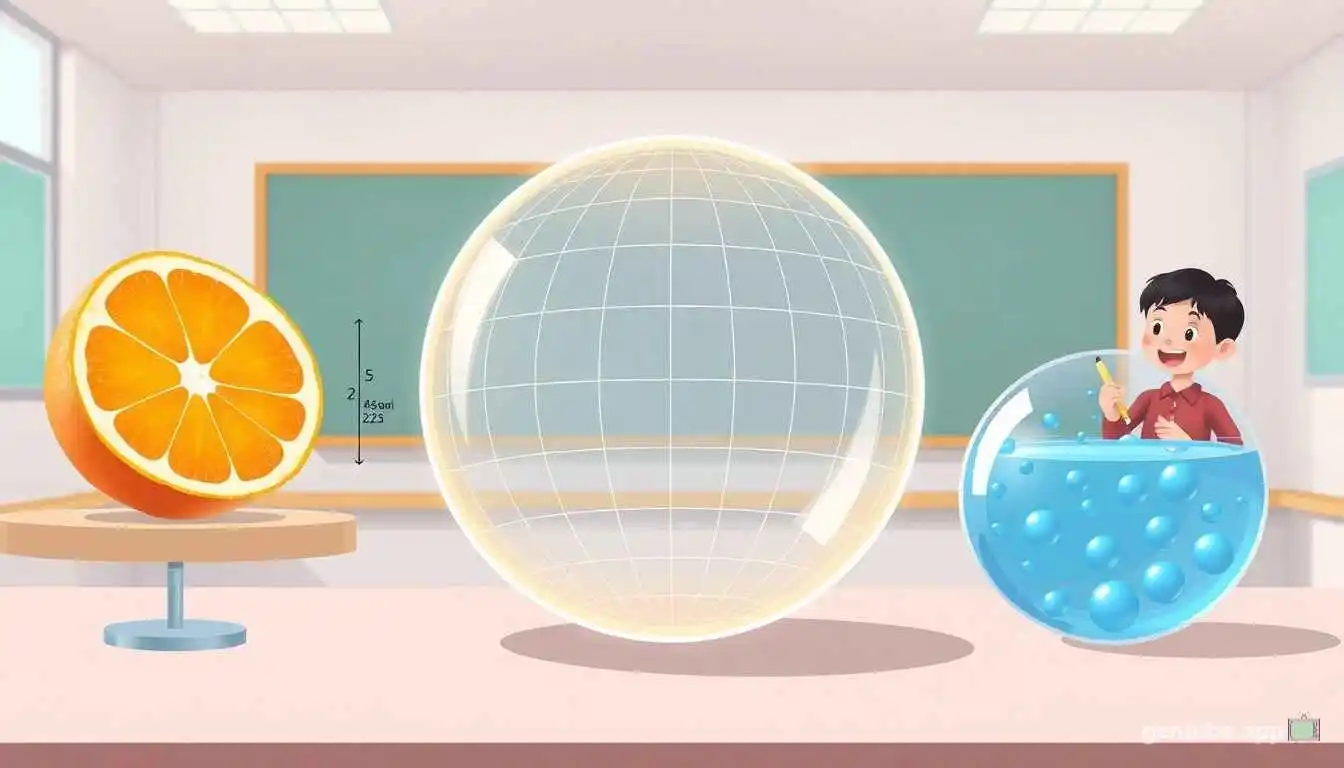
The whole class laughed. But Maya’s comment highlighted a massive misunderstanding that so many students share. We look at 3D objects and just think of them as “puffed up” 2D shapes. That day, I brought out a bowl of orange peels, some water, and a measuring cup, and we spent the hour proving why a sphere is so much more than a fat circle. By the end of the class, Maya wasn’t confused anymore; she was amazed. She looked at the basketball and said, “It’s a superhero shape!”
As an educator for over 15 years, I have seen thousands of students struggle with 3D geometry. It feels abstract and confusing. But it doesn’t have to be. Today, we are going to explore the sphere in mathematics together. We will break down what it is, why it matters, how the formulas actually work, and how you can master it without memorizing a single thing you don’t understand. Let us step out of the flat paper and into the real world!
What Is A Sphere In Mathematics?
Let us get the textbook definition out of the way first. In mathematics, a sphere is a perfectly symmetrical three-dimensional shape. It is the set of all points in 3D space that are at the exact same distance from a single central point.
Think about a bubble floating in the air. The very center of the bubble is the central point. The invisible line from that center to the outer skin of the bubble is the radius. Every single spot on that thin, soapy skin is the exact same distance from the center. That is what makes it a sphere. If even one tiny bump is longer or shorter than the radius, it stops being a sphere and just becomes a weird blob.
Now, here is a massive trap that catches students all the time: A sphere is hollow.
In strict math terms, a sphere is just the 2D surface—the skin of the basketball. If you fill it up with air or rubber, mathematicians call that a “ball” or a “solid sphere.” When we calculate the Surface Area, we are measuring the hollow skin. When we calculate the Volume, we are measuring the space inside the solid ball. For school tests, teachers usually just say “sphere” for both, but knowing this difference makes you the smartest student in the room.
The Importance Of The Sphere: Why Does Nature Love This Shape?
You might wonder, “Why do I need to learn about this?” The answer is simple: the sphere is the most important shape in the universe. Nature is obsessed with it.
Planets, stars, and moons are spheres. Water droplets in zero gravity form perfect spheres. Even your eyeballs are roughly spherical. Why? Because the sphere is the most efficient shape in existence.
A sphere has the smallest possible surface area for a given volume. Imagine you have a piece of clay. You can shape it into a cube, a pyramid, or a long skinny tube. If you shape it into a sphere, it will take up the most room on the inside while having the least amount of skin on the outside.
This matters in the real world. A soap bubble traps air inside. To use the least amount of soap possible (because soap takes energy), it pulls itself into a sphere. A planet has a lot of mass pulling inward due to gravity. Gravity pulls everything as close to the center as possible, which naturally creates a sphere. When you understand the sphere in mathematics, you are understanding the rule that governs how the universe saves energy and space.
Core Concepts: How The Sphere Works In Math
To truly master this topic, we need to look at the anatomy, the formulas, and the special features of a sphere. We will take it step by step so it makes perfect sense.
The Anatomy Of A Sphere
Before we do any math, we need to know the parts. Just like a doctor needs to know body parts, a math student needs to know shape parts.
- Center: The exact middle point inside the sphere.
- Radius (r): The distance from the center to the surface. This is the most important measurement. Every formula uses the radius.
- Diameter (d): The distance straight across the sphere, passing through the center. It is exactly twice the radius (d = 2r).
- Chord: Any line that connects two points on the surface of the sphere. The diameter is the longest chord.
- Tangent: A straight line that just touches the surface of the sphere at exactly one point, like a pencil barely tapping a ball.
Surface Area: The Skin Of The Sphere
The formula for the surface area of a sphere is: Surface Area = 4 × π × r²
Let us break this down so you never forget it. Do you remember the area of a flat circle? It is π × r².
So, the surface area of a sphere is exactly 4 times the area of a flat circle with the same radius. But why 4 times?
Imagine you have an orange. You peel it carefully. Now, take one of those flat circular peels and lay it on the table. If you peeled the entire orange and flattened all the pieces, they would perfectly cover exactly four flat circles of the same radius. This is the famous “Orange Peel Proof” that I show my students. It takes a 3D concept and turns it into a 2D picture you can visualize.
Let us try an example: If a basketball has a radius of 12 cm, what is its surface area?
- Surface Area = 4 × π × (12)²
- Surface Area = 4 × π × 144
- Surface Area = 576π cm² (If you use a calculator, this is about 1809.56 cm²)
Always remember to write your units squared (cm², m², in²) for surface area, because you are counting flat squares on the skin.
Volume: The Inside Story
The formula for the volume of a sphere is: Volume = (4/3) × π × r³
This formula tells us how much space is inside the sphere—how much water it can hold, or how much air is inside it.
Where does the (4/3) come from? This is harder to show with a simple orange peel, but it comes from the world of Calculus. Over 2000 years ago, a genius named Archimedes figured this out without modern math. He imagined slicing a sphere into thousands of paper-thin circles and adding their areas together. He proved that the volume of a sphere is exactly two-thirds the volume of a cylinder that perfectly wraps around the sphere.
Let us try an example: If a globe has a radius of 15 cm, what is its volume?
- Volume = (4/3) × π × (15)³
- Volume = (4/3) × π × 3375
- Volume = 4500π cm³ (If you use a calculator, this is about 14137.17 cm³)
Always remember to write your units cubed (cm³, m³, in³) for volume, because you are counting little 3D cubes inside the shape.
Great Circles: The Equator Of The Sphere
A “Great Circle” is the largest possible circle you can draw on a sphere. It happens when a flat plane cuts directly through the center of the sphere.
On Earth, the Equator is a Great Circle. If you fly an airplane along a Great Circle, you are taking the shortest possible path between two points on the surface. This is why flights from the USA to Europe often curve up toward the North Pole on a flat map—because they are following the Great Circle on the sphere of the Earth!
Hemispheres: Slicing The Sphere In Half
If you take a knife and cut a sphere exactly through its center, you get two equal halves. Each half is called a hemisphere. Earth is divided into the Northern Hemisphere and the Southern Hemisphere.
For a hemisphere, the math changes slightly:
- Curved Surface Area: Half of the sphere’s skin, so it is 2 × π × r².
- Total Surface Area: If you include the flat circle you just cut, you add another π × r², making it 3 × π × r².
- Volume: Half of the full volume, so it is (2/3) × π × r³.
Real-Life Case Study: Leo’s Giant Snow Globe Project
To see how this math is used in real life, let me tell you about Leo, an 11th-grade student I mentored last year. Leo wanted to build a giant, custom snow globe for the school winter festival. He bought a clear, hollow plastic dome with a radius of 20 cm.
His plan was to glue a flat wooden base to the bottom of the dome, fill it with water and glitter, and seal it. But he had two big problems to solve first:
Problem 1: How much water does he need? Leo needed to know the volume of the hemisphere to buy the right amount of distilled water.
- Volume of a hemisphere = (2/3) × π × r³
- Volume = (2/3) × π × (20)³
- Volume = (2/3) × π × 8000
- Volume = 5333.33 × π ≈ 16,755 cm³
Since 1,000 cm³ is equal to 1 liter, Leo knew he needed about 16.7 liters of water. Because he did the math, he didn’t waste money buying too much water or spilling it everywhere.
Problem 2: How much glue does he need for the base? Leo needed to glue the flat, circular base to the bottom of the dome. He needed the area of that flat circle to know how much adhesive to apply.
- Area of a circle = π × r²
- Area = π × (20)²
- Area = 400π ≈ 1,256 cm²
Leo’s snow globe was the hit of the festival. He didn’t guess; he used the math, and it worked perfectly. That is the power of understanding the sphere in mathematics.
The Benefits Of Learning 3D Geometry
You might think geometry is just about passing tests, but it trains your brain in ways you don’t expect.
- Building Spatial Reasoning: When you study 3D shapes, you train your brain to visualize objects from different angles. This is crucial if you ever want to be an engineer, an architect, a surgeon, or even a video game designer.
- Connecting Math to the Physical World: Algebra can feel like moving random letters around. Geometry is different. When you calculate the volume of a sphere, you are calculating the amount of water in a fishbowl. It is real, physical, and useful.
- Foundation for Higher Science: You cannot pass Physics or Chemistry without understanding volume and surface area. When you study planetary gravity, fluid dynamics, or atomic structures, the sphere is always the starting point.
- Problem Solving and Logic: Geometry forces you to follow a logical step-by-step process. You learn to take what you know (the radius) and use rules to find what you don’t know (the volume). This logical thinking helps you in coding, law, and everyday decision-making.
Common Mistakes And Challenges In Sphere Math
Even the best students make the same errors over and over. Let us look at the traps so you can avoid them.
Mistake 1: Mixing Up Radius And Diameter This is the number one killer of test scores. A problem will say, “A sphere has a diameter of 10 cm.” A student will grab the 10, plug it right into the formula as the radius, and get the wrong answer. Always check: did they give you the radius (r) or the diameter (d)? If they give the diameter, cut it in half before you do anything else!
Mistake 2: Squaring Instead Of Cubing (And Vice Versa) Students get excited and rush. They calculate r² when they should calculate r³, or they do r³ when they need r². Remember: Area is flat, so it uses r². Volume is 3D space, so it uses r³.
Mistake 3: Forgetting The Fraction In Volume It is so easy to look at the volume formula and accidentally use “4” instead of “4/3”. When you write out your steps, actually write the fraction down so you don’t forget to divide by 3 at the end.
Mistake 4: Wrong Units If a question asks for surface area and you write cm³, you will lose points. Area is always squared (²). Volume is always cubed (³). Write the units down for every single step.
Challenge 1: Visualizing The Invisible It is hard to imagine slicing a sphere with a flat plane when you are just staring at numbers on a page. The Solution: Always sketch a quick picture. Even a bad drawing helps your brain connect the numbers to the shape.
Challenge 2: Word Problems Word problems are tough because they hide the math inside a story. The Solution: Read the problem twice. Circle the numbers. Underline what the question is actually asking (is it asking for the paint on the outside = Surface Area, or the water on the inside = Volume?).
Comparison Table: Sphere vs. Circle vs. Hemisphere
Sometimes seeing things side-by-side is the best way to learn. Here is a quick comparison of the shapes we have talked about.
| Feature | Circle (2D) | Sphere (3D) | Hemisphere (3D) |
| Dimensions | 2 Dimensions (Flat) | 3 Dimensions (Solid/Surface) | 3 Dimensions (Half Solid) |
| What it is | Set of points equidistant from center on a flat plane | Set of points equidistant from center in 3D space | Half of a full sphere |
| Area Formula | π × r² | Surface Area: 4 × π × r² | Curved Area: 2 × π × r² |
| Volume Formula | No Volume (Area only) | Volume: (4/3) × π × r³ | Volume: (2/3) × π × r³ |
| Real World Example | A coin, a clock face | A basketball, a planet | A bowl, the Earth’s Northern half |
5 Proven Study Tips For Mastering Spherical Geometry
As your mentor, I want you to not just read this, but actually remember it and use it. Here are my top 5 strategies for studying the sphere in mathematics.
- Use Physical Objects Do not just stare at your textbook. Go to your kitchen. Find an orange, a melon, or a tennis ball. When you calculate the surface area, actually imagine wrapping the ball in paper. When you calculate volume, imagine filling it with water. Touching the object makes the math real.
- Create A Formula Sheet With Words, Not Just Letters Don’t just write “V = 4/3 π r³”. Write: “Volume (space inside) = 4/3 times pi times radius cubed.” Adding the English words next to the symbols stops your brain from treating it like a random alien language.
- Practice The “Radius Check” Habit Every time you read a math problem, train yourself to ask out loud: “Is this the radius or the diameter?” Make it an automatic reflex. If it is the diameter, write “r = d/2” on your paper immediately. This one habit will save you from 50% of geometry mistakes.
- Draw The “Cross Section” When a problem talks about a sphere, draw a circle. Why? Because a 2D circle is the cross-section of a 3D sphere. If you cut a basketball in half and look at the flat face, you see a circle. Drawing a flat circle on your paper lets you easily draw the radius, the diameter, and see how they relate.
- Teach The “Orange Peel” To A Friend The best way to remember the Surface Area formula (4πr²) is to teach it. Tell a friend, sibling, or parent about the orange peel experiment. Explain that the skin of a sphere perfectly covers exactly four flat circles. When you teach the “why” behind the formula, the formula sticks in your memory forever.
The sphere in mathematics is so much more than a formula on a test. It is the shape of our planet, the shape of our eyes, and the shape that nature relies on to be efficient and strong. Moving from flat 2D circles into the 3D world of spheres is a major step in your mathematical journey. It means you are starting to think like a scientist and an engineer.
Yes, the formulas might look a little messy at first. Yes, it is easy to mix up radius and diameter. But if you take it step by step, visualize the real-world objects, and remember the orange peel, you will master this shape. Embrace the curve, trust the logic, and keep practicing. You have the tools to conquer 3D geometry. Now go out there and show the math world what you can do!
FAQS
1.What is a sphere in simple terms?
A sphere is a perfectly round 3D shape where every point on its surface is the exact same distance from its center, like a bubble or a basketball.
- Is a sphere hollow or solid?
In strict mathematical terms, a sphere is just the hollow 2D surface or skin; the solid inside is called a ball, though everyday language often mixes them up.
- What is the difference between a circle and a sphere?
A circle is a flat, 2D shape drawn on a plane, while a sphere is a 3D object that takes up space in all directions from the center.
- Why is the surface area of a sphere 4 times the area of a circle?
If you peel a sphere (like an orange) and flatten the pieces, they perfectly cover exactly four flat circles of the same radius, proving the 4πr² formula.
- Who discovered the formula for the volume of a sphere?
The ancient Greek mathematician Archimedes discovered it over 2000 years ago by imagining slicing the sphere into infinitely thin circles.
- What units do I use for the surface area of a sphere?
You always use square units (like cm², m², or in²) because surface area measures the flat 2D skin covering the outside of the shape.
- What units do I use for the volume of a sphere?
You always use cubic units (like cm³, m³, or in³) because volume measures the 3D space inside the object.
- What is a hemisphere?
A hemisphere is exactly half of a sphere, created by slicing a sphere straight through its center; Earth has a Northern and Southern hemisphere.
- What is a great circle on a sphere?
A great circle is the largest possible circle you can draw on a sphere, formed by a plane cutting directly through the center, like the Equator.
- Why do airplanes fly great circle routes?
Great circles represent the shortest possible distance between two points on a curved spherical surface, saving time and fuel.
- If the diameter is 10, what is the radius?
The radius is always half of the diameter, so if the diameter is 10, the radius is 5.
- Can a sphere have corners?
No, a sphere is perfectly smooth and continuous; it has zero corners, edges, or flat faces.
- What is the formula for the volume of a hemisphere?
The volume of a hemisphere is exactly half of a full sphere’s volume, which is (2/3) × π × r³.
- What is the formula for the curved surface area of a hemisphere?
The curved surface area of a hemisphere is half of the sphere’s total surface area, which is 2 × π × r².
- If I add the flat base to a hemisphere, what is the total surface area?
The total surface area becomes the curved area (2πr²) plus the flat circle base (πr²), which equals 3 × π × r².
- Why does nature prefer the sphere shape?
Nature prefers spheres because a sphere has the smallest possible surface area for a given volume, making it the most energy-efficient shape.
- How do I find the radius if I only have the volume?
You set the volume formula (V = 4/3 π r³) equal to your known volume, divide by (4/3 π), and then take the cube root of the answer.
- How do I find the radius if I only have the surface area?
You set the surface area formula (SA = 4 π r²) equal to your known area, divide by (4 π), and then take the square root of the answer.
- Is pi (π) exactly 3.14?
No, 3.14 is just a rough approximation; pi is an irrational number that goes on forever without repeating (3.14159…).
- What is the difference between a sphere and an ellipsoid?
A sphere has the same radius in all directions, while an ellipsoid is stretched out, like a rugby ball or an egg, having different radii.
- Can a sphere have a negative radius?
No, in geometry, a radius represents a physical distance, and distance cannot be negative.
- How does a sphere relate to a cylinder?
Archimedes proved that a sphere has exactly two-thirds the volume of a cylinder that perfectly encloses it (where the cylinder’s height equals its diameter).
- What is a unit sphere?
A unit sphere is a special mathematical sphere where the radius is exactly equal to 1, making calculations much simpler.
- How are spherical coordinates different from regular x-y-z coordinates?
Spherical coordinates locate a point using a radius and two angles (like latitude and longitude), which is much easier for round objects than x-y-z grids.
- What happens to the volume if I double the radius?
If you double the radius, the volume increases by a factor of 8 (2³), because volume depends on the radius cubed.
- What happens to the surface area if I double the radius?
If you double the radius, the surface area increases by a factor of 4 (2²), because surface area depends on the radius squared.
- Why do I need to learn this if I am not going to be a mathematician?
Understanding spheres builds spatial reasoning and logical problem-solving skills, and it is necessary for many real-world jobs like engineering, medicine, and design.
- What is a geodesic on a sphere?
A geodesic is the shortest path between two points on a curved surface; on a sphere, geodesics are segments of great circles.
- Can a sphere be a polygon?
No, a polygon must be made of straight line segments and flat faces; a sphere is perfectly curved with no flat parts at all.
- How can I memorize the sphere formulas easily?
Instead of rote memorization, remember the visual logic: Area uses r² (flat squares), Volume uses r³ (3D cubes), and the orange peel proves the 4 in surface area.
Disclaimer: The content on this blog is for informational purposes only. The author’s opinions are personal and not endorsed. Efforts are made to provide accurate information, but completeness, accuracy, or reliability are not guaranteed. The author is not liable for any loss or damage resulting from the use of this blog. It is recommended to use the information on this blog at your own discretion.

