

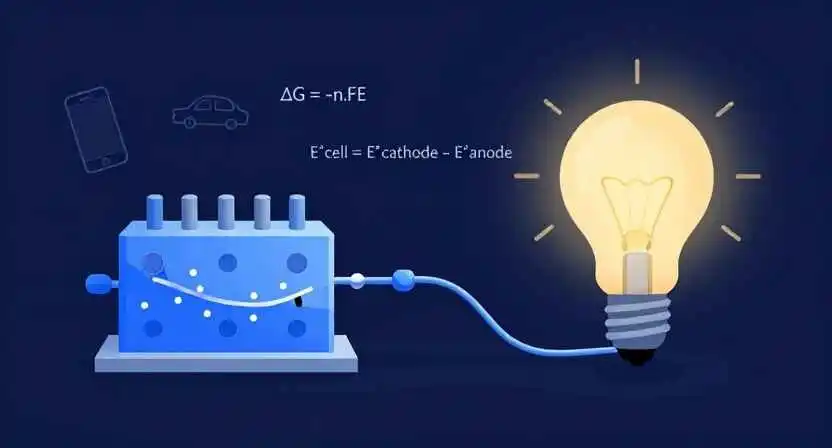
Gibbs Energy Change and EMF of a Cell: The Chemistry Behind Every Battery You Use
Your phone dies at 23%. Your car refuses to start on a cold morning. A remote control stops working after months of sitting in a drawer. All of these everyday frustrations trace back to one quiet but powerful idea in electrochemistry: the relationship between Gibbs energy change and the EMF of a cell.
In simple terms, a battery converts chemical energy into electrical energy. But not every chemical reaction can do this usefully. Some reactions release energy as heat, some are too slow, and some simply do not happen on their own. Electrochemistry gives us a way to predict whether a redox reaction can produce electricity, how much electrical work it can deliver, and how strongly a cell will push electrons through a circuit.
That prediction comes from a beautifully compact equation:
ΔG=−nFEcellΔG=−nFEcell
This single relationship connects thermodynamics, electricity, and practical battery design. Once you understand it, the EMF of a cell stops being an abstract exam formula and becomes a measure of chemical “push.”
In this guide, we’ll break down Gibbs energy change and EMF of a cell step by step, with worked examples, real-life applications, exam-style questions, and answers. We’ll also connect the idea to the Nernst equation, standard electrode potential, galvanic cells, and the spontaneity of redox reactions.
The topic sits within the electrochemistry portion of Class 12 Chemistry, where the syllabus explicitly includes the relation between Gibbs energy change and EMF, along with redox reactions, electrode potentials, the Nernst equation, galvanic cells, fuel cells, and corrosion.
What Is Gibbs Energy Change?
The energy that decides feasibility
Gibbs energy, also called Gibbs free energy, is the portion of a system’s energy available to do useful work under constant temperature and pressure. Its change during a reaction is written as ΔGΔG.
Think of it like the usable balance in a bank account. Your total wealth may include money locked in fixed deposits, property, and investments, but the money available for an immediate transaction is different. Similarly, a reaction may contain plenty of total energy, but ΔGΔG tells us how much energy is actually available to do useful work.
For a chemical reaction:
- If ΔG<0ΔG<0, the reaction is spontaneous.
- If ΔG=0ΔG=0, the system is at equilibrium.
- If ΔG>0ΔG>0, the reaction is non-spontaneous as written.
“Spontaneous” does not necessarily mean fast. Rusting is spontaneous, yet it can take years. A spontaneous reaction simply means that, under the given conditions, it can proceed without continuous external help.
Gibbs energy and useful work
In an electrochemical cell, the useful work is electrical work. Electrons move from the species being oxidized to the species being reduced, and that flow can light a bulb, run a motor, or charge a device.
The maximum electrical work obtainable from a cell is:
welectrical=−ΔGwelectrical=−ΔG
The negative sign appears because the system loses Gibbs energy when it does work on the surroundings. If a reaction releases free energy, that energy can, ideally, be converted into electrical work.
The role of entropy and enthalpy
Gibbs energy brings together two major thermodynamic ideas:
ΔG=ΔH−TΔSΔG=ΔH−TΔS
Where:
- ΔHΔH is the enthalpy change.
- TT is the absolute temperature in kelvin.
- ΔSΔS is the entropy change.
A reaction becomes more favorable when it releases heat, increases disorder, or both. Batteries are engineered so that the redox reaction inside them has a favorable ΔGΔG, allowing chemical energy to emerge as electrical energy rather than being wasted entirely as heat.
What Is EMF of a Cell?
EMF is the electrical “push”
EMF stands for electromotive force. Despite the name, it is not actually a force in the mechanical sense. It is a potential difference, measured in volts.
The EMF of a cell is the maximum potential difference between the two electrodes when no current is drawn from the cell. In other words, it is the cell voltage under open-circuit conditions.
A higher EMF means the cell has a stronger tendency to push electrons through an external circuit. A lower EMF means the push is weaker.
For a galvanic cell:
Ecell=Ecathode−EanodeEcell=Ecathode−Eanode
Here:
- The cathode is where reduction occurs.
- The anode is where oxidation occurs.
- EcathodeEcathode and EanodeEanode are the respective electrode potentials.
Standard EMF versus actual EMF
The standard EMF, written Ecell∘Ecell∘, is measured under standard conditions:
- Concentration of soluble species: 1 M
- Gas pressure: 1 bar
- Temperature: usually 298 K
Real cells rarely operate under perfectly standard conditions. The actual EMF depends on ion concentrations, temperature, and the state of charge of the battery. That is why a fresh battery may read slightly above its rated voltage, while a nearly exhausted battery may show a lower voltage even before it completely stops working.
The Core Relationship: Gibbs Energy Change and EMF
Deriving the equation
In an electrochemical cell, nn moles of electrons pass through the external circuit. Each mole of electrons carries a charge equal to Faraday’s constant, FF.
F=96485 C mol−1F=96485 C mol−1
So the total charge transferred is:
Q=nFQ=nF
Electrical work is charge multiplied by potential difference:
welectrical=Q×Ecell=nFEcellwelectrical=Q×Ecell=nFEcell
But the maximum useful work done by a spontaneous cell equals the decrease in Gibbs energy:
wmax=−ΔGwmax=−ΔG
Therefore:
−ΔG=nFEcell−ΔG=nFEcell
Rearranging:
ΔG=−nFEcellΔG=−nFEcell
This is the central equation linking Gibbs free energy and cell potential.
What each symbol means
| Symbol | Meaning | Units |
| ΔGΔG | Gibbs energy change | J or kJ |
| nn | Number of moles of electrons transferred | mol |
| FF | Faraday constant | 96485 C mol−1−1 |
| EcellEcell | EMF or cell potential | V |
Why the negative sign matters
The negative sign is not decorative. It tells us that a positive cell EMF corresponds to a negative Gibbs energy change.
- Positive EcellEcell means the cell reaction is spontaneous.
- Negative EcellEcell means the reaction is non-spontaneous in that direction.
- Zero EcellEcell means the cell is at equilibrium.
This is why a working galvanic cell always has a positive EMF. If the calculated EMF is negative, the reaction would need external electrical energy to proceed; that is electrolysis rather than a battery.
Standard Conditions and Standard Gibbs Energy
Under standard conditions, the relationship becomes:
ΔG∘=−nFEcell∘ΔG∘=−nFEcell∘
This equation is especially useful because standard electrode potentials are tabulated. From them, you can calculate the standard EMF of a cell, then calculate the standard Gibbs energy change.
Example 1: Daniell cell
Consider the Daniell cell:
Zn(s)+Cu2+(aq)→Zn2+(aq)+Cu(s)Zn(s)+Cu2+(aq)→Zn2+(aq)+Cu(s)
The half-reactions are:
Zn(s)→Zn2+(aq)+2e−Zn(s)→Zn2+(aq)+2e−
Cu2+(aq)+2e−→Cu(s)Cu2+(aq)+2e−→Cu(s)
Using standard electrode potentials:
EZn2+/Zn∘=−0.76 VEZn2+/Zn∘=−0.76 V
ECu2+/Cu∘=+0.34 VECu2+/Cu∘=+0.34 V
The standard cell EMF is:
Ecell∘=Ecathode∘−Eanode∘Ecell∘=Ecathode∘−Eanode∘
Ecell∘=0.34−(−0.76)=1.10 VEcell∘=0.34−(−0.76)=1.10 V
Two electrons are transferred, so n=2n=2.
ΔG∘=−nFEcell∘ΔG∘=−nFEcell∘
ΔG∘=−2×96485×1.10ΔG∘=−2×96485×1.10
ΔG∘=−212267 J mol−1ΔG∘=−212267 J mol−1
ΔG∘≈−212.3 kJ mol−1ΔG∘≈−212.3 kJ mol−1
Because ΔG∘ΔG∘ is negative and Ecell∘Ecell∘ is positive, the reaction is spontaneous. The zinc electrode is oxidized, copper ions are reduced, and electrons flow through the wire from zinc to copper.
A simple way to remember it
Think of EMF as the “voltage pressure” and Gibbs energy change as the “chemical fuel value.” A higher EMF means more free energy is released per mole of electrons transferred.
However, do not assume that a higher-voltage battery is always more energy-dense. Total energy also depends on the quantity of reactants and the number of electrons transferred. Voltage tells you the push; capacity tells you how long that push can be maintained.
Connecting EMF to the Nernst Equation
Why actual cell voltage changes
A battery does not maintain exactly the same voltage throughout its life. As the cell operates, reactants are consumed and products accumulate. Ion concentrations change, so the actual EMF changes too.
The Nernst equation adjusts the standard EMF for non-standard conditions:
Ecell=Ecell∘−RTnFlnQEcell=Ecell∘−nFRTlnQ
At 298 K, using base-10 logarithms:
Ecell=Ecell∘−0.0591nlogQEcell=Ecell∘−n0.0591logQ
Where QQ is the reaction quotient.
Linking Nernst equation to Gibbs energy
Start with:
ΔG=ΔG∘+RTlnQΔG=ΔG∘+RTlnQ
Substitute:
ΔG∘=−nFEcell∘ΔG∘=−nFEcell∘
ΔG=−nFEcellΔG=−nFEcell
You get:
−nFEcell=−nFEcell∘+RTlnQ−nFEcell=−nFEcell∘+RTlnQ
Divide by −nF−nF:
Ecell=Ecell∘−RTnFlnQEcell=Ecell∘−nFRTlnQ
That is the Nernst equation. It is not a separate concept floating beside Gibbs energy; it is the same thermodynamic relationship expressed in terms of voltage.
Example 2: Effect of concentration
For the Daniell cell:
Zn(s)+Cu2+(aq)→Zn2+(aq)+Cu(s)Zn(s)+Cu2+(aq)→Zn2+(aq)+Cu(s)
The reaction quotient is:
Q=[Zn2+][Cu2+]Q=[Cu2+][Zn2+]
Suppose:
[Zn2+]=1.0 M[Zn2+]=1.0 M
[Cu2+]=0.10 M[Cu2+]=0.10 M
Then:
Q=1.00.10=10Q=0.101.0=10
Using:
Ecell=Ecell∘−0.0591nlogQEcell=Ecell∘−n0.0591logQ
Ecell=1.10−0.05912log10Ecell=1.10−20.0591log10
Ecell=1.10−0.02955Ecell=1.10−0.02955
Ecell≈1.07 VEcell≈1.07 V
The EMF drops slightly because the concentration of copper ions has decreased. As the battery discharges further, this effect becomes more noticeable.
Spontaneity, Equilibrium, and Cell Direction
The sign tells the story
The relationship between Gibbs energy and EMF gives a quick test for spontaneity:
| ΔGΔG | EcellEcell | Reaction behavior |
| Negative | Positive | Spontaneous; cell produces electricity |
| Zero | Zero | Equilibrium; no net electron flow |
| Positive | Negative | Non-spontaneous; requires external energy |
At equilibrium
At equilibrium:
ΔG=0ΔG=0
Therefore:
Ecell=0Ecell=0
This makes intuitive sense. A dead battery does not necessarily mean every reactant has vanished. It often means the cell reaction has approached equilibrium, so there is no longer enough thermodynamic drive to push electrons through the circuit.
Equilibrium constant from standard EMF
At equilibrium, Q=KQ=K, and:
Ecell=0Ecell=0
Using the Nernst equation:
0=Ecell∘−RTnFlnK0=Ecell∘−nFRTlnK
Rearranging:
lnK=nFEcell∘RTlnK=RTnFEcell∘
At 298 K:
logK=nEcell∘0.0591logK=0.0591nEcell∘
A larger positive standard EMF means a larger equilibrium constant, which means the reaction strongly favors products.
Example 3: Finding the equilibrium constant
For a cell with:
Ecell∘=1.10 VEcell∘=1.10 V
n=2n=2
logK=nEcell∘0.0591logK=0.0591nEcell∘
logK=2×1.100.0591logK=0.05912×1.10
logK≈37.23logK≈37.23
K≈1037.23K≈1037.23
That is an enormous equilibrium constant. The Daniell cell reaction strongly favors the formation of zinc ions and copper metal.
Galvanic Cells: Turning Chemistry into Electricity
How a galvanic cell works
A galvanic cell, also called a voltaic cell, converts the free energy of a spontaneous redox reaction into electrical energy.
It has three essential parts:
- An anode, where oxidation occurs.
- A cathode, where reduction occurs.
- An electrolyte, which allows ions to move and maintains electrical neutrality.
Electrons travel through the external wire, while ions move through the salt bridge or separator. This separation prevents the two half-reactions from occurring directly at one place, where much of the energy would be lost as heat.
Example: Zinc-copper cell
In the Daniell cell:
- Zinc acts as the anode.
- Copper acts as the cathode.
- Zinc is oxidized to zinc ions.
- Copper ions are reduced to copper metal.
- Electrons flow from zinc to copper through the wire.
The salt bridge maintains charge balance by allowing ions to migrate between the two half-cells. Without it, positive charge would build up in one compartment and negative charge in the other, quickly stopping the current.
Why electrode potential matters
The standard electrode potential measures the tendency of a species to be reduced. More positive values indicate a stronger tendency to gain electrons.
In a galvanic cell:
- The electrode with the higher reduction potential becomes the cathode.
- The electrode with the lower reduction potential becomes the anode.
- The difference between them gives the cell EMF.
This is why lithium, zinc, magnesium, and aluminum can serve as useful anode materials in different battery systems. Their oxidation tendencies help create a favorable potential difference with suitable cathode materials.
Practical Applications in Everyday Life
Batteries in phones and laptops
Your smartphone battery is a lithium-ion cell. During discharge, lithium ions move from the anode to the cathode through the electrolyte, while electrons travel through the external circuit to power the device.
The cell voltage is tied to the Gibbs energy change of the redox reaction. Engineers choose electrode materials and electrolytes to obtain a useful voltage, good energy density, long cycle life, and acceptable safety.
Electric vehicles
Electric vehicles depend on battery packs made of many individual cells. The total voltage is determined by how the cells are connected, while the total energy depends on both voltage and capacity.
A higher cell EMF can contribute to higher energy per unit charge, but real-world performance also depends on internal resistance, temperature, degradation, charging strategy, and the weight of the battery pack.
Fuel cells
Fuel cells are electrochemical cells that continuously convert the chemical energy of a fuel, commonly hydrogen, into electricity. Unlike a conventional battery, they do not store all reactants inside; fuel and oxidizer are supplied from outside.
Hydrogen fuel cells are important in vehicles, backup power systems, and some industrial applications because their only major product at the point of use is water.
Corrosion: electrochemistry in reverse
Corrosion is essentially an unwanted electrochemical process. Iron rusting involves oxidation of iron and reduction of oxygen, often in the presence of moisture.
The same principles of electrode potential and Gibbs energy explain why some metals corrode readily and why protective methods such as galvanization, painting, and sacrificial anodes work. A sacrificial anode is a more easily oxidized metal connected to the protected metal; it corrodes preferentially, sparing the valuable structure.
Medical and wearable devices
Pacemakers, glucose monitors, hearing aids, and wearable health devices rely on compact electrochemical power sources. In these applications, stable voltage, reliability, and safety matter as much as raw energy density.
A pacemaker battery, for example, must deliver a dependable potential over years. That reliability is ultimately rooted in controlled redox chemistry and favorable Gibbs energy changes.
Common Mistakes Students Make
Mixing up anode and cathode
In a galvanic cell:
- Anode: oxidation, negative terminal.
- Cathode: reduction, positive terminal.
In an electrolytic cell, the polarity labels reverse because an external power supply drives the reaction. Always identify oxidation and reduction first, then assign the electrodes.
Forgetting the value of nn
The number of electrons transferred, nn, changes the result dramatically. A one-electron reaction and a two-electron reaction with the same EMF do not have the same Gibbs energy change.
For example, if Ecell∘=1.00 VEcell∘=1.00 V:
- For n=1n=1, ΔG∘=−96.485 kJ mol−1ΔG∘=−96.485 kJ mol−1.
- For n=2n=2, ΔG∘=−192.97 kJ mol−1ΔG∘=−192.97 kJ mol−1.
Using the wrong electrode subtraction
Always use:
Ecell∘=Ecathode∘−Eanode∘Ecell∘=Ecathode∘−Eanode∘
Do not simply add electrode potentials unless the problem specifically provides oxidation and reduction potentials in a compatible form.
Ignoring units
EMF is in volts. Faraday’s constant is in coulombs per mole. Multiplying them gives joules per mole. Convert to kilojoules by dividing by 1000 when needed.
Treating spontaneous as instantaneous
A negative ΔGΔG means thermodynamic feasibility, not speed. Reaction rate depends on activation energy, temperature, surface area, catalysts, and other kinetic factors.
Sample Questions and Answers
Question 1
Q: For a cell reaction, n=2n=2 and Ecell∘=0.85 VEcell∘=0.85 V. Calculate ΔG∘ΔG∘.
Answer:
ΔG∘=−nFEcell∘ΔG∘=−nFEcell∘
ΔG∘=−2×96485×0.85ΔG∘=−2×96485×0.85
ΔG∘=−164024.5 J mol−1ΔG∘=−164024.5 J mol−1
ΔG∘≈−164.0 kJ mol−1ΔG∘≈−164.0 kJ mol−1
Since ΔG∘ΔG∘ is negative, the reaction is spontaneous under standard conditions.
Question 2
Q: A cell has ΔG=−285 kJ mol−1ΔG=−285 kJ mol−1 and transfers 2 moles of electrons. Calculate its EMF.
Answer:
Ecell=−ΔGnFEcell=−nFΔG
Ecell=−−2850002×96485Ecell=−2×96485−285000
Ecell≈1.48 VEcell≈1.48 V
The positive EMF confirms that the cell can operate as a galvanic cell.
Question 3
Q: The standard EMF of a cell is 1.50 V and n=1n=1. Calculate the standard Gibbs energy change.
Answer:
ΔG∘=−1×96485×1.50ΔG∘=−1×96485×1.50
ΔG∘=−144727.5 J mol−1ΔG∘=−144727.5 J mol−1
ΔG∘≈−144.7 kJ mol−1ΔG∘≈−144.7 kJ mol−1
Question 4
Q: For a reaction at equilibrium, what are the values of ΔGΔG and EcellEcell?
Answer:
At equilibrium:
ΔG=0ΔG=0
Ecell=0Ecell=0
There is no net driving force for electron flow, so the cell produces no useful electrical work.
Question 5
Q: Why is a positive EMF associated with a negative Gibbs energy change?
Answer:
A galvanic cell does electrical work on the surroundings. The maximum useful work equals the decrease in Gibbs energy:
wmax=−ΔGwmax=−ΔG
Electrical work is also:
welectrical=nFEcellwelectrical=nFEcell
Equating them gives:
−nFEcell=ΔG−nFEcell=ΔG
So a positive EcellEcell necessarily gives a negative ΔGΔG.
Question 6
Q: The standard EMF of a cell is 0.46 V and n=2n=2. Calculate logKlogK at 298 K.
Answer:
logK=nEcell∘0.0591logK=0.0591nEcell∘
logK=2×0.460.0591logK=0.05912×0.46
logK≈15.57logK≈15.57
The large positive value indicates a very large equilibrium constant and a reaction that strongly favors products.
Common Doubts Clarified
- What is Gibbs energy change in an electrochemical cell?
It is the change in free energy during the cell reaction. It measures the maximum useful electrical work the cell can perform. - What is EMF of a cell?
EMF is the maximum potential difference between the electrodes when no current is being drawn from the cell. - What is the relation between Gibbs energy change and EMF?
The relation is ΔG=−nFEcellΔG=−nFEcell. - Why is there a negative sign in ΔG=−nFEcellΔG=−nFEcell?
Because a spontaneous cell releases Gibbs energy while doing electrical work on the surroundings. - What are the units of ΔGΔG?
Gibbs energy change is measured in joules or kilojoules, usually per mole of reaction. - What is Faraday’s constant?
It is the charge carried by one mole of electrons, approximately 96485 C mol−1−1. - What does nn represent?
nn is the number of moles of electrons transferred in the balanced cell reaction. - What does a positive EMF mean?
It means the cell reaction is spontaneous in the forward direction and can generate electrical energy. - What does a negative EMF mean?
It means the reaction is non-spontaneous as written and would require external electrical energy. - Can a cell have positive EMF but slow reaction rate?
Yes. EMF relates to thermodynamic spontaneity, while reaction rate depends on kinetics. - What is standard EMF?
It is the EMF measured under standard conditions, typically 1 M concentrations, 1 bar gas pressure, and 298 K. - How is standard cell EMF calculated?
Subtract the standard anode potential from the standard cathode potential: Ecell∘=Ecathode∘−Eanode∘Ecell∘=Ecathode∘−Eanode∘. - What happens to EMF at equilibrium?
EMF becomes zero because there is no net driving force for electron flow. - What happens to Gibbs energy at equilibrium?
Gibbs energy change becomes zero. - How is the equilibrium constant related to standard EMF?
At 298 K, logK=nEcell∘0.0591logK=0.0591nEcell∘. - Does a higher EMF always mean a better battery?
No. A good battery also needs high capacity, stability, safety, low internal resistance, long cycle life, and suitable cost. - What is the difference between EMF and terminal voltage?
EMF is the maximum potential difference when no current flows; terminal voltage is the measured voltage when the cell supplies current. - Why is terminal voltage lower than EMF during discharge?
Some potential is lost across the internal resistance of the cell. - What is a galvanic cell?
A galvanic cell converts the free energy of a spontaneous redox reaction into electrical energy. - What is an electrolytic cell?
An electrolytic cell uses external electrical energy to drive a non-spontaneous redox reaction. - Where does oxidation occur in a galvanic cell?
Oxidation occurs at the anode. - Where does reduction occur in a galvanic cell?
Reduction occurs at the cathode. - Why is a salt bridge needed?
It maintains electrical neutrality by allowing ions to move between half-cells. - What is the Nernst equation used for?
It calculates the actual EMF of a cell under non-standard conditions. - How does concentration affect cell EMF?
Changing reactant and product concentrations changes the reaction quotient, which changes the EMF. - What is the relation between ΔG∘ΔG∘ and KK?
ΔG∘=−RTlnKΔG∘=−RTlnK. - Can Gibbs energy predict whether a battery will work?
Yes. A battery requires a spontaneous redox reaction with negative Gibbs energy change and positive cell EMF. - Why do batteries lose voltage over time?
Reactants are consumed, products accumulate, internal resistance may increase, and the cell moves closer to equilibrium. - How does temperature affect EMF?
Temperature affects both the Nernst term and, in some cases, the thermodynamic properties of the cell reaction. - Why is the Gibbs energy-EMF relationship important in real life?
It helps scientists and engineers design batteries, fuel cells, sensors, corrosion-protection systems, and electrochemical industrial processes.
Key Takeaways for Exams
- Memorize the core relation: ΔG=−nFEcellΔG=−nFEcell.
- Under standard conditions: ΔG∘=−nFEcell∘ΔG∘=−nFEcell∘.
- A positive cell EMF means a spontaneous redox reaction.
- A negative Gibbs energy change means the cell can do useful electrical work.
- At equilibrium, both ΔGΔG and EcellEcell are zero.
- The Nernst equation explains why EMF changes with concentration and reaction progress.
- Always balance the redox equation before identifying nn.
- Use Ecell∘=Ecathode∘−Eanode∘Ecell∘=Ecathode∘−Eanode∘, never randomly add potentials.
- Remember: spontaneity is not the same as speed.
The next time your phone battery percentage drops, you are watching electrochemistry in action. A carefully designed redox reaction is releasing Gibbs energy, pushing electrons through a circuit, and converting chemical potential into the electricity that keeps your digital life running.
Understanding Gibbs energy change and EMF of a cell is not just about scoring marks. It is about seeing the invisible energy economy inside every battery, fuel cell, corrosion patch, and electric vehicle. Master the equation, practice the numericals, and the topic becomes one of the most satisfying parts of electrochemistry.
⚠️ Disclaimer: This blog post is for educational purposes only and does not substitute professional scientific, academic, or medical advice. Simplifications have been made for clarity. Numerical values are approximate. Students should rely on their curriculum and instructors; professionals should verify against peer-reviewed sources. The author assumes no liability for errors or consequences arising from use of this information.

