

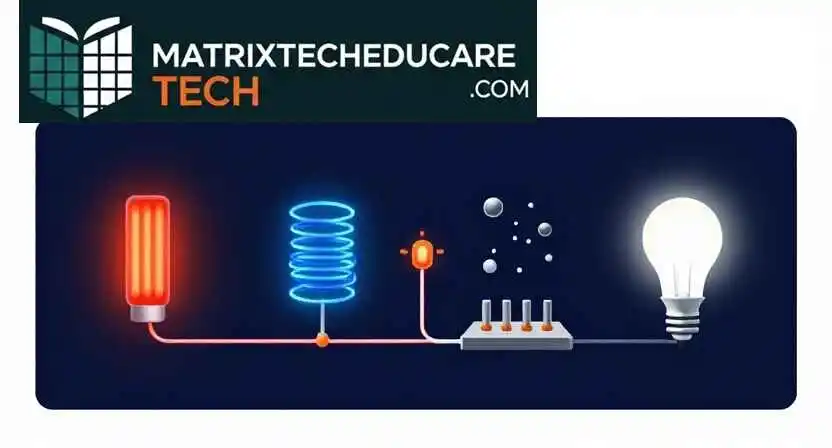
Effects of Electric Current: What Happens When Electricity Flows?
A phone charger feels warm. A fuse suddenly snaps. A small motor spins to life. These everyday moments all have something in common: electric current is flowing—and producing an effect.
But what does current actually do as it moves through a wire or an appliance? Why can it heat a kettle, light a bulb, turn a motor, or cause an electric shock? And how can we use electricity safely without treating every wire like a mystery?
This guide explains the effects of electric current in clear, practical terms. You’ll find real-world examples, simple calculations, safety guidance, and 30 mock questions and answers to check your understanding.
Safety first: Never experiment with mains electricity or exposed wiring. The demonstrations described here should use only low-voltage batteries and suitable components, with adult supervision where appropriate.
What Is Electric Current—and What Does It Do?
Electric current is the flow of electric charge through a material. In a metal wire, the moving charges are electrons. For current to flow continuously, there must generally be a complete circuit: a power source, a conducting path, and a device that uses electrical energy.
A useful way to picture a circuit is as a water system. Voltage is like the pressure pushing water through a pipe, while current is like the amount of water flowing. The analogy isn’t perfect, but it helps explain why current depends on the circuit and its components.
Current is measured in amperes, often shortened to amps (A). A smaller current may be measured in milliamperes (mA):
1 ampere = 1,000 milliamperes
A small indicator light might use only a few milliamps.
A kettle or heater may draw several amperes from a household supply.
The three core electrical quantities
| Quantity | What it describes | Unit | Common symbol |
| Current | Rate of flow of electric charge | Ampere (A) | I |
| Voltage | Energy transferred per unit of charge | Volt (V) | V |
| Resistance | How much a component opposes current | Ohm (Ω) | R |
For many basic circuits, these quantities are connected by Ohm’s law:
V = I × R
That means current can be calculated as:
I = V ÷ R
For example, if a 12-volt supply is connected across a 6-ohm resistor, the current is:
I = 12 ÷ 6 = 2 amperes
Real devices can behave in more complicated ways, but this relationship is a useful starting point.
How does current affect a device?
Current transfers electrical energy. What happens to that energy depends on the device:
- In a heater, much of it becomes heat.
- In a lamp, it becomes light and heat.
- In a motor, it becomes movement, as well as some heat and sound.
- In an electromagnet, it creates a magnetic field.
In a battery-powered chemical cell, chemical reactions can produce electrical energy—or electrical energy can drive chemical changes during charging.
The key idea is that electricity doesn’t “disappear.” Energy is transferred or transformed.
The Heating Effect of Electric Current
Have you ever touched a phone charger after it has been plugged in for a while and noticed that it feels slightly warm? That warmth is one example of the heating effect of electric current.
When current passes through a material with electrical resistance, some electrical energy is converted into thermal energy. This is also called Joule heating or resistive heating.
At the microscopic level, moving charges interact with particles in the material. Those interactions transfer energy into the material’s internal energy, raising its temperature.
Why does a wire or component heat up?
The amount of heating depends on several factors, including:
- The size of the current
- The resistance of the material
- How long the current flows
A familiar relationship for the heat produced is:
H = I²Rt
Where:
- H is the heat energy produced, measured in joules
- I is current in amperes
- R is resistance in ohms
- t is time in seconds
The squared current term matters. If current doubles while resistance and time stay the same, the heating effect becomes four times as great.
Everyday examples of the heating effect
- Electric kettle: A heating element has resistance. Current flowing through it heats the element, which transfers thermal energy to the water.
- Toaster: Current heats metal wires until they glow and toast the bread.
- Hair dryer: An electric heating element warms the air, while a motor-driven fan pushes that air outward.
- Fuse: A fuse contains a deliberately designed weak link. If excessive current flows, the fuse wire heats up and melts, breaking the circuit.
- Incandescent bulb: The filament becomes hot enough to glow. It produces light, but also wastes a considerable amount of energy as heat compared with many modern lighting technologies.
When is heating useful—and when is it dangerous?
Heating is useful when it is controlled and designed into the device. It becomes dangerous when current is higher than the wiring or component can safely handle.
Overheating can result from:
- Damaged insulation
- Loose electrical connections
- A faulty appliance
- An overloaded extension lead
- Incorrectly rated components
- A short circuit
A warm charger may be normal, depending on its design and use. However, stop using a device if it becomes unusually hot, smells burnt, makes crackling sounds, shows visible damage, or repeatedly trips a breaker. Don’t open it to investigate; have it checked by a qualified professional.
Simple example: why current matters so much
Suppose a wire has a resistance of 2 ohms and carries 3 amperes. The rate at which electrical energy is converted into heat is:
P = I²R = 3² × 2 = 18 watts
If the current rises to 6 amperes:
P = 6² × 2 = 72 watts
The current has doubled, but the heating power has increased fourfold. This is why an overloaded circuit can heat up quickly.
The Magnetic Effect of Electric Current
What happens when current flows through a wire? The wire produces a magnetic field around it.
This is the magnetic effect of electric current. It’s the principle behind electromagnets, many motors, relays, speakers, and some medical and industrial equipment.
A current-carrying wire behaves like a magnet in the sense that it creates a magnetic field. The field can be made stronger by increasing the current or by winding the wire into a coil.
How does an electromagnet work?
An electromagnet is usually made by winding insulated wire around a core, often made of iron. When current flows through the coil, its magnetic field magnetizes the core.
- A simple electromagnet becomes stronger when you:
- Increase the current, within the safe rating of the circuit.
- Add more turns of wire to the coil.
- Use a suitable magnetic core, such as soft iron.
When the current is switched off, the magnetic effect usually becomes much weaker. That ability to switch magnetism on and off is what makes electromagnets useful.
Where do we use the magnetic effect?
- Scrap-yard cranes: Powerful electromagnets lift iron and steel objects. Switching off the current releases the load.
- Electric bells: An electromagnet pulls a moving part, making the bell strike. The circuit repeatedly makes and breaks, creating a ringing motion.
- Relays: A small current activates an electromagnet that opens or closes another circuit. Relays let a low-power control circuit operate a higher-power device.
- Speakers: Changing current in a coil interacts with a magnetic field, moving a diaphragm and producing sound.
- Electric motors: Magnetic forces help turn electrical energy into mechanical movement.
How can you observe the magnetic effect safely?
A classroom demonstration may use a small low-voltage battery, insulated wire, and a compass. When current flows through the wire, the compass needle may deflect.
This shows that a current can create a magnetic field. Use only a brief connection and a suitable battery. A wire directly connected across a battery can heat up or damage it, so don’t leave the circuit connected.
The Chemical Effect of Electric Current
Can electricity cause a chemical change? Yes. When current passes through certain liquids or solutions, it can drive chemical reactions. This is called the chemical effect of electric current.
The process is known as electrolysis. It involves an electrolyte—a liquid or solution that contains mobile ions—and electrodes connected to a power source.
The power supply pushes charged particles through the electrolyte. Chemical substances may form at the electrodes or be deposited onto them.
What is an electrolyte?
An electrolyte is a substance that conducts electricity through moving ions when dissolved in water or melted. Examples include some salts, acids, and bases.
Pure water is a poor conductor compared with many salt solutions because it contains relatively few mobile ions. Adding certain dissolved substances can increase conductivity—but experimenting with unknown chemicals is not safe.
Everyday uses of electrolysis
- Electroplating: A thin layer of one metal is deposited onto another object. This can improve appearance, protect against corrosion, or change a surface’s properties.
- Metal extraction and purification: Electrochemical processes are used in industry to produce or refine certain metals.
- Water treatment and chemical production: Electrolysis is used in controlled industrial processes to produce useful substances.
- Battery charging: In rechargeable batteries, electrical energy drives chemical changes that store energy for later use. The details vary by battery chemistry.
What should learners remember?
The chemical effect is not simply “electricity making a liquid bubble.” The important idea is that electrical energy can cause ions to move and participate in chemical reactions.
Electrolysis demonstrations require care. Some processes produce hazardous gases or corrosive substances. Don’t use mains electricity, unknown solutions, or improvised setups. Follow a teacher’s instructions and use properly designed low-voltage equipment.
The Light Effect, Power, and Electrical Safety
Electric current can also produce light. Sometimes light is the main intended output; sometimes it is a side effect of another process.
How can electricity produce light?
- LEDs: A light-emitting diode produces light when current flows through it in the correct direction. LEDs are efficient and are used in displays, indicators, and household lighting.
- Incandescent lamps: A filament heats up until it glows. The light comes from the high temperature of the filament.
- Fluorescent lamps: Electrical energy excites gas inside the tube, producing ultraviolet light that causes an inner coating to glow.
- Electric arcs: Under particular conditions, current can pass through a gap as a bright arc. This can be useful in specialized equipment, but it is extremely dangerous outside controlled settings.
Power: how quickly is energy transferred?
Electrical power tells us how quickly a device transfers or uses energy. It is measured in watts (W).
For a simple circuit:
P = V × I
A 12-volt device drawing 2 amperes uses:
P = 12 × 2 = 24 watts
A higher wattage generally means more energy is transferred per second, but it doesn’t automatically tell you how efficient or safe a device is.
Why can electric current be dangerous?
The effects of current on the human body depend on factors such as the amount of current, its path through the body, how long contact lasts, and the condition of the skin. Wet skin can make electrical contact more dangerous because it may reduce resistance.
Electric shock can interfere with nerves, muscles, and the heart. Household electricity can cause serious injury or death. Never test a wire by touching it, and never handle electrical equipment with wet hands.
Practical electrical safety checklist
- Keep liquids away from sockets and electrical devices.
- Don’t use frayed cords or damaged plugs.
- Avoid overloading power strips or extension leads.
- Unplug an appliance before cleaning it, where appropriate.
- Don’t insert objects into sockets.
- Use equipment only as instructed by the manufacturer.
- Ask a qualified electrician to handle household wiring.
If someone is receiving an electric shock, don’t touch them while they’re still in contact with the source. If safe, switch off the power and call emergency services.
FAQs.
- What is electric current?
Electric current is the rate at which electric charge flows through a conductor or circuit. It is measured in amperes.
- What is the SI unit of current?
The SI unit is the ampere, symbol A.
- What is needed for current to flow continuously in a basic circuit?
A complete conducting path and a source of electrical energy are generally needed. If the circuit is broken, current stops flowing.
- What are the main effects of electric current?
Commonly taught effects include the heating, magnetic, chemical, and light effects. Current can also produce movement, sound, and other forms of energy transfer through devices.
- What causes the heating effect of current?
As current passes through a material with resistance, electrical energy is converted into thermal energy.
- What is Joule heating?
Joule heating is the production of heat when electric current flows through a resistance.
- What is the formula for heat produced in a resistor?
A common formula is H = I²Rt, where current is in amperes, resistance in ohms, and time in seconds.
- Why does a kettle become hot?
Current flows through its heating element, which converts electrical energy into heat. The element then transfers heat to the water.
- Why does a fuse melt when too much current flows?
A fuse is designed to heat up and melt if current exceeds its rating. This breaks the circuit and helps protect wiring and equipment.
- Why can an overloaded extension lead be dangerous?
Excessive current can cause the wiring or connections to overheat, potentially damaging insulation or starting a fire.
- What is the magnetic effect of current?
It is the creation of a magnetic field around a wire or coil when current flows through it.
- What is an electromagnet?
An electromagnet is a magnet produced by electric current, usually flowing through a coil of wire. It can often be switched on and off.
- How can the strength of an electromagnet be increased?
Within safe limits, it can be increased by using more coil turns, increasing current, or using a suitable magnetic core.
- Name two devices that use electromagnets.
Electric bells and relays use electromagnets. Motors, speakers, and lifting cranes also use magnetic effects.
- What is the chemical effect of current?
It is the chemical change caused when current passes through an electrolyte, often involving the movement of ions and reactions at electrodes.
- What is electrolysis?
Electrolysis is a process in which electrical energy drives chemical reactions in an electrolyte.
- What is an electrolyte?
An electrolyte is a liquid or solution that conducts electricity through mobile ions.
- What is electroplating?
Electroplating is the process of depositing a thin layer of one metal onto the surface of another object using an electric current.
- Does pure water conduct electricity well?
Pure water is a poor conductor compared with many solutions containing dissolved ions. The conductivity of water depends on what substances are dissolved in it.
- How can current produce light in an LED?
When current flows through an LED in the correct direction, energy is released as light. The precise process depends on the semiconductor materials in the diode.
- How does an incandescent bulb produce light?
Current heats a filament until it becomes hot enough to glow. Much of the energy is also released as heat.
- What is electrical power?
Power is the rate at which energy is transferred or used. It is measured in watts.
- What formula connects power, voltage, and current?
For a basic electrical device, P = V × I.
- A 10-volt device draws 2 amperes. What power does it use?
P = 10 × 2 = 20 watts.
- What is Ohm’s law?
Ohm’s law describes the relationship between voltage, current, and resistance: V = I × R, for many basic circuit conditions.
- If voltage stays the same and resistance increases, what usually happens to current?
For an ohmic component under the same conditions, current decreases because I = V ÷ R.
- Why can a phone charger feel warm?
Some energy is lost as heat during power conversion and normal operation. Slight warmth may occur, but unusual heat, burning smells, or visible damage should be treated as warning signs.
- Why is electric shock more dangerous when skin is wet?
Wet skin can reduce the resistance of the contact path, potentially allowing more current to pass through the body. Electrical equipment should never be handled with wet hands.
- What should you do if someone is being shocked by an electrical source?
Do not touch them while they may still be connected to the source. If it is safe, turn off the power, call emergency services, and follow their instructions.
- Which effect of current is used in an electric motor?
The magnetic effect is central to how electric motors produce movement. The motor’s design uses magnetic forces to turn electrical energy into mechanical energy.
Electricity Is Useful When Its Effects Are Understood
The effects of electric current are all around us. They heat food, produce light, power motors, create magnetic fields, and drive chemical processes. The same effects that make electricity useful can also create hazards when circuits are overloaded, damaged, or handled carelessly.
A good way to understand any electrical device is to ask three questions: What is the energy source? What is the current doing inside the device? And where does the energy go? Those questions turn an abstract topic into something you can recognize in everyday life.
Want more clear explanations, study resources, and learning support? Visit matrixtecheducare.com and continue exploring the science behind the devices you use every day.
⚠️ Disclaimer: This blog post is for educational purposes only and does not substitute professional scientific, academic, or medical advice. Simplifications have been made for clarity. Numerical values are approximate. Students should rely on their curriculum and instructors; professionals should verify against peer-reviewed sources. The author assumes no liability for errors or consequences arising from use of this information.

