

Chromosomes, the Cell Cycle, and Cell Division: How Cells Copy Life Without Losing the Plot
You scrape your knee, and a few days later, new skin has formed. A child grows taller. A single fertilized egg develops into a body made of trillions of cells.
Behind these everyday events is a remarkable process: cells copy their genetic instructions, organize them into chromosomes, and divide. It sounds straightforward—make a copy, split in two—but the details matter. A cell must duplicate its DNA accurately, check that the copies are ready, and distribute them to the right places.
That’s where chromosomes, the cell cycle, and cell division come together. Understanding how they work helps explain growth, tissue repair, inheritance, and what can go wrong when cell division loses its safeguards.
This guide breaks down the key ideas in plain language, with practical comparisons, a stage-by-stage overview, and answers to common questions.
Chromosomes: How Cells Organize DNA
DNA is the instruction set; chromosomes are the packaging
DNA carries genetic information. In humans, most DNA is stored in the nucleus of a cell. But DNA molecules are extraordinarily long. If a cell left its DNA loose and unorganized, it would be difficult to protect, access, and copy.
Cells solve this problem by packaging DNA with proteins. The resulting structures are chromosomes.
A useful analogy is a long thread wound around spools, then folded into a carefully organized set of bundles. The thread is DNA; the spools are largely proteins called histones; and the compact bundles are chromosomes.
The packaging is not just for storage. It also helps control which genes are accessible and when. Some DNA regions are tightly packed, while others are more open and available for gene activity.
Chromatin and chromosomes are related
When a cell is not preparing to divide, its DNA is generally organized as chromatin—a DNA-protein complex that is relatively spread out in the nucleus. This arrangement makes it easier for the cell to read genes and carry out other DNA-related tasks.
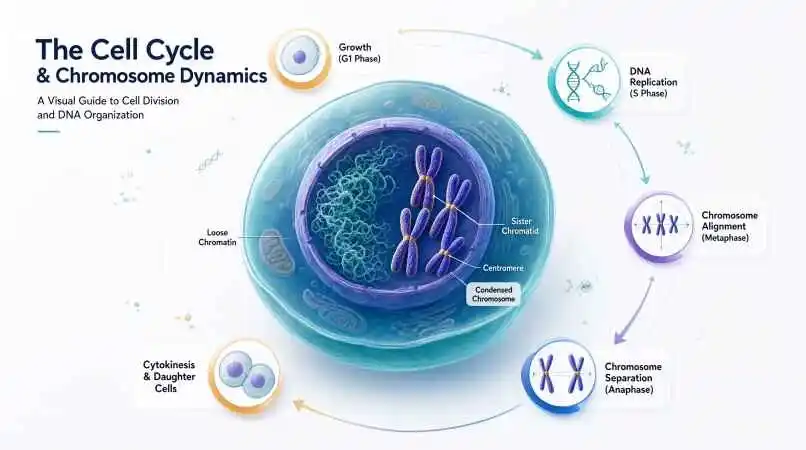
As a cell prepares to divide, chromatin becomes more tightly condensed. The familiar X-shaped chromosome diagrams show chromosomes in this compact, duplicated state, when they are easier to move without tangling.
So, chromatin and chromosomes are not different kinds of genetic material. They are different ways DNA is organized, depending on what the cell needs to do.
What is a chromosome made of?
A chromosome contains:
- DNA, which holds genes and other genetic sequences.
- Histone proteins, around which DNA is wrapped.
- Other proteins, which help organize, copy, repair, and regulate DNA.
A gene is a segment of DNA that contributes to a functional product, such as a protein or a functional RNA. But genes make up only part of the genome. Much of the DNA between genes has regulatory, structural, or other roles, and some sequences still aren’t fully understood.
Chromosome number: humans as an example
Most human body cells have 46 chromosomes, arranged in 23 pairs. One chromosome in each pair usually comes from the egg and the other from the sperm.
These include:
- 22 pairs of autosomes, which are numbered chromosomes.
- One pair of sex chromosomes, commonly XX or XY, though biological sex development has more variation than this simplified description suggests.
Egg and sperm cells are different. They normally have 23 chromosomes each, so that when they join at fertilization, the resulting cell has 46.
This is why chromosome number is often described in terms of ploidy:
Diploid cells have two sets of chromosomes.
Haploid cells have one set.
The number 46 is typical for human body cells, but chromosome numbers differ across species. Some organisms have far fewer chromosomes, while others have many more. The number alone does not tell you how complex an organism is.
Chromosome parts you’ll see in diagrams
A chromosome diagram may label several structures:
Centromere: A region that helps hold duplicated chromosome copies together and provides an attachment point for the machinery that moves them during cell division.
Sister chromatids: The two matching DNA-containing copies of a chromosome after DNA replication.
Telomeres: Protective DNA-protein structures at chromosome ends. They help prevent chromosome ends from being mistaken for broken DNA.
Genes and regulatory sequences: DNA regions that contribute to cell function and the control of gene activity.
A common point of confusion: the centromere is a region of the chromosome, not necessarily the exact middle. Its position varies among chromosomes.
Why chromosome packaging matters
Chromosome organization supports several essential tasks:
Protecting DNA: Packaging helps limit damage and tangling.
Regulating gene activity: The way DNA is packed affects which regions are available to be used.
Copying DNA: Cells need to duplicate their genetic material before dividing.
Distributing DNA: Condensed chromosomes can be moved more reliably during cell division.
Maintaining chromosome ends: Telomeres help protect the ends of linear chromosomes.
Key takeaway: DNA carries the information, while chromosomes organize and manage that information. Their form changes as a cell moves through its life cycle.
The Cell Cycle: A Cell’s Copy-and-Prepare Routine
The cell cycle is the sequence of events a cell goes through as it grows, copies its DNA, and prepares to divide. It is often described as a cycle because, after division, daughter cells may begin the process again.
Not every cell cycles at the same rate. Some divide frequently, some divide only when needed, and some become highly specialized and rarely divide at all.
The two broad parts of the cell cycle
The cell cycle is commonly divided into:
- Interphase: The cell grows, performs its normal functions, and duplicates its DNA.
- M phase: The cell separates its chromosomes and divides its contents.
Interphase is not a period of inactivity. It is a busy stretch of growth, maintenance, and preparation.
G1 phase: growth and everyday work
During G1, the cell grows and carries out its specialized functions. A skin cell, for example, makes the proteins and structures it needs to function as part of the skin.
The cell also checks whether conditions are suitable for division. It may consider factors such as:
- Is there enough energy and raw material?
- Are growth signals present?
- Is the DNA damaged?
- Is this the right time for the cell to divide?
Some cells pause the cycle in a state often called G0. A cell in G0 is not actively preparing to divide, though it may still be metabolically active. Some cells can re-enter the cycle under certain conditions; others remain specialized and divide rarely.
S phase: DNA replication
The S phase is when DNA is replicated. Each chromosome is copied, producing two matching DNA molecules associated as sister chromatids.
Before DNA replication, a typical human diploid cell has 46 chromosomes, each consisting of one chromatid. After replication, it still has 46 chromosomes, but each chromosome consists of two sister chromatids.
That distinction is important: DNA replication doubles the cell’s DNA content, but it does not immediately double the chromosome count under the usual counting convention.
G2 phase: preparation and checking
During G2, the cell continues to grow and prepares for division. It checks whether DNA replication has been completed and whether the DNA has sustained damage that needs repair.
If a problem is detected, the cell may pause the cycle while repair processes act. If damage is too severe, the cell may enter a permanent non-dividing state or undergo programmed cell death.
M phase: separating and dividing
The M phase includes:
- Mitosis, when duplicated chromosomes are separated into two groups.
- Cytokinesis, when the cell’s cytoplasm and other contents are divided.
The result is usually two daughter cells with the same chromosome number as the original cell.
A quick stage-by-stage table
| Stage | What happens | Why it matters |
| G1 | Cell grows and performs normal functions | Builds resources and assesses conditions |
| S | DNA is replicated | Creates a copy of the genome |
| G2 | Cell prepares for division and checks DNA | Helps ensure replication is complete |
| Mitosis | Chromosomes are separated | Sends one copy of each chromosome to each side |
| Cytokinesis | Cell contents divide | Produces two separate daughter cells |
Cell-cycle checkpoints: quality control, not a guarantee
The cell cycle has regulatory checkpoints that help prevent a cell from progressing when important conditions aren’t met. These checkpoints are sometimes compared to inspection stations on an assembly line.
Major checkpoint concepts include:
- G1 checkpoint: Is the cell large enough, and is the DNA suitable for replication?
- G2 checkpoint: Has DNA replication been completed accurately enough for division to proceed?
- Spindle checkpoint: Are chromosomes properly attached to the spindle machinery before they separate?
These controls reduce errors, but they are not perfect. DNA damage can go unrepaired, and chromosome separation can still go wrong. Cells also use additional systems to repair DNA or remove cells that are too damaged to function safely.
Practical way to remember the cycle: Grow → Copy → Check → Separate → Divide.
Mitosis and Cytokinesis: Making Two Similar Cells
Mitosis is the process that separates duplicated chromosomes into two nuclei. It is used for growth, tissue maintenance, and repair in many organisms.
Mitosis is often taught as a series of named stages. The boundaries between them are useful for learning, though in living cells the process is continuous.
Before mitosis: DNA has already been copied
Mitosis does not copy the DNA. DNA replication happens earlier, during S phase. Mitosis organizes and separates the already duplicated chromosomes.
Each duplicated chromosome contains two sister chromatids joined at the centromere region. The cell’s goal is to send one chromatid from each pair to each new nucleus.
The stages of mitosis
Prophase: chromosomes condense
Chromatin condenses into visible chromosomes. The structures that will help move chromosomes begin to organize, and the mitotic spindle starts to form.
Prometaphase: spindle fibers connect
The nuclear envelope breaks down in many textbook descriptions of animal-cell mitosis. Spindle fibers connect to protein structures called kinetochores, which are associated with chromosome centromeres.
These connections allow chromosomes to be moved and positioned.
Metaphase: chromosomes line up
Chromosomes align near the middle of the cell. This arrangement helps the cell check that each duplicated chromosome is attached to the spindle from opposite sides.
The metaphase alignment is a useful visual landmark, but it isn’t simply a perfect row of X-shaped objects in every cell.
Anaphase: sister chromatids separate
The sister chromatids separate and move toward opposite ends of the cell. Once separated, each chromatid is considered an individual chromosome.
This is the key distribution step: each side should receive one copy of each chromosome.
Telophase: new nuclei form
Chromosomes arrive at opposite ends of the cell and begin to loosen. New nuclear envelopes form around the two chromosome sets.
Cytokinesis: splitting the cell itself
After, or partly overlapping with, mitosis, cytokinesis divides the cytoplasm.
In many animal cells, a contractile ring tightens around the cell, forming a cleavage furrow that pinches it into two. In plant cells, the rigid cell wall makes this approach unsuitable. Instead, a cell plate forms between the two new nuclei and develops into a new dividing wall.
The result is typically two daughter cells. They usually have the same chromosome number and very similar DNA, though small differences can arise from mutations or copying errors.
Why mitosis matters in real life
Mitosis supports:
- Growth: A developing organism increases its cell number.
- Repair: Cells replace some damaged or lost cells.
- Maintenance: Tissues renew cells as older ones wear out.
Asexual reproduction: Some organisms reproduce by making genetically similar cells or individuals.
For example, the outer layer of skin is continually renewed. Cells in deeper layers divide, and some of their descendants move toward the surface, where they eventually become part of the protective outer barrier.
What mitosis does not do
Mitosis does not normally reduce chromosome number by half. It also does not create egg or sperm cells in humans. Those are produced through meiosis, a different type of cell division.
A helpful comparison:
| Feature | Mitosis | Meiosis |
| Main role | Growth, repair, cell replacement | Production of reproductive cells |
| Number of divisions | One | Two |
| Typical outcome in humans | Two daughter cells | Four haploid products, with details varying during development |
| Chromosome number | Usually maintained | Reduced by half |
| Genetic similarity | Daughter cells are generally similar | Products are genetically varied |
Meiosis: Cell Division for Reproduction
While mitosis makes cells for growth and maintenance, meiosis produces cells with one set of chromosomes. In humans, this is part of the process that creates sperm and eggs.
If reproductive cells had 46 chromosomes each, fertilization would combine two full sets and produce a cell with 92. Meiosis helps prevent that doubling by reducing chromosome number.
Meiosis has two rounds of division
DNA is replicated once before meiosis begins. Then the cell goes through two divisions:
- Meiosis I: Homologous chromosomes separate.
- Meiosis II: Sister chromatids separate.
The key difference is that meiosis I separates matching chromosome pairs, while meiosis II separates the duplicated copies within each chromosome.
Homologous chromosomes and genetic variation
A pair of homologous chromosomes contains the same kinds of genes in corresponding locations, though the versions of those genes may differ. One homolog usually came from each parent.
During meiosis I, homologous chromosomes pair up. They can exchange corresponding DNA segments in a process called crossing over or recombination. This reshuffles genetic material.
Another source of variation is independent assortment: chromosome pairs can line up in different orientations, so the maternal and paternal chromosomes are distributed into reproductive cells in many possible combinations.
Together, these processes help make reproductive cells genetically distinct.
Why meiosis matters
Meiosis:
- Reduces chromosome number in reproductive cells.
- Helps maintain chromosome number across generations after fertilization.
- Creates genetic variation among offspring.
- Provides the biological foundation for inheritance patterns.
Meiosis is more complex than a simple “half the chromosomes” process. Errors can occur, and the details of egg and sperm development differ. Still, the central idea is clear: meiosis produces cells with one chromosome set, while mitosis generally preserves the chromosome set.
What Can Go Wrong—and Why It Matters
Cell division is tightly controlled, but it is not flawless. Errors can happen while DNA is copied, while chromosomes are separated, or while the cell-cycle controls respond to damage.
DNA mutations and copying errors
A mutation is a change in DNA sequence. Mutations can arise from copying errors, exposure to certain chemicals or radiation, or other sources of DNA damage.
A mutation may:
- Have no noticeable effect.
- Change how a gene functions.
- Affect how much of a gene product is made.
- Disrupt an important cellular process.
- Give a cell a growth advantage in some circumstances.
Cells have DNA repair systems, but repair is not perfect. The effect of a mutation depends on where it occurs, what it changes, and how the cell responds.
Chromosome-number changes
If chromosomes do not separate correctly, a daughter cell may receive too many or too few chromosomes. This is called aneuploidy.
In humans, some chromosome-number differences are compatible with life, while others are not. The consequences vary depending on which chromosome is involved and how many cells in the body carry the change.
An error can occur during meiosis, potentially affecting a reproductive cell, or during mitosis, affecting a subset of cells in the developing or adult body.
Structural chromosome changes
Chromosomes can also undergo structural changes, including:
- Deletion: A segment is missing.
- Duplication: A segment is copied more than once.
- Inversion: A segment is reversed.
- Translocation: A segment becomes attached to a different chromosome.
Some structural changes have little effect; others can disrupt genes or their regulation. The outcome depends on the specific change and its context.
Cell-cycle control and cancer
Cancer is not one disease with one cause. Many cancers involve changes that allow cells to grow or survive when they should not. These changes may affect genes that regulate division, repair DNA, or trigger cell death.
The cell cycle’s control systems help limit the spread of damaged cells, but they cannot prevent every problem. Cancer can develop when multiple safeguards are disrupted over time.
That does not mean every cell-cycle error causes cancer. Most cells do not become cancerous after a single mutation, and many damaged cells are repaired, stop dividing, or are removed. Cancer risk reflects a complex combination of genetic, environmental, and biological factors.
A useful way to think about division errors
When considering a cell-division problem, ask:
- Was the DNA copied incorrectly?
- Did the chromosomes separate properly?
- Did the cell detect and respond to the error?
- Did the change affect one cell or many?
- Does the altered cell have a survival or growth advantage?
These questions help distinguish a DNA sequence change from a chromosome-number error or a broader problem with cell-cycle regulation.
When to seek medical guidance
This guide is educational and cannot diagnose a genetic or medical condition. If you have questions about a genetic test, a family history of a chromosome condition, or a diagnosis involving cell division, discuss the results with a qualified healthcare professional or genetic counselor. They can interpret findings in context and explain what they may—or may not—mean for you.
FAQs
- What is a chromosome?
A chromosome is DNA packaged with proteins. It organizes genetic material so the cell can protect it, use it, copy it, and distribute it during division.
- Are chromosomes made only of DNA?
No. Chromosomes contain DNA and many proteins, including histones that help package the DNA.
- What is the difference between DNA and a chromosome?
DNA is the molecule that carries genetic information. A chromosome is an organized structure made from DNA and associated proteins.
- What is the difference between chromatin and chromosomes?
Chromatin is DNA combined with proteins, often in a less condensed form. Before cell division, chromatin condenses into compact chromosomes that are easier to move.
- How many chromosomes do humans have?
Most human body cells have 46 chromosomes, arranged in 23 pairs. Human egg and sperm cells normally have 23.
- Do all humans have exactly 46 chromosomes?
Most do, but some people have chromosome-number variations. The effects depend on the specific change and can vary widely.
- What is a gene?
A gene is a DNA sequence that contributes to a functional product, such as a protein or functional RNA. Genes are only part of the genome.
- What are sister chromatids?
Sister chromatids are matching DNA-containing copies of a chromosome formed after DNA replication. They usually remain connected until they separate during cell division.
- Does DNA replication double the chromosome number?
Not under the usual chromosome-counting convention. After replication, each chromosome has two sister chromatids, but the chromosome is still counted as one until the chromatids separate.
- What is the cell cycle?
The cell cycle is the sequence in which a cell grows, duplicates its DNA, and divides. It includes interphase and the M phase.
- What happens during interphase?
During interphase, the cell performs normal functions, grows, copies its DNA, and prepares for division. It includes G1, S, and G2 phases.
- What happens during the S phase?
The cell replicates its DNA during S phase. This produces duplicated chromosomes made of sister chromatids.
- What is G0?
G0 is a state outside the active cell cycle. A cell in G0 may continue to function but is not currently preparing to divide. Some cells can leave G0 under certain conditions.
- What are cell-cycle checkpoints?
Checkpoints are regulatory controls that help a cell assess whether it is ready to move to the next stage. They can pause progression when problems are detected.
- What is mitosis?
Mitosis is the process that separates duplicated chromosomes into two nuclei. It typically supports growth, tissue repair, and cell replacement.
- What is cytokinesis?
Cytokinesis is the division of the cell’s cytoplasm, producing two separate daughter cells. It often happens during or after mitosis.
- What are the main stages of mitosis?
The commonly taught stages are prophase, prometaphase, metaphase, anaphase, and telophase. Cytokinesis follows or overlaps with the final stages.
- What happens during metaphase?
During metaphase, chromosomes align near the middle of the cell, and the cell checks that they are attached to the spindle machinery.
- What happens during anaphase?
During anaphase, sister chromatids separate and move toward opposite sides of the cell.
- Are daughter cells from mitosis identical?
They are generally very similar genetically and usually have the same chromosome number as the original cell. Small differences can arise from mutations or other errors.
- What is meiosis?
Meiosis is a type of cell division that reduces chromosome number and helps produce reproductive cells. It includes two rounds of division after one round of DNA replication.
- How is meiosis different from mitosis?
Mitosis usually produces two cells with the original chromosome number. Meiosis involves two divisions and produces cells with one chromosome set, while also creating genetic variation.
- Why do humans need meiosis?
Meiosis helps make egg and sperm cells with 23 chromosomes each. When they combine during fertilization, the resulting cell typically has 46.
- What is crossing over?
Crossing over is the exchange of corresponding DNA segments between homologous chromosomes during meiosis. It creates new combinations of genetic material.
- What are homologous chromosomes?
Homologous chromosomes are a pair that carry the same kinds of genes in corresponding positions. One usually came from each parent, and the gene versions may differ.
- What is aneuploidy?
Aneuploidy means a cell has an unusual number of particular chromosomes, often because chromosomes did not separate correctly.
- What is a chromosome mutation?
The phrase can refer to a change in chromosome structure or number. Examples include deletions, duplications, inversions, translocations, and aneuploidy.
- What is the role of telomeres?
Telomeres help protect the ends of linear chromosomes. They contribute to chromosome stability, though they are only one part of a cell’s broader maintenance systems.
- How is cell division related to cancer?
Cancer can involve changes that disrupt normal controls over cell growth, DNA repair, or cell death. Cell-cycle errors can contribute, but cancer usually involves multiple factors and changes.
- Can lifestyle choices change your chromosomes?
Lifestyle choices do not rewrite your inherited chromosome set in a simple, predictable way. Some exposures can damage DNA or affect health risks, but questions about personal risk should be discussed with a healthcare professional.
A Carefully Managed Copy of Life
Chromosomes are more than compact bundles of DNA. They are part of the system that lets cells store genetic instructions, access them when needed, and pass them on during division.
The cell cycle coordinates growth and preparation. Mitosis separates duplicated chromosomes for maintenance and repair. Meiosis creates reproductive cells and reshuffles genetic material. Together, these processes help explain how bodies grow, tissues renew, and inherited information moves between generations.
A helpful next step is to sketch the cell cycle and label where DNA replication, chromosome separation, and cytokinesis occur. If you’re studying biology, try explaining the difference between mitosis and meiosis without looking at your notes—that’s often the quickest way to find what you understand and what needs another pass.
⚠️ Disclaimer: This blog post is for educational purposes only and does not substitute professional scientific, academic, or medical advice. Simplifications have been made for clarity. Numerical values are approximate. Students should rely on their curriculum and instructors; professionals should verify against peer-reviewed sources. The author assumes no liability for errors or consequences arising from use of this information.

